
Engineering Materials
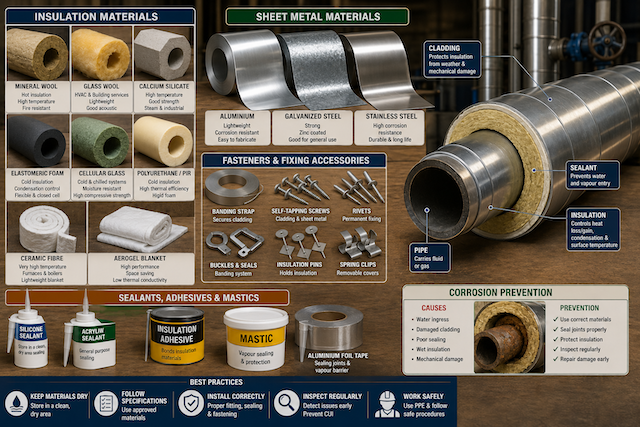
Introduction to Engineering Materials
Engineering materials are the insulation, sheet metal, fasteners, sealants, adhesives, mastics, and protective materials used to fabricate, install, protect, and maintain pipe insulation and cladding systems.
The correct material must be selected for the service condition. A material that works well on a hot pipe may fail on a cold pipe. A cladding material suitable for indoor use may not last outdoors. A sealant that is poorly selected may allow water into the insulation system and increase the risk of corrosion.
Common factors that affect material selection include:
- Pipe operating temperature
- Indoor or outdoor location
- Weather exposure
- Moisture and condensation risk
- Fire-performance requirement
- Mechanical damage risk
- Chemical exposure
- Pipe size and shape
- Maintenance access
- Project specification
- Cost and availability
Types of Insulation Materials
Pipe insulation materials are used to control heat loss, heat gain, condensation, freezing, noise, and surface temperature. Common insulation materials include mineral wool, glass wool, calcium silicate, cellular glass, elastomeric foam, polyurethane, polyisocyanurate, phenolic foam, ceramic fibre, perlite, and aerogel blanket.
Mineral Wool
Mineral wool is a common insulation material made from rock or slag fibres. It is widely used for hot pipework, industrial systems, HVAC systems, vessels, and equipment.
Mineral wool is useful because it has good thermal performance, fire resistance, and sound absorption. It is commonly supplied as pipe sections, slabs, rolls, or blankets.
| Feature | Description |
|---|---|
| Common use | Hot insulation, HVAC, industrial pipework |
| Strength | Good thermal and acoustic performance |
| Limitation | Can absorb moisture if not properly protected |
| Protection needed | Cladding, vapour barrier where required, weatherproofing |
Mineral wool must be kept dry. Wet insulation loses performance and may contribute to corrosion risk on metal pipework.
Glass Wool
Glass wool is made from fine glass fibres. It is used in HVAC, plumbing, building services, and some industrial applications.
It is lightweight and has good thermal and acoustic properties. However, it can irritate the skin, eyes, and respiratory system if handled without protection.
| Feature | Description |
|---|---|
| Common use | HVAC, ducts, light pipe insulation, building services |
| Strength | Lightweight and easy to cut |
| Limitation | Fibre irritation and moisture sensitivity |
| PPE needed | Gloves, long sleeves, goggles, dust mask where required |
Calcium Silicate
Calcium silicate is a rigid insulation material commonly used for high-temperature pipework and industrial systems.
It has good compressive strength, which makes it useful around pipe supports, high-temperature lines, and areas where mechanical strength is important.
| Feature | Description |
|---|---|
| Common use | High-temperature pipes, steam lines, supports |
| Strength | Rigid, strong, high-temperature resistance |
| Limitation | Can absorb moisture if not protected |
| Protection needed | Proper cladding and sealing |
Cellular Glass
Cellular glass is a rigid insulation material made from glass with closed cells. It is often used where moisture resistance, vapour control, and strength are important.
It is useful for cold insulation, chilled water, refrigeration, cryogenic-related systems, and areas where moisture entry must be controlled. Cellular glass is non-combustible and does not absorb water easily.
| Feature | Description |
|---|---|
| Common use | Cold systems, chilled water, underground or high-moisture areas |
| Strength | Moisture-resistant and rigid |
| Limitation | Brittle if handled roughly |
| Protection needed | Correct jointing, vapour sealing, and cladding |
Elastomeric Foam
Elastomeric foam is a flexible closed-cell insulation material commonly used for chilled water, refrigeration, air-conditioning, and condensation-control applications.
It is easy to cut and fit around small pipework and fittings. It helps reduce condensation when joints are sealed correctly.
| Feature | Description |
|---|---|
| Common use | Cold water, chilled water, AC and refrigeration lines |
| Strength | Flexible, closed-cell, good condensation control |
| Limitation | Can be damaged by UV, heat, oil, or poor installation |
| Protection needed | UV coating, cladding, or covering where exposed |
Polyurethane, PIR and Phenolic Foam
Polyurethane, polyisocyanurate, and phenolic foam are rigid foam insulation materials used where good thermal performance is required.
They are commonly used in cold insulation, chilled systems, refrigeration, building services, and industrial applications. Material selection should consider temperature, fire performance, moisture resistance, and project specification.
| Material | Common Use |
|---|---|
| Polyurethane foam | Cold insulation, refrigeration, panels |
| PIR foam | Pipe insulation, building services, chilled systems |
| Phenolic foam | Low-temperature and building services insulation |
Ceramic Fibre
Ceramic fibre is used for very high-temperature applications. It is commonly found in furnaces, boilers, kilns, exhaust systems, and special high-temperature equipment.
It must be handled carefully because fibres and dust can be harmful if inhaled. Suitable respiratory protection and handling procedures are required.
Aerogel Blanket
Aerogel blanket is a high-performance insulation material with very low thermal conductivity. It is thin, flexible, and useful where space is limited.
It is used in industrial pipework, offshore systems, high-temperature systems, and areas where reduced insulation thickness is important.
| Feature | Description |
|---|---|
| Common use | Space-limited insulation, industrial systems |
| Strength | High thermal performance with thin thickness |
| Limitation | Higher cost than many common materials |
| Handling | Cut carefully and follow product guidance |
Selecting Insulation Materials
The insulation material should match the operating condition.
| Application | Suitable Material Examples |
|---|---|
| Hot water pipe | Mineral wool, glass wool, elastomeric foam depending on temperature |
| Steam pipe | Mineral wool, calcium silicate, perlite, aerogel |
| Chilled water pipe | Elastomeric foam, cellular glass, phenolic foam |
| Refrigeration line | Elastomeric foam, cellular glass, polyurethane/PIR |
| High-temperature equipment | Ceramic fibre, calcium silicate, mineral wool |
| Acoustic control | Mineral wool, glass wool, acoustic insulation systems |
| Moisture-sensitive area | Cellular glass or closed-cell materials with good vapour sealing |
The final choice should follow project specifications, manufacturer data, and the service temperature range.
Sheet Metal Materials
Sheet metal materials are used for cladding, jacketing, flashing, boxes, fittings, protection covers, and fabricated components.
In pipe insulation and tinsmith work, common sheet metal materials include:
- Aluminium
- Galvanized steel
- Stainless steel
- Aluzinc or coated steel
- Pre-painted sheets
- Perforated sheets for special applications
Metal cladding protects insulation from impact, weather, tearing, contamination, and water entry. Some insulation materials can soak up water if the protective covering fails, reducing thermal performance and increasing corrosion risk.
Aluminium Sheet
Aluminium is one of the most common cladding materials for pipe insulation. It is lightweight, easy to cut, easy to form, and corrosion-resistant in many environments.
| Feature | Description |
|---|---|
| Common use | Pipe cladding, elbows, valve boxes, outdoor insulation protection |
| Strength | Lightweight, easy to fabricate, good appearance |
| Limitation | Can dent easily compared with steel |
| Common forms | Plain sheet, stucco embossed sheet, pre-coated sheet |
Aluminium is commonly used where lightweight cladding and neat finishing are required.
Galvanized Steel
Galvanized steel is steel coated with zinc to reduce corrosion. It is stronger than aluminium and useful where more mechanical protection is required.
| Feature | Description |
|---|---|
| Common use | Ducting, cladding, trays, covers, protective fabrication |
| Strength | Stronger and more impact-resistant than aluminium |
| Limitation | Can corrode if zinc coating is damaged |
| Handling | Cut edges may need protection in corrosive areas |
Galvanized steel should be protected from deep scratches, aggressive chemicals, and prolonged wet conditions.
Stainless Steel
Stainless steel is used where high corrosion resistance, strength, hygiene, or durability is required.
It is common in chemical plants, marine environments, food processing, offshore facilities, and areas with aggressive weather or chemicals.
| Feature | Description |
|---|---|
| Common use | Harsh environments, marine, chemical, food and industrial systems |
| Strength | Durable, strong, corrosion-resistant |
| Limitation | More expensive and harder to cut/form than aluminium |
| Handling | Requires suitable tools and careful finishing |
Stainless steel cladding may be selected where aluminium is not strong enough or where corrosion risk is high. Metallic cladding systems commonly use stainless steel, galvanised steel, aluminium, and coated materials depending on project conditions.
Fasteners and Fixing Accessories
Fasteners and fixing accessories secure insulation, cladding, supports, covers, boxes, and fabricated sheet metal parts.
Common fasteners include:
| Fastener / Accessory | Common Use |
|---|---|
| Self-tapping screws | Fixing cladding and sheet metal joints |
| Rivets | Permanent joining of sheet metal parts |
| Banding straps | Holding cladding around insulated pipes |
| Buckles / seals | Securing metal bands |
| Wire ties | Temporary or light-duty fixing |
| Spring clips | Holding removable covers |
| Washers | Spreading load and improving fixing |
| Nuts and bolts | Strong mechanical fastening |
| Insulation pins | Holding insulation on flat or curved surfaces |
| Cladding clips | Securing removable or overlapped cladding |
Selecting Fasteners
Fasteners must be selected correctly. Wrong fasteners can loosen, corrode, damage cladding, or allow water entry.
Consider:
- Material compatibility
- Indoor or outdoor use
- Corrosion resistance
- Vibration
- Temperature
- Strength required
- Removable or permanent fixing
- Cladding thickness
- Site specification
Stainless steel fasteners are often used where corrosion resistance is important. Aluminium and galvanized materials should be matched carefully to reduce galvanic corrosion risk.
Sealants, Adhesives and Mastics
Sealants, adhesives, and mastics are used to join, seal, bond, waterproof, and protect insulation and cladding systems.
They help prevent air leakage, water entry, vapour movement, and loose joints.
Sealants
Sealants are used to close gaps and joints so that water, air, or vapour does not enter the insulation system.
Common uses include:
- Sealing cladding overlaps
- Sealing around valve boxes
- Sealing penetration points
- Sealing joints on outdoor systems
- Sealing vapour barriers on cold insulation
A poor seal can allow water into insulation. HSE notes that water ingress into insulation is often caused by poor cladding design or installation, sealant breakdown, mechanical damage, or cladding removed and not properly replaced.
Adhesives
Adhesives are used to bond insulation materials, vapour barriers, facings, tapes, and some protective coverings.
Common uses include:
- Joining elastomeric foam seams
- Bonding insulation to surfaces
- Fixing vapour barrier layers
- Attaching protective coverings
- Securing insulation accessories
Adhesives must be compatible with the insulation material. Some adhesives may damage foam or fail at high temperature.
Mastics
Mastic is a thick protective compound used to seal or coat insulation systems. It can help protect against moisture, weather, or vapour movement.
Common uses include:
- Vapour sealing on cold insulation
- Weatherproof coating
- Joint sealing
- Protection of irregular shapes
- Sealing around fittings and penetrations
Mastic must be applied to clean surfaces and allowed to cure properly. Poor application may crack, peel, or fail.
Safe Use of Sealants, Adhesives and Mastics
These materials may contain chemicals that can irritate the skin, eyes, or respiratory system.
Safe practices include:
- Read the product label.
- Follow the safety data sheet.
- Use gloves and eye protection.
- Work in a ventilated area.
- Keep away from open flame where flammable.
- Do not inhale fumes.
- Do not mix products unless approved.
- Keep containers closed after use.
- Store away from heat and direct sunlight.
- Dispose of waste properly.
Corrosion Prevention
Corrosion is the gradual deterioration of metal due to reaction with moisture, oxygen, chemicals, or the environment.
In pipe insulation work, corrosion prevention is very important because insulation and cladding can hide pipe surfaces. If water enters the insulation system, corrosion may continue unnoticed until serious damage occurs.
Corrosion Under Insulation: CUI
Corrosion Under Insulation, or CUI, is corrosion that occurs beneath insulation. It is difficult to detect because the pipe surface is hidden by insulation and cladding.
CUI can occur when water enters the insulation through damaged cladding, poor sealing, broken vapour barriers, unsealed joints, or poorly replaced covers. Once water or chemicals enter the insulation system, corrosion can begin and continue unseen.
Common Causes of CUI
| Cause | Explanation |
|---|---|
| Damaged cladding | Allows rainwater or wash water into the insulation |
| Failed sealant | Opens gaps at joints and overlaps |
| Poorly fitted valve boxes | Allows water to collect around fittings |
| Wet insulation | Holds moisture against the pipe surface |
| Damaged vapour barrier | Allows condensation and moisture entry |
| Poor drainage | Traps water in low points |
| Loose bands or fasteners | Creates openings for water entry |
| Wrong material selection | Material may absorb moisture or fail in service |
| Mechanical damage | Dents and cracks expose insulation to water |
Corrosion Prevention Methods
Corrosion prevention depends on good design, correct materials, proper installation, inspection, and maintenance.
Good practices include:
- Keep insulation dry before installation.
- Use correct insulation for the service.
- Use suitable cladding material.
- Seal joints properly.
- Overlap cladding in the correct direction.
- Use correct bands, rivets, screws, and fasteners.
- Protect vapour barriers on cold systems.
- Avoid gaps around valves, flanges, supports, and penetrations.
- Repair damaged cladding quickly.
- Use protective coatings where specified.
- Inspect high-risk areas regularly.
- Report wet insulation, rust stains, open joints, or loose cladding.
Waterproof sealing, correct vapour barriers, stainless steel banding, properly riveted seams, and planned inspection schedules are all used in CUI prevention and re-insulation work.
Material Storage and Handling
Good materials can fail if they are poorly stored or handled.
Storage rules include:
- Keep insulation dry and covered.
- Store sheet metal flat or in safe racks.
- Keep sealants and adhesives sealed.
- Store chemicals away from heat and flame.
- Protect cladding sheets from scratches and dents.
- Keep fasteners organised by type and size.
- Do not place heavy objects on insulation.
- Keep materials off wet floors.
- Use older materials first where shelf life applies.
- Follow manufacturer storage instructions.
Damaged, wet, expired, or contaminated materials should not be installed without approval.
Real-Life Scenario
A tinsmith is asked to install aluminium cladding over pipe insulation outdoors. The insulation was left uncovered in the rain before installation. The cladding is available, and the team wants to cover the pipe quickly to meet the deadline.
This is unsafe and poor practice.
Wet insulation should not simply be covered with cladding. Trapped moisture can reduce insulation performance and increase the risk of corrosion under insulation. The correct action is to report the condition, allow proper inspection, replace or dry the insulation where approved, and only install cladding when the insulation system is suitable.
Common Material Mistakes
Avoid these mistakes:
- Using hot insulation material on a cold system without vapour control.
- Installing wet insulation.
- Using damaged cladding sheets.
- Mixing incompatible metals without considering corrosion.
- Using the wrong sealant for the temperature or environment.
- Leaving cladding joints unsealed outdoors.
- Using weak fasteners in high-vibration areas.
- Installing insulation without checking temperature limits.
- Storing insulation directly on wet floors.
- Ignoring rust stains or water marks.
- Using expired adhesives or mastics.
- Covering corrosion without reporting it.
What a Pipe Insulator or Tinsmith Should Never Do
A pipe insulator or tinsmith should never:
- Install materials without checking suitability.
- Use wet, damaged, or contaminated insulation.
- Cover visible corrosion without reporting it.
- Use sealants or adhesives without reading safety instructions.
- Mix materials carelessly where corrosion may occur.
- Leave insulation exposed to weather without protection.
- Use fasteners that damage the cladding or insulation.
- Ignore vapour barrier requirements on cold systems.
- Leave sharp cladding edges exposed.
- Store materials where they can be damaged by water, heat, chemicals, or impact.
Quick Recap
Engineering materials are the foundation of good pipe insulation and tinsmith work. Insulation materials control heat, cold, condensation, noise, and surface temperature. Sheet metals such as aluminium, galvanized steel, and stainless steel protect insulation from weather and mechanical damage. Fasteners secure the system, while sealants, adhesives, and mastics help prevent water and vapour entry. Corrosion prevention is essential because moisture trapped under insulation can cause hidden pipe damage. Correct material selection, dry storage, careful handling, proper sealing, and regular inspection are key to long-lasting insulation systems.