
Industrial Maintenance
Introduction to Industrial Maintenance
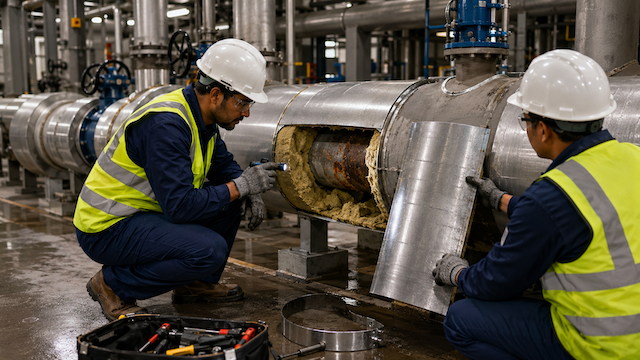
Industrial maintenance in pipe insulation and tinsmith work involves inspecting, repairing, replacing, and protecting insulation and cladding systems so they remain safe, effective, and durable.
A good insulation system can fail if it is not maintained. Damage to cladding, broken sealant, wet insulation, loose bands, open joints, missing covers, and corrosion under insulation can reduce performance and create serious safety and operational risks.
Industrial maintenance helps to:
- Extend insulation system life.
- Reduce energy loss.
- Prevent condensation and water damage.
- Protect workers from hot or cold surfaces.
- Maintain process temperature.
- Prevent loose cladding from becoming a hazard.
- Detect corrosion risks early.
- Reduce shutdowns and repair costs.
- Support safe and reliable plant operation.
The National Insulation Association’s Mechanical Insulation Design Guide includes inspection and maintenance as part of insulation system performance, covering maintainability, repair, finishes, and risk-based considerations.
Inspection of Insulation Systems
Inspection is the process of checking insulation and cladding systems to identify damage, poor installation, moisture entry, corrosion risk, missing parts, or reduced performance.
Inspections may be routine, planned, condition-based, or carried out after a fault is reported.
Common inspection areas include:
| Area | What to Check |
|---|---|
| Straight pipe sections | Loose cladding, open joints, dents, missing bands |
| Elbows and bends | Gaps, damaged segments, poor overlap, water entry |
| Tees and reducers | Poor fit, open cut-outs, cracked sealant |
| Valves and flanges | Missing covers, poor sealing, damaged removable boxes |
| Pipe supports | Crushed insulation, open vapour barrier, corrosion signs |
| Outdoor pipework | Failed weatherproofing, rainwater entry, loose cladding |
| Cold systems | Condensation, sweating, damaged vapour barrier |
| Hot systems | Burn-risk areas, damaged insulation, heat loss |
| Cladding joints | Failed sealant, wrong overlap, loose screws or rivets |
| Pipe surface signs | Rust stains, leaks, damp patches, bulging cladding |
Inspection should not focus only on appearance. A shiny cladding surface can still hide wet insulation or corrosion underneath.
Why Regular Inspection Matters
Pipe insulation systems are often installed in harsh environments. They may be exposed to rain, heat, vibration, chemicals, maintenance activity, walking traffic, pressure washing, and mechanical impact.
Regular inspection helps detect early warning signs before they become major failures.
Inspection can help prevent:
- Wet insulation
- Energy loss
- Corrosion under insulation
- Loose or falling cladding
- Condensation damage
- Unsafe hot surfaces
- Pipe support deterioration
- Hidden leaks
- Poor system performance
- Costly shutdown repairs
HSE notes that corrosion under insulation can progress undetected beneath insulation and has caused failures due to localised corrosion on plant and pipework.
Fault Identification
Fault identification means recognising signs that an insulation or cladding system is damaged, unsafe, or no longer performing correctly.
A fault may be visible, such as a dented cladding sheet, or hidden, such as wet insulation behind a sealed cover. A good worker must know what signs to look for and when to report them.
Common Insulation and Cladding Faults
| Fault | Possible Cause |
|---|---|
| Loose cladding | Missing bands, poor fastening, vibration, weak fixing |
| Wet insulation | Failed sealant, open joints, rainwater entry, damaged cladding |
| Rust stains | Possible corrosion beneath insulation |
| Condensation | Poor vapour barrier, wrong insulation thickness, gaps |
| High surface temperature | Missing or damaged insulation |
| Bulging cladding | Wet insulation, poor fitting, internal damage |
| Missing valve cover | Cover removed during maintenance and not replaced |
| Cracked sealant | Ageing, poor application, wrong sealant, movement |
| Dented cladding | Impact damage, foot traffic, poor handling |
| Open seams | Poor installation, failed rivets, loose bands |
| Crushed insulation | Poor support detail, over-tightened bands, mechanical load |
| Damaged vapour barrier | Poor installation, maintenance damage, cuts or punctures |
Faults should be reported early. Small openings in cladding or vapour barriers can become serious problems when water enters the insulation system.
Signs of Poor Insulation Performance
Poor insulation performance may show as:
- Heat loss from hot pipework.
- Cold spots on hot systems.
- Sweating or dripping on cold systems.
- Ice formation on chilled or cryogenic systems.
- Unusual energy consumption.
- Process temperature instability.
- Hot surfaces exposed to workers.
- Noise increase from pipework.
- Water stains beneath pipe runs.
- Rust staining around joints or supports.
- Frequent insulation repairs in the same area.
When these signs appear, the cause should be investigated instead of simply covering the area again.
Repair and Replacement
Repair and replacement are carried out when insulation, cladding, sealing, vapour barriers, or fixing accessories are damaged or no longer suitable.
A repair should restore the system’s safety, performance, protection, and appearance. It should not simply hide the defect.
Basic Repair Process
A safe repair process should include:
- Identify the damaged area.
- Check the cause of damage.
- Isolate or obtain work permit where required.
- Remove damaged cladding carefully.
- Inspect insulation condition.
- Report wet insulation, corrosion, leaks, or pipe damage.
- Remove damaged or unsuitable insulation where required.
- Replace with correct insulation material and thickness.
- Restore vapour barrier on cold systems.
- Install or refit cladding correctly.
- Seal joints and penetrations properly.
- Secure with correct fasteners.
- Inspect the completed work.
- Record the repair.
If pipe corrosion or leakage is discovered, insulation workers should report it immediately and wait for inspection or clearance before covering it again.
Repairing Damaged Cladding
Cladding may be repaired when it is dented, loose, cut, open, or poorly sealed.
Cladding repair may involve:
- Replacing damaged sheets.
- Tightening or replacing bands.
- Replacing screws, rivets, or clips.
- Resealing joints.
- Refitting removable covers.
- Correcting overlap direction.
- Replacing end caps.
- Repairing holes or penetrations.
- Reinstalling loose valve or flange boxes.
Cladding repair must restore weather protection. Outdoor cladding should shed water, not collect it.
Replacing Wet Insulation
Wet insulation is a serious issue. It can reduce thermal performance and increase corrosion risk. In cold systems, wet insulation can destroy vapour-control performance. In hot systems, it can hold water against the pipe surface and contribute to corrosion.
When wet insulation is found:
- Do not cover it immediately.
- Identify the water-entry source.
- Remove damaged cladding if required.
- Report the condition.
- Inspect the pipe surface where authorised.
- Replace insulation if it cannot be properly dried or approved for reuse.
- Restore vapour barrier where required.
- Reinstall cladding and seal joints properly.
- Record the repair and cause.
HSE identifies causes of water ingress into insulation such as poor cladding design or installation, failed joint sealant, mechanical damage, and cladding that was removed and not properly replaced.
Preventive Maintenance
Preventive maintenance is planned work carried out to prevent insulation and cladding failure before it happens.
Preventive maintenance helps reduce repair costs, prevent CUI, improve energy efficiency, and keep systems safe.
Preventive maintenance may include:
- Routine inspection of insulation and cladding.
- Checking cladding joints and overlaps.
- Replacing failed sealants.
- Tightening loose bands and fasteners.
- Repairing damaged cladding quickly.
- Replacing missing valve and flange covers.
- Checking for wet insulation.
- Monitoring areas with repeated damage.
- Inspecting pipe supports and penetrations.
- Keeping maintenance records.
- Reporting CUI risk areas.
Preventive maintenance is especially important in outdoor, marine, chemical, oil and gas, chilled water, and high-temperature systems.
Preventive Maintenance Checklist
| Check | Action |
|---|---|
| Loose cladding | Tighten or replace fixings |
| Failed sealant | Remove and reseal correctly |
| Open joints | Refit, overlap, and seal |
| Rust stains | Report for inspection |
| Wet insulation | Remove, inspect, and replace where required |
| Missing covers | Replace and seal properly |
| Damaged valve boxes | Repair or fabricate new removable covers |
| Crushed insulation | Replace and correct support detail |
| Damaged vapour barrier | Repair immediately |
| Poor drainage | Correct cladding detail and report design issues |
| Repeated damage areas | Add protection or improve access control |
| Unclear line identification | Label or report for proper identification |
Preventive maintenance should be planned, documented, and carried out by competent persons.
Corrective Maintenance
Corrective maintenance is carried out after a fault has already occurred. It may involve repairing damaged insulation, replacing cladding, restoring vapour barriers, resealing joints, or replacing defective covers.
Corrective maintenance is needed when:
- Insulation is wet.
- Cladding is missing or damaged.
- A pipe surface is exposed.
- There is condensation or dripping.
- Valve or flange covers are missing.
- Bands, screws, or rivets have failed.
- Vapour barrier is damaged.
- Corrosion signs are visible.
- Insulation has been removed for maintenance.
- A system has failed inspection.
Corrective maintenance should address the cause of the fault. Replacing cladding without correcting the water-entry point will allow the same problem to return.
Corrosion Under Insulation: CUI Awareness
Corrosion Under Insulation, commonly called CUI, is corrosion that occurs on pipework, vessels, or equipment beneath insulation. It is dangerous because the insulation and cladding hide the pipe surface, allowing corrosion to continue unnoticed.
CUI is usually associated with moisture trapped under insulation. Steel corrodes when water and oxygen are present, and insulation can hold moisture against the pipe surface if water enters the system. HSE describes CUI as mainly associated with steel plant and pipework, with failures occurring when localised corrosion progresses undetected beneath insulation.
Why CUI Is Serious
CUI can lead to:
- Pipe wall thinning
- Leaks
- Loss of containment
- Plant shutdown
- Fire or explosion risk, depending on service
- Environmental release
- Expensive repairs
- Unplanned maintenance
- Safety incidents
- Equipment failure
CUI is a major concern in oil and gas, petrochemical, power generation, marine, chemical processing, refrigeration, and industrial facilities. HOIS guidance describes CUI as a major issue for oil and gas facility owners and notes the continued need for effective inspection and NDT methods to reduce loss-of-containment risk.
Common Causes of CUI
| Cause | Explanation |
|---|---|
| Damaged cladding | Allows water to enter insulation |
| Failed sealant | Opens joints and overlaps |
| Poor weatherproofing | Allows rainwater or wash water into the system |
| Wet insulation | Holds moisture against metal surfaces |
| Damaged vapour barrier | Allows condensation inside cold systems |
| Poor valve and flange covers | Allows water to collect around fittings |
| Pipe supports | Create openings, compression, and moisture traps |
| Poor maintenance | Removed covers are not refitted properly |
| Mechanical impact | Dents or opens cladding |
| Wrong material selection | Insulation or cladding not suitable for environment |
CUI prevention depends heavily on correct design, installation, weatherproofing, inspection, and maintenance.
Areas Most Vulnerable to CUI
High-risk areas include:
- Outdoor pipework
- Areas exposed to rain or washdown
- Pipe supports and hangers
- Elbows and low points
- Valves and flanges
- Nozzles and penetrations
- Damaged cladding areas
- Areas with failed sealant
- Dead legs and stagnant lines
- Pipe sections with repeated temperature cycling
- Insulation removed for maintenance and poorly replaced
- Areas where water can collect
FESI guidance notes that because corrosion under insulation tends to go undetected unless the insulation system is opened, high-risk areas should have insulation removed on a regular basis as part of inspection programmes.
CUI Warning Signs
Workers should report these signs immediately:
- Rust staining on cladding
- Water dripping from insulation
- Wet or soft insulation
- Bulging cladding
- Damaged or missing cladding
- Failed sealant
- Open joints
- Loose bands
- Missing valve or flange covers
- Corroded pipe supports
- Brown stains around seams
- Unusual smell or leakage
- Repeated repairs in the same area
A pipe insulator or tinsmith may not be responsible for corrosion assessment, but they are responsible for reporting warning signs and not hiding them.
CUI Prevention Practices
CUI prevention begins before installation and continues through maintenance.
Good prevention practices include:
- Use correct insulation material.
- Keep insulation dry before and during installation.
- Install cladding with correct overlap direction.
- Seal outdoor joints properly.
- Use suitable vapour barriers on cold systems.
- Seal around supports, valves, flanges, and penetrations.
- Repair damaged cladding quickly.
- Refit removable covers properly after maintenance.
- Avoid trapping water inside cladding.
- Inspect high-risk areas regularly.
- Report rust stains, wet insulation, and failed sealants.
- Maintain good records of defects and repairs.
CINI describes its industrial insulation manual as covering general insulation guidelines, product specifications, hot/cold/acoustic insulation system details, and prevention of corrosion under insulation.
Maintenance Around Valves, Flanges and Covers
Valves and flanges are often opened during maintenance. After maintenance, covers may be poorly replaced or left off completely. This creates water-entry points and damages system performance.
Good practice includes:
- Remove covers carefully.
- Keep reusable covers in good condition.
- Avoid damaging insulation during removal.
- Inspect insulation before refitting.
- Replace wet or damaged insulation.
- Refit covers correctly.
- Seal edges and joints where required.
- Ensure valves remain operable.
- Ensure bolts and inspection points remain accessible.
- Record removed, replaced, or repaired covers.
Valve and flange covers should not be treated as disposable unless specified. Poorly refitted covers are a common cause of insulation failure.
Repair Around Pipe Supports
Pipe supports are common maintenance problem areas because they carry weight and often interrupt insulation continuity.
When maintaining support areas:
- Check for crushed insulation.
- Check for rust stains.
- Check whether water is collecting.
- Check vapour barrier continuity on cold systems.
- Inspect cladding around the support.
- Replace weak insulation with load-bearing insulation where specified.
- Seal around support penetrations.
- Maintain pipe movement where required.
- Report damaged supports or corrosion.
Support details should be repaired carefully because they affect both thermal performance and pipe safety.
Documentation and Reporting
Maintenance work should be documented clearly. Good records help track recurring defects, plan future repairs, identify high-risk areas, and support quality assurance.
A maintenance record may include:
| Record Item | Purpose |
|---|---|
| Date | Shows when inspection or repair was done |
| Location | Identifies the exact pipe or equipment |
| Line number / tag | Links work to drawings or asset records |
| Fault found | Describes the defect |
| Cause, if known | Helps prevent repeat failure |
| Material removed | Shows what was replaced |
| Material installed | Confirms specification compliance |
| Photos | Supports inspection and future comparison |
| CUI signs | Records rust, wet insulation, or pipe concerns |
| Action taken | Shows repair or replacement work completed |
| Person responsible | Identifies who performed the work |
| Follow-up required | Shows whether further inspection is needed |
Poor records make future maintenance harder and allow repeated problems to continue unnoticed.
Safe Maintenance Practices
Industrial maintenance should be done safely because workers may be exposed to sharp cladding, wet surfaces, hot pipes, cold pipes, chemicals, height, confined spaces, and active process systems.
Safe practices include:
- Obtain work permit where required.
- Wear correct PPE.
- Confirm the pipe service condition.
- Do not open insulation on live high-risk systems without authorisation.
- Watch for hot or cold surface hazards.
- Use gloves when handling cladding.
- Use eye protection when cutting or drilling.
- Control sharp edges.
- Keep work areas clean.
- Do not block access routes.
- Report leaks, corrosion, or unsafe pipe condition.
- Use fall protection where working at height.
- Follow site emergency procedures.
Maintenance should never create a new hazard for operations, inspection teams, or other workers.
Real-Life Scenario
A maintenance team removes cladding from an outdoor insulated pipe to inspect a flange. After the work, the cladding cover is loosely refitted without proper sealing. During rainfall, water enters through the loose cover and wets the insulation.
Months later, rust staining appears around the same area.
The correct approach is to remove the cover, inspect the insulation condition, report any corrosion or wet insulation, replace damaged insulation where required, refit the cover properly, seal the joint, and record the repair. Cladding removed during maintenance must always be replaced correctly.
Common Maintenance Mistakes
Avoid these mistakes:
- Ignoring wet insulation.
- Refitting damaged cladding.
- Covering rust stains without reporting.
- Leaving valve and flange covers loose.
- Failing to seal outdoor joints.
- Using poor-quality replacement materials.
- Replacing only the visible damaged area without checking the cause.
- Leaving sharp edges after repairs.
- Crushing insulation during refitting.
- Removing cladding and not replacing it properly.
- Ignoring pipe support problems.
- Failing to record inspection findings.
- Treating CUI as only an engineering problem, not a workmanship issue.
- Repeating repairs without identifying the root cause.
What a Pipe Insulator or Tinsmith Should Never Do
A pipe insulator or tinsmith should never:
- Cover wet insulation without reporting it.
- Hide visible corrosion or rust staining.
- Refit cladding loosely after maintenance.
- Leave outdoor joints unsealed.
- Use damaged or unsuitable replacement materials.
- Remove insulation from high-risk live systems without authorisation.
- Ignore damaged vapour barriers on cold systems.
- Block access to valves, flanges, drains, or instruments.
- Leave sharp cladding edges exposed.
- Assume CUI is not serious because it is hidden.
- Hand over maintenance work without inspection and records.
Quick Recap
Industrial maintenance keeps pipe insulation and cladding systems safe, efficient, and reliable. Inspection helps identify damage, wet insulation, failed sealants, loose cladding, missing covers, and CUI risks. Fault identification requires careful observation and reporting. Repairs should correct the cause of the problem, not just cover the defect. Preventive maintenance reduces failures through routine inspection, resealing, refitting, and early repair. Corrosion Under Insulation is a serious hidden risk that can cause leaks, shutdowns, and safety incidents. Good maintenance depends on safe work practices, correct materials, proper sealing, careful refitting, regular inspection, and accurate records.