
Industrial Safety
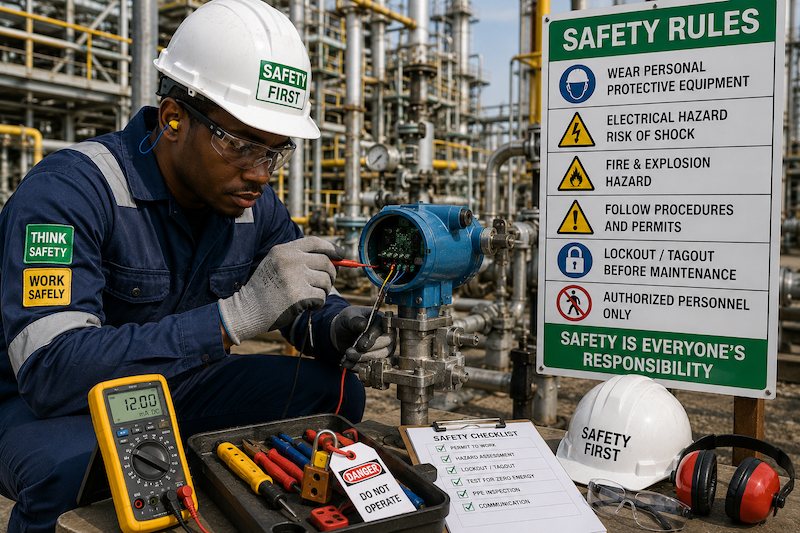
Introduction to Industrial Safety
Industrial safety is one of the most important parts of instrumentation and control work. Instrumentation technicians work around electricity, pressure, steam, chemicals, moving equipment, rotating machines, hot surfaces, confined spaces, heights, hazardous areas, and live process systems.
A technician may be skilled with tools, calibration, wiring, PLCs, and troubleshooting, but without safety discipline, the work can lead to injury, equipment damage, fire, explosion, shutdown, or loss of life.
Industrial safety means identifying hazards, controlling risks, following procedures, using the correct PPE, communicating clearly, and refusing unsafe work. Safety is not only the responsibility of HSE officers. It is the responsibility of every technician, supervisor, operator, contractor, and learner on site.
Why Safety Is Important in Instrumentation Work
Instrumentation work often involves systems that monitor, control, or protect industrial processes. A small mistake can affect the entire plant.
Safety is important because it helps to:
- Protect lives.
- Prevent injuries.
- Prevent electric shock and arc flash.
- Prevent fire and explosion.
- Prevent chemical exposure.
- Prevent pressure release incidents.
- Prevent falls.
- Prevent equipment damage.
- Prevent plant trips and shutdowns.
- Protect the environment.
- Improve work quality.
- Build professional discipline.
A technician must never sacrifice safety for speed.
Common Hazards in Instrumentation and Control
Instrumentation technicians may face different hazards depending on the job location and equipment.
| Hazard | Example |
|---|---|
| Electrical hazard | Live terminals, panels, motors, power supplies |
| Pressure hazard | Pressurised impulse lines, transmitters, valves |
| Temperature hazard | Steam lines, hot pipes, furnaces, heaters |
| Chemical hazard | Corrosive, toxic, flammable, or irritating fluids |
| Mechanical hazard | Moving machinery, rotating shafts, actuators |
| Stored energy | Capacitors, springs, pressure, pneumatic or hydraulic systems |
| Fall hazard | Work on platforms, ladders, tanks, and structures |
| Confined space hazard | Tanks, vessels, pits, manholes, enclosed chambers |
| Fire and explosion hazard | Flammable gas, vapour, dust, hazardous areas |
| Noise hazard | Compressors, turbines, pumps, engines |
| Environmental hazard | Heat stress, poor lighting, rain, slippery surfaces |
| Ergonomic hazard | Awkward posture, lifting, repetitive work |
A safe technician identifies hazards before starting work.
Hazard Identification
Hazard identification means looking for anything that can cause harm.
Before starting a job, ask:
- What can injure me?
- What energy sources are present?
- Is the equipment live, pressurised, hot, or moving?
- Is there gas, vapour, or chemical exposure?
- Do I need a permit?
- Do I need isolation?
- Do I need gas testing?
- Do I need fall protection?
- Is the area safe to access?
- Are the tools correct and in good condition?
- What could go wrong if I make a mistake?
- Who else could be affected by this job?
Hazard identification should be done before the job, during the job, and after any change in condition.
Risk Assessment
Risk assessment means deciding how serious a hazard is and what controls are needed.
A simple risk assessment considers:
| Question | Meaning |
|---|---|
| What is the hazard? | What can cause harm? |
| Who may be harmed? | Technician, operator, contractor, public, environment |
| How likely is it? | Can it happen easily? |
| How severe is it? | Minor injury, serious injury, fatality, major damage |
| What controls are needed? | Isolation, PPE, permit, barricade, supervision, procedure |
| Is the risk acceptable? | Can the job continue safely? |
If the risk is not controlled, the job should not continue.
Hierarchy of Controls
The hierarchy of controls is a safety method used to reduce risk from most effective to least effective.
| Control Level | Meaning | Example |
|---|---|---|
| Elimination | Remove the hazard completely | Do the job with equipment fully de-energised |
| Substitution | Replace with a safer option | Use a lower-voltage test method where possible |
| Engineering control | Physically control the hazard | Guarding, barriers, ventilation, interlocks |
| Administrative control | Use procedures and work rules | Permit, training, warning signs, supervision |
| PPE | Protect the worker | Gloves, helmet, goggles, arc-rated clothing |
PPE is important, but it should not be the only control.
Personal Protective Equipment
PPE means protective clothing and equipment worn to reduce exposure to hazards.
Common PPE includes:
| PPE | Purpose |
|---|---|
| Safety helmet | Protects the head |
| Safety glasses | Protects eyes |
| Face shield | Protects face during higher-risk tasks |
| Gloves | Protects hands from cuts, heat, chemicals, or electrical hazards |
| Coverall | Protects body and improves visibility |
| Safety boots | Protects feet |
| Ear protection | Protects hearing |
| Respirator | Protects from harmful dust, fumes, or vapour |
| Fall-arrest harness | Protects during work at height |
| Arc-rated clothing | Protects against arc-flash heat where required |
PPE must match the hazard. The wrong PPE may give false confidence.
PPE Good Practice
Good PPE practice includes:
- Wear the required PPE before entering the work area.
- Inspect PPE before use.
- Do not use damaged PPE.
- Use the correct glove for the hazard.
- Wear eye protection when cutting, drilling, wiring, or testing.
- Use hearing protection in noisy areas.
- Use fall-protection equipment only after inspection and training.
- Keep PPE clean and stored properly.
- Replace worn-out PPE.
- Report missing or defective PPE.
PPE protects only when it is used correctly.
Permit to Work
A Permit to Work is a formal written or electronic authorisation for high-risk jobs. It ensures that hazards are identified and controls are agreed before work begins.
A permit may be required for:
- Electrical work
- Hot work
- Confined-space entry
- Work at height
- Excavation
- Pressure-system work
- Hazardous-area work
- Instrument removal from live process
- Bypass or override of safety systems
- Work involving chemicals
- Work near moving equipment
A permit does not make a job safe by itself. It confirms that safety controls are planned and approved.
Types of Work Permits
| Permit Type | Common Use |
|---|---|
| Cold work permit | Non-hot work maintenance activities |
| Hot work permit | Welding, grinding, cutting, spark-producing work |
| Electrical work permit | Work on electrical systems |
| Confined-space entry permit | Entry into tanks, vessels, pits, or enclosed spaces |
| Work-at-height permit | Elevated work with fall risk |
| Excavation permit | Digging or trench work |
| Isolation certificate | Confirms energy isolation |
| Override/bypass permit | Temporary bypass of alarms, trips, or interlocks |
Technicians must read and understand permit conditions before starting work.
Permit Responsibilities
Before working under a permit, the technician should confirm:
- Correct job description.
- Correct location.
- Correct equipment tag.
- Valid permit date and time.
- Required isolations completed.
- Gas test completed where required.
- PPE requirements understood.
- Emergency arrangements known.
- Permit issuer and receiver are identified.
- Work scope is clear.
- Work team has signed or acknowledged the permit.
- Conditions have not changed.
If the job changes, the permit may need to be reviewed or reissued.
Lockout/Tagout
Lockout/Tagout, or LOTO, is used to prevent unexpected energisation, startup, movement, or release of hazardous energy during servicing and maintenance.
Hazardous energy may include:
- Electrical energy
- Mechanical energy
- Pressure energy
- Hydraulic energy
- Pneumatic energy
- Thermal energy
- Chemical energy
- Gravity energy
- Stored energy in springs or capacitors
OSHA’s Lockout/Tagout standard covers servicing and maintenance where unexpected energisation, startup, or release of stored energy could injure workers, and it establishes minimum requirements for controlling hazardous energy.
Basic LOTO Steps
A general LOTO process includes:
- Prepare for shutdown.
- Notify affected persons.
- Shut down the equipment.
- Isolate energy sources.
- Apply lock and tag.
- Release or control stored energy.
- Verify zero energy state.
- Perform the work safely.
- Inspect the area after work.
- Remove tools and personnel.
- Remove locks only by authorised persons.
- Restore energy safely.
- Inform operations.
Verification is very important. Do not assume equipment is isolated just because a switch is off.
Why LOTO Matters in Instrumentation
Instrumentation work may involve equipment that can start automatically or release energy unexpectedly.
Examples:
- A control valve can move suddenly.
- A solenoid valve can energise unexpectedly.
- A pump can start from PLC logic.
- A motor can start from remote command.
- A pressure line can release trapped pressure.
- A panel can remain live from another supply.
- A VFD can retain stored electrical energy.
- A pneumatic actuator can move if air pressure returns.
LOTO prevents surprise energy release during maintenance.
Electrical Safety
Electrical safety is critical for instrumentation technicians because they work with panels, transmitters, power supplies, PLC modules, relays, solenoids, VFDs, junction boxes, and field cables.
Electrical hazards include:
- Electric shock
- Burns
- Arc flash
- Arc blast
- Fire
- Short circuit
- Explosive atmosphere ignition
- Equipment damage
NFPA explains that NFPA 70E provides requirements and guidance for reducing electrical risks such as shock, arc flash, and arc blast in the workplace.
Electrical Safety Rules
Follow these rules:
- Treat all circuits as live until proven dead.
- Use Lockout/Tagout before electrical maintenance.
- Verify absence of voltage using an approved tester.
- Use insulated tools where required.
- Wear correct electrical PPE.
- Do not work on live circuits unless authorised and controlled.
- Keep panels dry and clean.
- Do not bypass fuses or breakers.
- Replace fuses only with correct rating and type.
- Keep covers and barriers in place.
- Do not leave exposed live terminals unattended.
- Do not wear metal jewellery while working on electrical systems.
- Use the correct meter setting before measuring.
- Do not measure current like voltage.
Electrical shortcuts are dangerous.
Arc Flash Awareness
Arc flash is a sudden release of energy caused by an electrical fault. It can produce extreme heat, bright light, pressure wave, molten metal, and serious burns.
Arc flash may occur during:
- Faulty switching
- Short circuit
- Tool contact across live terminals
- Loose connections
- Panel faults
- Wrong meter use
- Poor maintenance
- Incorrect work on energised equipment
Arc-rated PPE, proper isolation, boundaries, procedures, and trained personnel are required where arc-flash risk exists.
Safe Use of Multimeters
A multimeter is useful but can be dangerous if used wrongly.
Safe practices include:
- Inspect the meter and test leads.
- Use a meter rated for the circuit category.
- Select the correct function before connecting.
- Use the correct input jack.
- Confirm AC or DC before measuring.
- Do not measure voltage with leads in the current terminal.
- Do not measure resistance on live circuits.
- Do not touch probe metal tips.
- Keep fingers behind probe guards.
- Remove leads after testing.
- Use proving method where required.
Many electrical incidents happen because of wrong meter connection.
Pressure Safety
Pressure systems can be dangerous. Even small instrument lines can release high-pressure gas, steam, liquid, or chemicals.
Pressure hazards include:
- Sudden release of fluid
- Flying fittings
- Injection injury
- Burns from steam or hot fluid
- Chemical exposure
- Fire from flammable release
- Noise and impact
- Equipment damage
Before opening any pressure connection, confirm isolation, depressurisation, draining, and venting.
Safe Work on Pressure Instruments
When working on pressure gauges, transmitters, impulse lines, manifolds, and tubing:
- Confirm the correct instrument tag.
- Inform operations.
- Isolate the process.
- Depressurise safely.
- Drain or vent where required.
- Check pressure gauge or bleed point.
- Open fittings slowly.
- Stand away from possible release direction.
- Wear eye and hand protection.
- Use correct tools and fittings.
- Do not overtighten fittings.
- Leak-test after reassembly.
- Restore valves and manifolds to correct position.
Never loosen a transmitter, gauge, or impulse tube connection under pressure.
Temperature and Hot Surface Safety
Instrumentation work may occur around steam lines, boilers, heat exchangers, furnaces, dryers, heaters, engines, and hot process pipes.
Hazards include:
- Burns
- Steam release
- Hot condensate
- Heat stress
- Fire risk
- Damage to cables and instruments
Safety practices include:
- Identify hot surfaces before work.
- Wear heat-resistant gloves where needed.
- Allow equipment to cool where possible.
- Use barriers or insulation.
- Avoid leaning on pipes.
- Protect cables and tubing from heat.
- Confirm steam isolation before removing instruments.
- Use siphons or cooling arrangements where required for pressure gauges.
Hot surfaces can injure instantly.
Chemical Safety
Some instruments are connected to chemical processes. Chemicals may be corrosive, toxic, flammable, reactive, irritating, or harmful if inhaled.
Chemical safety practices include:
- Know the process fluid.
- Read the Safety Data Sheet where available.
- Wear correct chemical PPE.
- Avoid skin and eye contact.
- Avoid breathing vapour.
- Use correct containment.
- Depressurise and drain before opening lines.
- Use compatible materials.
- Wash immediately after exposure.
- Report spills.
- Dispose of contaminated materials properly.
Do not assume a clear liquid is water.
Hazardous Area Awareness
Hazardous areas are locations where flammable gas, vapour, mist, or dust may be present. Instrumentation work in these areas requires extra care because sparks, hot surfaces, or unsuitable equipment can cause ignition.
Hazardous-area safety includes:
- Use certified equipment.
- Use correct cable glands.
- Keep enclosures closed.
- Do not open live equipment unless allowed by procedure and certification.
- Use approved tools and test equipment.
- Maintain seals and stopping plugs.
- Do not modify certified equipment casually.
- Follow area classification requirements.
- Control static electricity.
- Report damaged explosion-protected equipment.
Instrumentation technicians must respect hazardous-area rules.
Intrinsic Safety Awareness
Intrinsic safety is a protection method that limits electrical energy so that circuits are less likely to ignite a hazardous atmosphere.
Intrinsically safe systems may include:
- IS transmitters
- IS barriers
- Galvanic isolators
- IS cable
- Proper earthing
- Certified devices
- Approved drawings
Technicians should never mix IS and non-IS wiring, bypass barriers, replace devices without checking certification, or make unauthorised modifications.
Gas Testing
Gas testing may be required before and during work in areas where flammable, toxic, or oxygen-deficient atmospheres may exist.
Gas testing may check for:
- Oxygen level
- Flammable gas
- Toxic gas
- Hydrogen sulphide
- Carbon monoxide
- Other site-specific gases
Gas testing should be done by competent authorised persons using approved and calibrated equipment.
Do not enter or work in a hazardous atmosphere unless it has been tested, controlled, and approved.
Confined Space Safety
A confined space is a space that is large enough to enter, has limited means of entry or exit, and is not designed for continuous occupancy. Examples include tanks, vessels, pits, manholes, sumps, boilers, ducts, and silos.
Confined spaces can contain dangerous atmospheres, engulfment hazards, heat, poor ventilation, chemicals, moving parts, or difficult rescue conditions.
OSHA’s permit-required confined space standard requires employers to evaluate workplaces for permit-required confined spaces and inform exposed employees about their location and hazards.
Confined Space Entry Requirements
Before confined-space entry:
- Confirm entry permit.
- Conduct gas testing.
- Provide ventilation where required.
- Isolate energy sources.
- Isolate process lines.
- Control mechanical hazards.
- Provide attendant outside the space.
- Use communication system.
- Prepare rescue plan.
- Wear required PPE.
- Use approved lighting and tools.
- Maintain continuous monitoring where required.
Never enter a confined space without authorisation and rescue arrangements.
Working at Height
Instrumentation work may require access to transmitters, tanks, cable trays, platforms, vessels, columns, and elevated structures.
Fall hazards may occur from:
- Ladders
- Scaffolds
- Platforms
- Roofs
- Tank tops
- Cable trays
- Pipe racks
- Open edges
- Unprotected holes
OSHA requires employers to provide fall protection and falling-object protection for employees exposed to fall and falling-object hazards under its walking-working surfaces rules.
Working at Height Safety Rules
Safe practices include:
- Use approved access equipment.
- Inspect ladders and scaffolds before use.
- Wear fall-arrest harness where required.
- Anchor only to approved anchor points.
- Keep three points of contact on ladders.
- Do not overreach.
- Do not climb on pipes or cable trays.
- Secure tools to prevent falling objects.
- Barricade area below where required.
- Do not work at height during unsafe weather.
- Keep platforms clean and free from trip hazards.
Never improvise access.
Ladder Safety
When using ladders:
- Inspect ladder before use.
- Use the correct ladder type.
- Place ladder on firm level ground.
- Secure ladder where required.
- Maintain three points of contact.
- Do not carry heavy tools while climbing.
- Do not stand on the top step.
- Do not overreach sideways.
- Keep ladder away from live electrical hazards unless suitable.
- Barricade around ladder where needed.
A ladder is a tool, not a working platform for complex tasks.
Manual Handling and Lifting
Technicians may lift panels, instruments, valves, cable drums, tools, junction boxes, and calibration equipment.
Manual handling hazards include:
- Back injury
- Hand injury
- Dropped objects
- Strains and sprains
- Crush injury
Safe lifting practices include:
- Assess the weight.
- Use mechanical aid for heavy loads.
- Ask for help.
- Keep load close to the body.
- Bend knees, not the back.
- Avoid twisting while lifting.
- Keep path clear.
- Wear gloves and safety boots.
- Do not lift above safe capacity.
Do not lift what should be handled by a team or lifting device.
Fire Safety
Instrumentation work can create or be exposed to fire hazards.
Fire hazards may include:
- Flammable gas
- Flammable liquids
- Hot work
- Electrical faults
- Overloaded circuits
- Sparks from tools
- Static electricity
- Poor housekeeping
- Leaking chemicals
- Open panels
Fire safety practices include:
- Follow hot-work permit requirements.
- Remove or protect flammable materials.
- Use gas testing where required.
- Keep fire extinguishers accessible.
- Avoid overloading circuits.
- Report leaks.
- Keep panels clean.
- Do not block emergency exits.
- Know alarm and evacuation routes.
Fire prevention is better than emergency response.
Hot Work Safety
Hot work includes welding, grinding, cutting, brazing, soldering, or any activity that can produce flame, spark, or heat.
Hot work requires strict control in industrial areas.
Controls may include:
- Hot-work permit.
- Gas test.
- Fire watch.
- Fire extinguisher.
- Removal of combustible materials.
- Spark containment.
- Equipment isolation.
- Area barricade.
- Ventilation.
- Post-work fire watch.
Never perform spark-producing work without approval.
Rotating and Moving Equipment Safety
Instrumentation technicians may work near pumps, motors, fans, conveyors, compressors, turbines, actuators, and control valves.
Hazards include:
- Entanglement
- Crushing
- Pinch points
- Unexpected startup
- Moving actuator parts
- Rotating shafts
- Belt and coupling hazards
Safety practices include:
- Keep guards in place.
- Do not wear loose clothing near rotating equipment.
- Isolate equipment before maintenance.
- Keep hands away from moving parts.
- Stay clear of actuator travel path.
- Inform operations before testing movement.
- Use barricades where required.
- Do not bypass interlocks without authorisation.
Moving equipment can injure without warning.
Control Valve and Actuator Safety
Control valves and actuators can move suddenly when air, hydraulic pressure, electrical signal, or controller output changes.
Before working on valves:
- Inform operations.
- Confirm the valve tag.
- Check whether valve is in service.
- Isolate signal or air supply where required.
- Depressurise actuator where required.
- Keep hands away from stem and linkage.
- Beware of spring-return actuators.
- Use correct procedure for stroke testing.
- Barricade where movement can create risk.
- Confirm fail position.
- Restore signal and air carefully.
Never place fingers near moving valve stems or linkages.
Instrument Air Safety
Instrument air is used for pneumatic valves and control devices. It may seem harmless, but compressed air can be dangerous.
Hazards include:
- Hose whipping
- Eye injury
- Noise
- Flying particles
- Sudden actuator movement
- Pressure injection injury
Safety rules:
- Do not point compressed air at people.
- Do not use compressed air to clean clothing.
- Check hoses and fittings.
- Secure connections.
- Depressurise before disconnecting.
- Use correct regulator setting.
- Wear eye protection.
- Control valve movement during testing.
Compressed air must be treated as stored energy.
Environmental Safety
Instrumentation work can affect the environment if fluids, chemicals, oil, gas, or waste are released.
Environmental safety includes:
- Prevent spills.
- Use drip trays where required.
- Dispose of waste properly.
- Report leaks immediately.
- Do not discharge chemicals into drains.
- Handle contaminated rags safely.
- Use correct containers.
- Keep work area clean.
- Follow site environmental procedures.
A technician should protect both people and the environment.
Housekeeping
Good housekeeping prevents accidents and improves work quality.
Good housekeeping includes:
- Keep walkways clear.
- Remove cable offcuts.
- Keep tools organised.
- Close panel doors after work.
- Clean spills immediately.
- Remove unused materials.
- Dispose of waste correctly.
- Do not leave tools inside panels.
- Coil test leads neatly.
- Keep junction boxes and panels clean.
- Store chemicals properly.
Poor housekeeping causes trips, falls, fires, and equipment faults.
Warning Signs and Barricades
Signs and barricades warn people about hazards.
They may be used for:
- Electrical work
- Open panels
- Work at height
- Hot work
- Confined-space entry
- Excavation
- Pressure testing
- Chemical spill
- Restricted area
- Lifting operation
- Hazardous area
Do not remove signs or barricades unless authorised.
Communication and Toolbox Talk
A toolbox talk is a short safety discussion before work begins.
It should cover:
- Job scope
- Hazards
- Controls
- PPE
- Permit requirements
- Isolation status
- Emergency plan
- Roles and responsibilities
- Stop-work authority
- Changes from normal condition
Clear communication prevents mistakes.
Stop Work Authority
Stop Work Authority means every worker has the right and responsibility to stop a job if it is unsafe.
Stop the job if:
- Permit is missing or unclear.
- Isolation is not confirmed.
- Gas test is not done where required.
- PPE is not available.
- Equipment is still live or pressurised.
- Weather makes the job unsafe.
- Work scope changes.
- People are unsure of the procedure.
- Tools are damaged.
- A new hazard appears.
Stopping unsafe work is a sign of professionalism, not weakness.
Emergency Response
Technicians should know what to do during an emergency.
Know:
- Emergency alarm sounds.
- Muster point.
- Escape routes.
- Fire extinguisher location.
- Emergency contact numbers.
- First aid station.
- Eye wash and safety shower location.
- Spill response procedure.
- Rescue procedure for confined space.
- Procedure for electric shock.
- Procedure for gas release.
- Procedure for injury reporting.
Do not wait until an emergency before learning the emergency procedure.
Electric Shock Response
If someone receives electric shock:
- Do not touch the person if they are still in contact with electricity.
- Isolate power immediately if safe.
- Call for emergency help.
- Use non-conductive means only if trained and safe.
- Begin first aid or CPR only if trained and safe to do so.
- Report the incident.
- Do not re-energise equipment until investigated.
Electric shock victims need medical attention, even if they appear fine.
Incident and Near-Miss Reporting
An incident is an event that caused harm, damage, spill, fire, or equipment loss. A near miss is an event that could have caused harm but did not.
Report:
- Injuries
- Electric shock
- Fires
- Chemical exposure
- Pressure release
- Falls
- Dropped objects
- Equipment damage
- Gas alarms
- Unsafe acts
- Unsafe conditions
- Near misses
Near-miss reporting prevents future accidents.
Safety Around PLCs and Control Systems
PLC and control-system work can affect plant operation.
Safety rules include:
- Do not force inputs or outputs without approval.
- Do not change logic without authorisation.
- Do not download programs casually.
- Do not bypass trips or interlocks without permit.
- Inform operations before testing outputs.
- Confirm equipment response before energising.
- Remove forces after testing.
- Keep backups before approved changes.
- Document changes clearly.
A software action can cause a physical machine to start, stop, open, close, trip, or alarm.
Bypasses, Overrides and Inhibits
Bypasses, overrides, and inhibits disable or suppress normal control or protection functions.
They may affect:
- Alarms
- Trips
- Interlocks
- Shutdown systems
- Fire and gas systems
- Control outputs
- Safety instrumented functions
Bypasses should only be used with formal approval, risk assessment, documentation, time limit, and clear handover.
Never leave a bypass active without control and communication.
Safety Instrumented Systems Awareness
Safety Instrumented Systems, or SIS, are designed to protect the process when dangerous conditions occur.
Examples:
- Emergency shutdown system
- High-high pressure shutdown
- Low-low level trip
- Burner management system
- Fire and gas shutdown
- Compressor protection system
Technicians must treat safety systems with high discipline. Testing, bypassing, and maintenance must follow approved procedures.
Working Alone
Instrumentation work should not be done alone when the task is high-risk.
Avoid working alone during:
- Live electrical testing
- Confined-space entry
- Work at height
- Hazardous-area work
- Pressure-line opening
- Chemical handling
- Remote-site work
- Night work
- Work on critical systems
Where lone work is unavoidable, site procedures must provide communication and emergency support.
Fitness for Work
A technician must be physically and mentally fit for work.
Do not work if affected by:
- Alcohol or drugs
- Extreme fatigue
- Serious illness
- Dizziness
- Poor concentration
- Heat stress
- Emotional distress that affects safety
- Medication that reduces alertness
Unsafe condition includes unsafe personal condition.
Heat Stress and Dehydration
Industrial work in hot environments can cause heat stress.
Signs include:
- Heavy sweating
- Weakness
- Dizziness
- Headache
- Muscle cramps
- Confusion
- Nausea
- Fainting
Controls include:
- Drink water regularly.
- Take rest breaks.
- Use shade where possible.
- Wear suitable clothing.
- Report symptoms early.
- Avoid unnecessary exposure to heat.
Heat stress can become serious if ignored.
Safety Documentation
Safety documents support safe work planning and control.
Common documents include:
- Permit to work
- Risk assessment
- Job safety analysis
- Method statement
- Isolation certificate
- Gas test record
- Confined-space entry permit
- Hot-work permit
- LOTO record
- Toolbox talk record
- Bypass register
- Incident report
- Safety data sheet
- Equipment manual
A technician should understand and follow the safety documents related to the job.
Real-Life Scenario
A technician is asked to remove a pressure transmitter from a live process line because the control room reading is unstable. The technician notices that the impulse line is connected to a pressurised steam service.
Instead of loosening the transmitter immediately, the technician stops and asks for the correct permit and isolation. Operations isolate the line, the impulse line is depressurised and cooled, and the technician confirms zero pressure before removing the transmitter.
The transmitter is later found to be healthy. The fault was caused by a partially blocked impulse line.
The key lesson is simple: even a small instrument connection can contain dangerous pressure or temperature. Safe isolation comes before maintenance.
Common Beginner Safety Mistakes
Avoid these mistakes:
- Starting work without a permit.
- Assuming equipment is isolated without testing.
- Opening pressure connections too quickly.
- Working inside panels without checking voltage.
- Using the wrong meter setting.
- Touching live terminals carelessly.
- Ignoring hot surfaces.
- Not wearing eye protection.
- Using damaged PPE.
- Standing in front of a possible pressure release point.
- Working at height without proper access.
- Entering confined spaces without approval.
- Bypassing alarms or trips casually.
- Not informing operations before testing signals.
- Leaving tools inside panels.
- Ignoring near misses.
What an Instrumentation Technician Should Never Do
An instrumentation technician should never:
- Work on live equipment without authorisation and controls.
- Open pressurised lines without isolation and depressurisation.
- Enter a confined space without permit and rescue plan.
- Work at height without fall protection where required.
- Bypass safety systems without approval.
- Ignore gas alarms.
- Use uncertified equipment in hazardous areas.
- Replace fuses with wire or wrong ratings.
- Leave exposed live terminals.
- Force PLC outputs without informing operations.
- Remove guards from rotating equipment casually.
- Hide incidents or near misses.
- Continue work when conditions become unsafe.
- Assume safety is someone else’s responsibility.
Industrial Safety Checklist
Use this checklist before starting instrumentation work:
| Check | Confirmed |
|---|---|
| Correct job and equipment tag confirmed | |
| Permit obtained where required | |
| Risk assessment reviewed | |
| Toolbox talk completed | |
| PPE available and inspected | |
| Energy sources identified | |
| LOTO applied where required | |
| Zero energy verified | |
| Pressure released where required | |
| Gas test completed where required | |
| Correct tools available | |
| Drawings and procedure reviewed | |
| Area barricaded where needed | |
| Operations informed | |
| Emergency route known | |
| Work team understands the task |
Quick Recap
Industrial safety is essential in instrumentation and control work. Technicians may face electrical, pressure, temperature, chemical, mechanical, confined-space, height, fire, explosion, and environmental hazards. Safe work requires hazard identification, risk assessment, permit-to-work, Lockout/Tagout, PPE, correct tools, gas testing, communication, and emergency readiness. Electrical work requires strong control against shock, arc flash, and wrong meter use. Pressure work requires isolation, depressurisation, draining, and leak checks. Confined spaces, hazardous areas, work at height, hot work, and control-system bypasses require special controls. A professional instrumentation technician must stop unsafe work, follow procedures, report incidents, document work, and never bypass safety for speed.