
Entrepreneurship
Introduction to Entrepreneurship
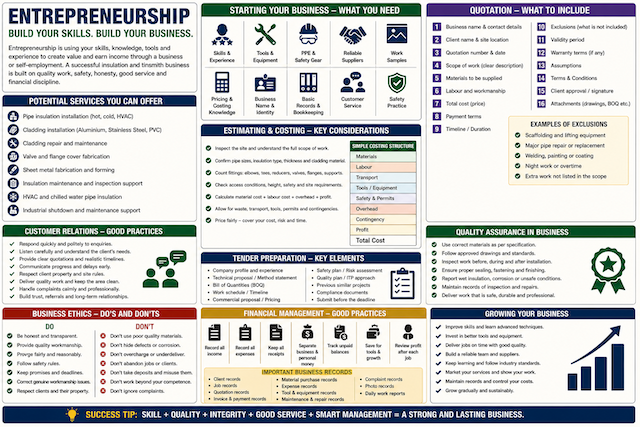
Entrepreneurship is the process of using your skills, knowledge, tools, and experience to create value and earn income through a business or self-employment.
For a pipe insulation and tinsmith worker, entrepreneurship may involve offering services such as pipe insulation installation, cladding fabrication, repair work, maintenance support, insulation inspection, valve and flange cover replacement, sheet metal fabrication, and small project contracting.
Technical skill is important, but it is not enough to run a successful business. A professional also needs customer relations, estimating, costing, tender preparation, business ethics, record keeping, financial discipline, and quality service delivery.
A good insulation and tinsmith business should be built on safety, honesty, quality workmanship, fair pricing, reliable service, and continuous improvement.
Starting a Pipe Insulation and Tinsmith Business
Starting a pipe insulation and tinsmith business requires planning. The business may begin small with basic tools and repair services, then grow into larger installation, fabrication, maintenance, or contracting work.
A beginner may start by offering:
- Small pipe insulation repairs
- Aluminium cladding replacement
- Valve and flange cover fabrication
- HVAC pipe insulation
- Chilled water pipe insulation
- Hot water pipe insulation
- Sheet metal cutting and forming
- Cladding maintenance
- Insulation inspection support
- Minor tinsmith fabrication work
As the business grows, it may take on larger industrial, commercial, construction, and facility maintenance projects.
Basic Requirements for Starting
Before starting, consider:
| Requirement | Why It Matters |
|---|---|
| Skill and experience | Ensures the worker can deliver safe and quality work |
| Tools and equipment | Enables measuring, cutting, forming, and installation |
| PPE | Protects the worker and shows professionalism |
| Reliable suppliers | Helps maintain material quality and availability |
| Work samples | Shows clients what you can do |
| Pricing knowledge | Prevents undercharging or overcharging |
| Business name | Helps create a professional identity |
| Basic records | Helps track jobs, payments, materials, and clients |
| Safety practice | Protects people, property, and reputation |
| Customer service | Helps generate repeat business and referrals |
Do not rush into work that is beyond your competence. It is better to start with tasks you can complete safely and professionally, then grow gradually.
Services You Can Offer
A pipe insulation and tinsmith business can offer different services depending on skill level, tools, market demand, and available materials.
Common services include:
| Service | Description |
|---|---|
| Pipe insulation installation | Installing insulation on hot, cold, or HVAC pipework |
| Cladding installation | Installing aluminium, stainless steel, PVC, or galvanized cladding |
| Cladding repair | Replacing damaged or loose cladding |
| Valve and flange covers | Fabricating and installing removable covers |
| Sheet metal fabrication | Cutting, bending, rolling, riveting, and forming sheet metal |
| Insulation maintenance | Inspecting and repairing insulation systems |
| CUI awareness support | Reporting water entry, rust stains, and damaged insulation |
| HVAC insulation | Insulating chilled water and air-conditioning pipework |
| Industrial support | Supporting plant shutdowns, maintenance, and construction work |
| Material supply support | Supplying insulation or cladding materials where appropriate |
A good business should clearly define what it can do and avoid promising services it cannot deliver.
Estimating and Costing
Estimating is the process of calculating the expected cost of a job before work begins. Costing helps you know how much the job will require and how much you should charge.
Poor estimating can cause loss, conflict, poor-quality work, unpaid labour, and business failure.
A good estimate should consider:
- Materials
- Labour
- Tools and equipment
- Transport
- Safety requirements
- Access difficulty
- Waste allowance
- Time required
- Site conditions
- Overhead costs
- Profit margin
A job is not profitable simply because the client pays money. Profit is what remains after all real costs have been removed.
What to Check Before Estimating
Before giving a price, check the job properly.
| Item | What to Confirm |
|---|---|
| Scope of work | What exactly needs to be done |
| Pipe size | Diameter, length, and number of sections |
| Insulation type | Hot, cold, acoustic, cryogenic, or HVAC insulation |
| Insulation thickness | Required thickness from specification or client request |
| Cladding type | Aluminium, stainless steel, PVC, or galvanized steel |
| Number of fittings | Elbows, tees, reducers, valves, flanges, supports |
| Access condition | Ground level, height, confined space, or difficult access |
| Site location | Transport distance and logistics |
| Safety needs | PPE, permits, scaffold, ladder, or fire control |
| Work duration | Estimated time to complete the job |
| Quality requirements | Finishing, sealing, removable covers, documentation |
Never estimate only by looking from a distance. Measure, inspect, ask questions, and confirm requirements.
Material Costing
Material costing means calculating the materials required and their cost.
Materials may include:
- Insulation sections
- Insulation rolls or blankets
- Aluminium or stainless steel sheets
- PVC cladding
- Sealants
- Adhesives
- Mastics
- Rivets
- Screws
- Bands
- Buckles
- Tapes
- Vapour barrier materials
- Fasteners
- Protective coverings
Always allow for reasonable waste, especially when cutting sheet metal, elbows, reducers, tees, and valve boxes.
Labour Costing
Labour costing means calculating the value of the worker’s time, skill, and effort.
Labour cost depends on:
- Job complexity
- Number of workers needed
- Number of work days
- Skill level required
- Working height or access difficulty
- Hot work or special permit needs
- Cutting and fabrication time
- Installation time
- Finishing and inspection time
Do not price only the materials and forget labour. Your skill, time, experience, and risk have value.
Simple Costing Structure
A basic costing structure may look like this:
| Cost Item | Example |
|---|---|
| Materials | Insulation, cladding, fasteners, sealants |
| Labour | Worker’s time and assistant’s time |
| Transport | Movement to site and material delivery |
| Tools/equipment | Tool wear, hired equipment, blades, drill bits |
| Safety | PPE, permits, access equipment where required |
| Overhead | Phone calls, data, workshop cost, administration |
| Contingency | Small allowance for minor unexpected costs |
| Profit | Business margin after all costs |
A professional contractor should not guess prices. Good costing protects both the business and the client.
Quotation Preparation
A quotation is a formal document showing the cost, scope, and conditions of a job. It helps the client understand what is included before work begins.
A quotation should be clear, honest, and professional.
What a Quotation Should Include
| Section | Content |
|---|---|
| Business name | Name of the company or service provider |
| Contact details | Phone number, email, address, or business location |
| Client name | Name of the person or organisation requesting the work |
| Site location | Where the work will be done |
| Quotation number | Unique reference number |
| Date | Date the quotation was prepared |
| Scope of work | Clear description of work to be done |
| Materials | Main materials to be supplied |
| Labour | Installation, fabrication, or repair labour |
| Total cost | Full amount payable |
| Payment terms | Deposit, balance, instalments, or full payment |
| Timeline | Expected start and completion period |
| Exclusions | Work or materials not included |
| Validity period | How long the quotation remains valid |
| Warranty terms | Any workmanship or material warranty, if applicable |
| Approval space | Client acceptance or signature |
A clear quotation prevents misunderstanding and protects both the client and the contractor.
Example Scope of Work
A professional scope of work may read:
Supply and installation of 50 mm thick pipe insulation and 0.6 mm aluminium cladding on 25 metres of straight chilled water pipework, including four elbows, two tees, and two valve covers. Work includes measurement, cutting, fitting, fastening, joint sealing, site cleanup, and final inspection.
This kind of wording is clear because it explains the material, length, fittings, and work included.
Exclusions in a Quotation
Exclusions are important because they state what is not included in the price.
Examples of exclusions include:
- Scaffolding
- Major pipe repairs
- Painting
- Welding
- Pipe replacement
- Removal of hazardous materials
- Night work
- Crane or lifting equipment
- Special access platforms
- Extra work not listed in the scope
- Repair of hidden corrosion
- Material price changes after quotation validity period
Without exclusions, clients may expect extra work at no additional cost.
Tender Preparation
A tender is a formal offer submitted for a project, usually in response to a client’s request. Tenders are common in construction, industrial maintenance, oil and gas, facility management, and government or corporate projects.
A tender is usually more detailed than a simple quotation.
Tender Documents May Include
| Document | Purpose |
|---|---|
| Company profile | Introduces the business and experience |
| Technical proposal | Explains how the work will be done |
| Commercial proposal | Shows pricing and payment terms |
| Bill of quantities | Lists items, quantities, rates, and totals |
| Work schedule | Shows expected timeline |
| Method statement | Explains the work procedure |
| Safety plan | Shows how risks will be controlled |
| Quality plan | Shows inspection and quality control approach |
| Previous experience | Shows similar jobs completed |
| Compliance documents | Shows registration, certifications, insurance, or permits where required |
A good tender should be complete, clear, realistic, and submitted before the deadline.
Preparing a Tender
When preparing a tender:
- Read the client’s request carefully.
- Understand the full scope of work.
- Attend site visit where required.
- Ask questions before submission deadline.
- Measure or calculate quantities accurately.
- Check material availability.
- Confirm labour and equipment needs.
- Include safety and quality requirements.
- Prepare realistic pricing.
- State assumptions and exclusions.
- Submit in the required format.
- Keep a copy of all submitted documents.
Do not submit a tender without understanding the job. Winning a job at the wrong price can create financial loss and poor performance.
Customer Relations
Customer relations means how a business communicates with and serves clients before, during, and after the job.
Good customer relations helps build trust, referrals, repeat work, and long-term reputation.
Good Customer Relations Practices
A professional should:
- Respond politely to enquiries.
- Listen carefully to the client’s needs.
- Explain technical issues in simple language.
- Be honest about what is possible.
- Arrive on time for site visits.
- Communicate delays early.
- Respect client property and workplace rules.
- Keep the work area clean.
- Provide clear quotations.
- Give updates during the job.
- Handle complaints calmly.
- Follow up after completion.
Clients may not understand insulation or cladding details, but they can recognise professionalism, honesty, neatness, and reliability.
Handling Customer Complaints
Complaints should be handled professionally.
A good approach is to:
- Listen calmly.
- Confirm the exact issue.
- Inspect the work if necessary.
- Avoid arguing or blaming.
- Explain findings clearly.
- Correct genuine workmanship issues.
- Record the complaint and action taken.
- Learn from the experience.
A complaint can become a chance to prove professionalism if it is handled well.
Business Ethics
Business ethics means doing business in a way that is honest, safe, fair, and responsible.
In pipe insulation and tinsmith work, poor ethics can lead to unsafe installations, hidden defects, water entry, corrosion risk, client disputes, and loss of reputation.
Ethical Practices
A professional business should:
- Put safety first.
- Use the agreed materials.
- Avoid fake or poor-quality materials.
- Give honest advice.
- Charge fairly.
- Do not hide defects.
- Report corrosion, wet insulation, or unsafe conditions.
- Follow specifications and drawings.
- Avoid shortcuts that can cause future failure.
- Respect client property.
- Correct genuine workmanship mistakes.
- Keep promises where possible.
- Work within competence.
- Maintain confidentiality.
A good reputation is one of the strongest assets of a trade business.
Unethical Practices to Avoid
Avoid these practices:
- Using cheaper materials after quoting quality materials.
- Charging for materials not used.
- Covering wet insulation without reporting.
- Hiding corrosion under new cladding.
- Ignoring safety to finish quickly.
- Giving false measurements.
- Overcharging without explanation.
- Abandoning work after collecting payment.
- Refusing to correct poor workmanship.
- Using untrained workers for high-risk tasks without supervision.
- Claiming certification or experience that you do not have.
Shortcuts may bring quick money, but they destroy trust and can create serious safety problems.
Financial Management
Financial management is the process of controlling money in the business.
Many small businesses fail not because the worker lacks skill, but because money is poorly managed.
Good Financial Practices
A small business owner should:
- Record all income.
- Record all expenses.
- Keep receipts.
- Separate business money from personal money where possible.
- Avoid spending job deposits carelessly.
- Pay workers as agreed.
- Save for tool replacement.
- Save for business growth.
- Track unpaid balances.
- Avoid unnecessary debt.
- Price jobs to include overhead and profit.
- Review profit after each job.
If a job brings money but all the money goes into materials, transport, unpaid labour, and debt, the business is not growing.
Basic Business Records
Records help the business stay organised and professional.
Important records include:
| Record Type | Purpose |
|---|---|
| Client record | Tracks client contact and job history |
| Job record | Shows work done and location |
| Quotation record | Shows prices submitted |
| Invoice record | Shows amount billed |
| Receipt record | Confirms payment received |
| Material record | Tracks materials bought and used |
| Expense record | Tracks business spending |
| Tool record | Tracks tools owned, borrowed, damaged, or replaced |
| Maintenance record | Tracks inspection and repair history |
| Complaint record | Tracks customer issues and corrections |
| Photo record | Shows before, during, and after work |
Records can be kept in a notebook, spreadsheet, phone app, printed form, or accounting software.
Simple Job Record Format
A simple job record may include:
| Item | Details |
|---|---|
| Client name | Name of client |
| Phone number | Client contact |
| Site location | Where the work was done |
| Date | Date of job |
| Scope of work | Description of work completed |
| Materials used | Main materials installed |
| Labour used | Number of workers or work days |
| Amount quoted | Approved price |
| Amount paid | Payment received |
| Balance | Outstanding amount |
| Issues found | Defects, wet insulation, corrosion, or access problems |
| Final status | Completed, pending, or follow-up required |
Good records reduce confusion and help future pricing.
Marketing Your Services
Marketing means making people aware of your services. A skilled worker should also learn how to present their work professionally.
Basic marketing methods include:
- Share clear photos of completed work.
- Ask satisfied clients for referrals.
- Create a simple business card.
- Use WhatsApp Business.
- Use social media professionally.
- Create a small portfolio.
- Build relationships with contractors.
- Visit facility managers and maintenance companies.
- Partner with plumbers, HVAC technicians, and construction workers.
- Be consistent with quality and communication.
Good work is one of the best forms of marketing. Neat finishing, honesty, punctuality, and safe work often bring repeat clients.
Building a Professional Image
A professional image helps clients trust the business.
A worker should maintain:
- Clean workwear
- Correct PPE
- Organised tools
- Polite communication
- Clear quotation
- Good time management
- Clean work area
- Quality finishing
- Honest reporting
- Proper records
Professionalism is not only for large companies. Even a small business can look organised and reliable.
Growing the Business
A business can grow gradually by improving skill, tools, service quality, and client trust.
Ways to grow include:
- Improve fabrication skills.
- Learn advanced insulation systems.
- Learn quality control documentation.
- Build a reliable team.
- Invest in better tools.
- Maintain relationships with suppliers.
- Keep photos of completed work.
- Deliver jobs on time.
- Handle complaints professionally.
- Register the business where required.
- Pursue relevant certifications.
- Take on larger jobs only when ready.
Growth should be controlled. Taking jobs beyond capacity can damage reputation.
Real-Life Scenario
A tinsmith is asked to quote for cladding replacement on outdoor pipework. He gives a quick price without measuring the pipe length, fittings, access height, or number of valve covers. After starting the job, he discovers there are more elbows and flanges than expected, and the work requires a scaffold.
The job becomes more expensive than the price he gave.
The correct approach is to inspect the site, measure the pipework, count fittings, check access, confirm materials, include labour and equipment cost, state exclusions, and prepare a clear quotation before work begins.
Common Entrepreneurship Mistakes
Avoid these mistakes:
- Starting work without agreed scope and price.
- Giving prices without site inspection.
- Forgetting labour, transport, tools, and overhead costs.
- Using poor materials to increase profit.
- Not keeping receipts.
- Mixing business and personal money carelessly.
- Failing to record payments.
- Overpromising completion time.
- Ignoring customer complaints.
- Taking jobs beyond competence.
- Submitting tenders without understanding requirements.
- Not stating exclusions.
- Failing to document changes.
- Not following up after completing work.
What a Pipe Insulation Business Owner Should Never Do
A business owner should never:
- Sacrifice safety to reduce cost.
- Use substandard materials secretly.
- Hide wet insulation, corrosion, or poor workmanship.
- Charge for work not done.
- Abandon a client’s job without communication.
- Work without proper agreement on scope and price.
- Ignore quality requirements.
- Refuse to correct genuine workmanship errors.
- Mislead clients about experience or certification.
- Take deposits and misuse them.
- Keep no records of jobs, materials, or payments.
Quick Recap
Entrepreneurship helps pipe insulation and tinsmith workers turn practical skills into income and business opportunities. A successful business requires technical ability, good customer relations, accurate estimating, proper costing, clear quotations, tender preparation, ethical behaviour, financial management, and good record keeping. Business growth depends on safety, quality workmanship, honest communication, fair pricing, reliable service, and professional conduct.