
Industrial Electrical Installation
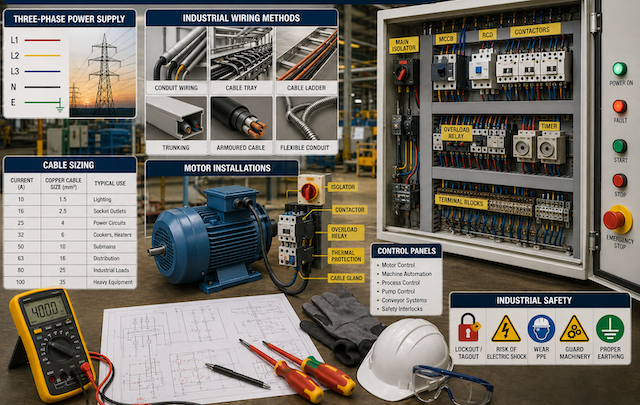
Introduction to Industrial Electrical Installation
Industrial electrical installation involves the design, wiring, connection, protection, control, and maintenance of electrical systems used in factories, workshops, plants, warehouses, oil and gas facilities, production lines, and heavy-duty work environments.
Unlike domestic installations, industrial installations often involve higher loads, three-phase power, motors, control panels, automation systems, larger cables, cable trays, trunking, conduits, isolators, emergency stops, and stronger safety controls. Industrial electrical work must be carefully planned because faults can lead to electric shock, fire, machine damage, production shutdown, arc flash, injury, or death.
Safe working practices are essential when working on or near electrical equipment. HSE guidance covers safe work planning, equipment selection, installation, commissioning, maintenance, operation, and supervision for people who work on or near electrical systems.
Three-Phase Power Supply
Three-phase power supply is commonly used in industrial installations because it is more efficient for running heavy loads, motors, pumps, compressors, machines, and large equipment.
A three-phase supply usually has three live conductors called phases. These may be identified as:
| Phase | Common Label |
|---|---|
| Phase 1 | L1 |
| Phase 2 | L2 |
| Phase 3 | L3 |
| Neutral | N |
| Earth | E / PE |
Three-phase systems can supply more power than single-phase systems and are especially useful for rotating machines such as electric motors.
Why Three-Phase Power Is Used in Industry
Three-phase power is preferred in industrial environments because it:
- Supplies high-power equipment more efficiently.
- Runs motors more smoothly.
- Reduces vibration in motor operation.
- Allows smaller conductor sizes for some large loads compared with equivalent single-phase systems.
- Supports balanced power distribution.
- Improves performance of pumps, compressors, conveyors, and machines.
A three-phase motor normally requires correct phase sequence. If two phases are reversed, the motor may rotate in the wrong direction. This can damage pumps, fans, conveyors, compressors, or connected machinery.
Balanced and Unbalanced Loads
A balanced three-phase load draws approximately equal current from each phase. An unbalanced load draws more current from one phase than others.
Unbalanced loads can cause:
- Overheating
- Poor motor performance
- Neutral conductor overload
- Voltage imbalance
- Nuisance tripping
- Equipment damage
Industrial circuits should be planned so that loads are distributed as evenly as possible across the phases.
Industrial Wiring Methods
Industrial wiring must be strong, protected, organised, and suitable for harsh working conditions. Cables may be exposed to heat, vibration, dust, oil, moisture, chemicals, mechanical impact, and heavy equipment movement.
Common industrial wiring methods include:
| Wiring Method | Common Use |
|---|---|
| Steel conduit wiring | Mechanical protection in exposed areas |
| PVC conduit wiring | Light industrial and indoor wiring |
| Cable tray | Supporting multiple power or control cables |
| Cable ladder | Heavy-duty support for large cables |
| Trunking | Organised routing of several circuits |
| Armoured cable | Outdoor, underground, and mechanically exposed areas |
| Flexible conduit | Motors, machines, and vibrating equipment |
| Busbar trunking | High-current distribution in factories and large buildings |
| Control cable wiring | Machine control and signal circuits |
Good Industrial Wiring Practice
Industrial wiring should be installed neatly and safely.
Good practice includes:
- Use the correct cable type for the environment.
- Protect cables from heat, sharp edges, oil, water, and chemicals.
- Support cables properly using trays, ladders, clips, or glands.
- Keep power and control cables separated where required.
- Avoid overcrowding trunking, conduits, and panels.
- Use proper glands and terminations.
- Label cables clearly.
- Keep bends within safe limits.
- Provide mechanical protection where cables may be damaged.
- Maintain access for inspection and maintenance.
- Follow approved drawings and installation standards.
Industrial wiring must not be improvised. A loose cable, poor gland, sharp tray edge, or badly terminated conductor can create serious safety and reliability problems.
Cable Sizing
Cable sizing means selecting a cable that can safely carry the expected current without overheating, excessive voltage drop, insulation damage, or fire risk.
Cable size should not be guessed. It must be based on the load, installation condition, protection device, cable length, temperature, grouping, and voltage drop.
Factors That Affect Cable Size
| Factor | Why It Matters |
|---|---|
| Load current | Cable must carry the expected current safely |
| Cable length | Long cables may cause voltage drop |
| Installation method | Cables in conduit, tray, ground, or air have different ratings |
| Ambient temperature | High temperature reduces cable capacity |
| Cable grouping | Grouped cables may overheat more easily |
| Type of insulation | Insulation rating affects safe operating temperature |
| Protective device | Breaker or fuse must protect the cable correctly |
| Voltage drop | Excessive drop can affect equipment performance |
| Fault current | Cable must withstand fault conditions until protection operates |
| Environment | Moisture, oil, chemicals, heat, and impact affect cable choice |
Basic Cable Sizing Process
A basic cable sizing process follows this order:
- Determine the load current.
- Select a cable with suitable current-carrying capacity.
- Consider installation method and environmental conditions.
- Apply correction factors where required.
- Check voltage drop.
- Confirm the protective device rating.
- Check short-circuit withstand capacity.
- Confirm the cable type is suitable for the environment.
For motor circuits, starting current must also be considered because motors can draw several times their running current during startup.
Voltage Drop
Voltage drop is the reduction in voltage along a cable due to cable resistance. Long cable runs and high currents increase voltage drop.
Excessive voltage drop can cause:
- Motors to run poorly
- Lights to dim
- Equipment to overheat
- Machines to trip
- Reduced efficiency
- Poor starting performance
Cable size may need to be increased when the cable run is long or the load is sensitive to voltage drop.
Motor Installations
Electric motors are widely used in industrial installations. They drive pumps, fans, compressors, conveyors, mixers, machine tools, blowers, crushers, and production equipment.
Motor installation requires careful attention to power supply, protection, control, mechanical mounting, rotation direction, earthing, and safety.
Common Types of Industrial Motors
| Motor Type | Common Use |
|---|---|
| Three-phase induction motor | Pumps, fans, compressors, conveyors |
| Single-phase motor | Small machines and light-duty equipment |
| DC motor | Speed-control applications and specialised systems |
| Servo motor | Precision control and automation |
| Stepper motor | Positioning and control systems |
| Explosion-proof motor | Hazardous areas with flammable gases or vapours |
Motor Circuit Components
A typical motor circuit may include:
| Component | Function |
|---|---|
| Isolator | Allows local disconnection for maintenance |
| Contactor | Electrically switches the motor on and off |
| Overload relay | Protects motor from overload |
| MCB / MCCB | Protects against short circuit and overcurrent |
| Motor starter | Controls motor starting and stopping |
| Emergency stop | Stops equipment during danger |
| Control push buttons | Start and stop control |
| Thermal protection | Protects against overheating |
| Earth connection | Provides fault protection |
| Cable gland | Secures and protects cable entry |
Motor Starting Methods
Different motors require different starting methods depending on power rating, load type, supply capacity, and application.
Common starting methods include:
| Starting Method | Description |
|---|---|
| Direct-on-line starter | Starts motor directly on full voltage |
| Star-delta starter | Reduces starting current for larger motors |
| Soft starter | Gradually increases voltage during startup |
| Variable Frequency Drive | Controls motor speed and starting smoothly |
| Auto-transformer starter | Reduces voltage during motor starting |
Direct-on-line starting is simple but can create high starting current. Larger motors may need reduced-voltage starting or speed-control systems.
Motor Installation Safety
Before installing or working on a motor:
- Confirm the motor voltage and power rating.
- Check nameplate details.
- Confirm correct cable size.
- Use suitable protection and starter.
- Ensure proper earthing.
- Check phase sequence before operation.
- Confirm direction of rotation.
- Align motor and driven equipment correctly.
- Protect moving parts with guards.
- Install emergency stop where required.
- Avoid loose connections.
- Test insulation resistance before energising where required.
- Isolate and lock out before maintenance.
Never work on a motor that may start unexpectedly. Motors and machines can store electrical, mechanical, pneumatic, hydraulic, or thermal energy. OSHA’s lockout/tagout guidance identifies hazardous energy sources, including electrical and mechanical energy, that must be controlled during servicing and maintenance.
Control Panels
A control panel houses the electrical and control devices used to operate, protect, monitor, and automate industrial equipment.
Control panels are used for:
- Motor control
- Machine automation
- Pump control
- Lighting control
- Process control
- Conveyor systems
- HVAC systems
- Production equipment
- Safety interlocks
Common Control Panel Components
| Component | Function |
|---|---|
| Main isolator | Disconnects panel supply |
| MCB / MCCB | Circuit protection |
| Contactor | Switches loads electrically |
| Overload relay | Protects motors from overload |
| Relay | Controls switching logic |
| Timer | Provides time-delay control |
| PLC | Programmable controller for automation |
| VFD | Controls motor speed and frequency |
| Transformer | Changes voltage level |
| Power supply unit | Supplies DC control voltage |
| Terminal block | Provides organised wiring connections |
| Indicator lamp | Shows operating status |
| Push button | Manual start, stop, reset, or control |
| Emergency stop | Stops machine operation in danger |
| Cooling fan / filter | Helps control panel temperature |
Good Control Panel Practice
A well-built control panel should be safe, neat, labelled, and easy to maintain.
Good practice includes:
- Use correct enclosure rating for the environment.
- Separate power and control wiring where required.
- Label all wires, terminals, and devices.
- Use correct cable ferrules and lugs.
- Keep wiring neat in ducts.
- Provide proper earthing.
- Avoid overcrowding.
- Use suitable ventilation or cooling.
- Tighten terminals correctly.
- Keep drawings updated.
- Ensure panel doors close properly.
- Protect live parts from accidental contact.
- Test all controls before operation.
Poor panel wiring can cause intermittent faults, overheating, nuisance tripping, wrong machine operation, or unsafe maintenance conditions.
Industrial Safety
Industrial electrical work has higher risk because it often involves high power, moving machinery, motors, heavy loads, complex controls, and production pressure.
Electrical hazards in industrial environments include:
- Electric shock
- Arc flash
- Burns
- Fire
- Explosion
- Stored energy
- Unexpected machine startup
- Rotating machinery
- Exposed live parts
- Overloaded circuits
- Poor earthing
- Damaged cables
- Wet or dusty environments
- Poor isolation
- Inadequate warning signs
HSE advises that work on or near electrical equipment should be properly planned, with suitable precautions, equipment, competence, supervision, and safe systems of work.
Lockout and Tagout
Lockout and tagout, often called LOTO, is a safety procedure used to isolate hazardous energy before maintenance, repair, cleaning, or adjustment.
OSHA’s lockout/tagout standard requires procedures for applying lockout or tagout devices to energy-isolating devices and disabling machines or equipment to prevent unexpected energisation, startup, or release of stored energy.
A basic LOTO process includes:
- Identify all energy sources.
- Inform affected workers.
- Shut down the machine.
- Isolate the energy source.
- Apply lock and tag.
- Release stored energy.
- Test to confirm isolation.
- Perform the work.
- Remove tools and restore guards.
- Remove lock and tag only by authorised persons.
- Re-energise safely.
LOTO is not only for electrical supply. It may also involve mechanical, pneumatic, hydraulic, thermal, chemical, and stored energy.
Industrial Electrical PPE
PPE must be selected according to the risk level and task.
Common industrial electrical PPE includes:
| PPE | Purpose |
|---|---|
| Safety helmet | Head protection |
| Safety boots | Foot protection |
| Insulated gloves | Shock protection where rated and required |
| Arc-rated clothing | Protection against arc flash burns |
| Face shield | Face protection from arc flash or flying particles |
| Safety goggles | Eye protection |
| Hearing protection | Noise protection |
| High-visibility clothing | Visibility around machines and vehicles |
| Respiratory protection | Protection from dust or fumes where required |
PPE does not replace isolation. The safest method is to de-energise and prove dead before work begins wherever possible.
Emergency Stops and Machine Safety
Emergency stop devices are installed to stop dangerous machine movement quickly.
Emergency stops should be:
- Clearly visible
- Easy to reach
- Clearly identified
- Tested regularly
- Not blocked by materials
- Connected to a suitable safety circuit
- Used only for emergencies, not normal stopping
Machine guards, interlocks, emergency stops, and safety relays must not be bypassed. Bypassing safety systems can expose workers to moving machinery, electrical faults, and serious injury.
Real-Life Scenario
A technician is called to inspect a conveyor motor that keeps tripping. The production team wants the technician to open the motor control panel quickly while the line remains energised.
The safe response is to stop and follow the proper procedure. The technician should identify the circuit, isolate the supply, apply lockout/tagout where required, verify absence of voltage, inspect the motor circuit safely, and only re-energise when the fault has been corrected and the area is safe.
Production pressure should never override electrical safety.
Common Mistakes in Industrial Electrical Installation
Avoid these unsafe practices:
- Working without proper isolation.
- Ignoring lockout/tagout procedures.
- Using undersized cables for motors.
- Ignoring voltage drop on long cable runs.
- Mixing power and control cables carelessly.
- Leaving control panels unlabelled.
- Poor cable glanding and termination.
- Incorrect motor rotation.
- Wrong overload relay setting.
- Bypassing emergency stops or interlocks.
- Leaving panel doors open.
- Using damaged flexible cables.
- Ignoring heat, dust, vibration, or moisture.
- Resetting tripped devices repeatedly without fault investigation.
- Energising equipment before testing.
What an Electrical Worker Should Never Do
An electrical worker should never:
- Work inside live panels without authorisation and proper controls.
- Bypass machine guards, interlocks, or emergency stops.
- Ignore a motor that trips repeatedly.
- Use a cable without checking load current and installation condition.
- Leave exposed live terminals accessible.
- Remove earth connections.
- Use damaged glands, cables, or flexible conduits.
- Guess phase sequence on motor installations.
- Work on a machine that can restart unexpectedly.
- Ignore lockout/tagout.
- Use control panels without updated drawings.
- Continue work when the environment is wet, unsafe, or poorly lit.
Quick Recap
Industrial electrical installation involves three-phase power, industrial wiring systems, cable sizing, motor installation, control panels, and strong safety procedures. Three-phase systems are widely used for heavy loads and motors. Industrial wiring must be protected, labelled, and suitable for the environment. Cable size must be selected according to load, length, protection, and installation conditions. Motor circuits require proper starters, protection, earthing, and control. Control panels must be neat, labelled, tested, and safely maintained. Industrial safety depends on isolation, lockout/tagout, PPE, competent workers, and strict control of electrical and mechanical hazards.