
Inspection and Maintenance
Introduction to Inspection and Maintenance
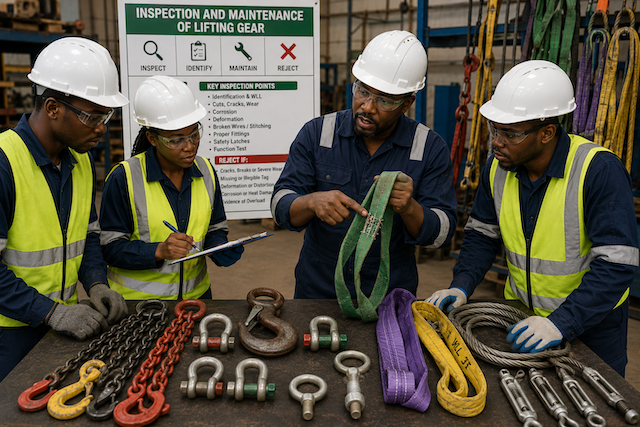
Inspection and maintenance are critical parts of safe rigging and lifting operations. Lifting accessories may look strong, but small defects such as cracks, cuts, corrosion, worn pins, missing tags, or stretched chain links can cause serious failure during a lift.
A professional rigger must never assume that equipment is safe because it was used before. Every item must be checked before use.
Rigging equipment should be inspected before use on each shift and removed from service if defective. OSHA states that rigging equipment for material handling must be inspected before use on each shift and as necessary during use to ensure it is safe.
Why Inspection Is Important
Inspection helps prevent:
- Dropped loads
- Sling failure
- Shackle failure
- Hook failure
- Crane or hoist damage
- Injury or death
- Equipment loss
- Project delays
- Legal and financial consequences
Safe lifting depends heavily on the continued condition of lifting equipment and accessories. HSE warns that failures of lifting equipment can result in significant or fatal injuries.
Inspection is not just a paperwork exercise. It is a life-saving habit.
Types of Inspection
There are different levels of inspection depending on the equipment, workplace procedure, risk level, and legal requirement.
1. Pre-Use Inspection
This is the inspection carried out by the rigger or user before using the equipment.
It is usually visual and hands-on.
2. In-Use Inspection
This happens during the lifting operation. The rigger should continue watching for signs of unsafe conditions, such as sling movement, load instability, equipment distortion, or unusual sounds.
3. Periodic Inspection
This is a more formal inspection done at set intervals by a competent person.
4. Thorough Examination
This is a detailed examination required under some legal systems and workplace standards. It is usually done by a competent person and recorded formally.
LOLER guidance explains that thorough examination is important for ensuring lifting equipment remains safe for use.
Pre-Use Inspection Procedures
Pre-use inspection should be done before each lifting operation or at the start of each shift.
Step 1: Identify the Equipment
Check that the equipment is the correct item for the job.
Confirm:
- Equipment type
- Size
- Capacity
- Identification number
- Tag or marking
- Inspection colour code, where used
- Correct certificate or inspection status, where required
Step 2: Check the Working Load Limit
Every lifting accessory must have a visible Working Load Limit, also called WLL.
Do not use lifting gear if the WLL is missing, unclear, or lower than the load requirement.
Step 3: Inspect the Physical Condition
Look carefully and feel for defects where safe.
Check for:
- Cracks
- Cuts
- Wear
- Corrosion
- Deformation
- Burn marks
- Broken wires
- Damaged stitching
- Bent pins
- Damaged hooks
- Missing safety latch
- Missing identification tag
Step 4: Check Compatibility
Make sure all parts fit correctly.
For example:
- The shackle pin should fit properly.
- The sling should sit correctly in the hook bowl.
- The eye bolt should match the load thread.
- The sling should not be bunched or pinched.
- The hook should not be side-loaded unless designed for that use.
Step 5: Check Suitability for the Task
Confirm that the equipment is suitable for:
- Load weight
- Load shape
- Load temperature
- Sharp edges
- Lifting angle
- Environment
- Chemical exposure
- Weather conditions
- Type of hitch
Step 6: Decide: Use, Quarantine, or Reject
After inspection, decide:
- Use if it is safe and suitable.
- Quarantine if you are unsure and need a competent person to assess it.
- Reject/remove from service if it is clearly defective.
Identifying Defects and Damage
Different lifting accessories have different defect signs. A rigger must know what to look for.
Wire Rope Sling Defects
Wire rope slings are strong, but they can fail if damaged or poorly maintained.
Check for:
- Broken wires
- Kinks
- Bird-caging
- Crushing
- Flattening
- Corrosion
- Heat damage
- Damaged ferrules
- Damaged thimbles
- Severe abrasion
- Reduced rope diameter
- Missing or unreadable tag
- Distorted eye
- Evidence of shock loading
Reject Wire Rope Slings If:
- The sling has no readable identification tag.
- There are excessive broken wires.
- The rope is kinked, crushed, or bird-caged.
- There is heavy corrosion.
- End fittings are cracked, loose, or deformed.
- The sling has been exposed to heat or chemicals beyond its rating.
- The sling has been overloaded or shock-loaded.
Chain Sling Defects
Chain slings are durable but must be carefully inspected link by link.
Check for:
- Stretched links
- Bent links
- Twisted links
- Cracked links
- Gouges
- Cuts
- Excessive wear
- Corrosion
- Heat damage
- Damaged master link
- Damaged hooks
- Missing tag
- Mismatched components
- Unauthorised repairs
Reject Chain Slings If:
- Any link is cracked, stretched, bent, twisted, or badly worn.
- The chain does not move freely.
- The tag is missing or unreadable.
- The hook or master link is damaged.
- There are signs of welding or unauthorised modification.
- The chain has been overloaded.
Synthetic Webbing Sling Defects
Synthetic webbing slings are lightweight and useful, but they are easily damaged by sharp edges, heat, chemicals, and abrasion.
Check for:
- Cuts
- Tears
- Holes
- Abrasion
- Burn marks
- Chemical damage
- Broken stitching
- Damaged eyes
- Knots
- Stiff or brittle areas
- Missing or unreadable tag
- UV damage
- Oil or chemical contamination
Reject Synthetic Slings If:
- The sling is cut, torn, burnt, or chemically damaged.
- Stitching is broken.
- The eyes are damaged.
- The sling has knots.
- The tag is missing or unreadable.
- There is heavy abrasion.
- The sling has been overloaded.
Important Safety Note:
Never tie knots in synthetic slings. Never use them over sharp edges without proper protection.
Shackle Defects
Shackles are critical connectors. A damaged shackle can fail suddenly under load.
Check for:
- WLL marking
- Manufacturer marking
- Correct pin
- Bent body
- Bent pin
- Damaged threads
- Cracks
- Corrosion
- Distortion
- Excessive wear
- Missing nut or cotter pin, where applicable
- Pin not seating correctly
- Signs of side loading or overloading
Reject Shackles If:
- WLL marking is missing or unreadable.
- The shackle body or pin is bent.
- Threads are worn or damaged.
- There are cracks or deep gouges.
- The pin is not original or does not fit correctly.
- The nut or cotter pin is missing on bolt-type shackles.
- The shackle has been overloaded.
Hook Defects
Hooks must be checked before use because stretching, twisting, or latch failure can release a load.
Check for:
- Cracks
- Twisting
- Bending
- Worn throat opening
- Missing safety latch
- Damaged safety latch
- Hook tip damage
- Corrosion
- Heat damage
- Missing rated load identification
- Damaged swivel, if fitted
Reject Hooks If:
- The hook is cracked, bent, or twisted.
- The throat opening has visibly increased.
- The safety latch is missing or not working.
- The hook tip is damaged.
- The hook has been overloaded.
- The rated load marking is missing.
Crosby’s rigging inspection guidance includes rejection concerns such as visible hook bend or twist, throat opening distortion, and missing or illegible rated-load identification.
Eye Bolt and Turnbuckle Defects
Eye Bolts: Check for:
- Cracks
- Bent eye
- Damaged threads
- Corrosion
- Missing WLL marking
- Poor seating
- Incomplete thread engagement
- Wrong type for the lifting angle
- Signs of side loading
Reject Eye Bolts If:
- Threads are damaged.
- The eye is bent or cracked.
- It is not rated for lifting.
- It does not seat properly.
- The WLL marking is missing.
- It has been overloaded or modified.
Turnbuckles: Check for:
- Bent body
- Damaged threads
- Cracks
- Corrosion
- Missing lock nuts or securing pins
- Overextension
- Wrong end fittings
- Signs of overloading
Reject Turnbuckles If:
- Threads are stripped or badly worn.
- The body is bent or cracked.
- End fittings are damaged.
- Locking parts are missing.
- The turnbuckle has been modified or overloaded.
Lifting Beam and Spreader Beam Defects
Lifting beams and spreader beams must be checked before use because they carry large forces and may fail if overloaded, cracked, or incorrectly configured.
Check for:
- Identification plate
- WLL/SWL marking
- Serial number
- Cracks
- Bent structure
- Damaged lifting lugs
- Damaged attachment points
- Corrosion
- Missing pins or bolts
- Deformation
- Unauthorised welding
- Expired inspection status
- Correct configuration
Reject Beams If:
- The identification plate is missing.
- WLL/SWL is not visible.
- There are cracks, bends, or deformation.
- Lifting points are damaged.
- Pins, bolts, or retaining parts are missing.
- The beam has been modified without approval.
- The inspection status is expired.
Inspection Checklist
Use this simple checklist before lifting.
| Inspection Area | What to Check | Status |
|---|---|---|
| Identification | Tag, serial number, WLL/SWL, manufacturer mark | Pass / Fail |
| Inspection status | Colour code, inspection date, certificate where required | Pass / Fail |
| Physical condition | Cracks, cuts, corrosion, wear, deformation | Pass / Fail |
| Fittings | Pins, bolts, hooks, latches, threads | Pass / Fail |
| Compatibility | Correct size and proper fit | Pass / Fail |
| Suitability | Suitable for load, angle, environment, temperature | Pass / Fail |
| Cleanliness | Free from oil, mud, chemicals, sharp debris | Pass / Fail |
| Storage condition | No poor storage damage | Pass / Fail |
| Final decision | Use, quarantine, or reject | Pass / Fail |
Maintenance of Lifting Gear
Maintenance helps keep lifting gear safe, clean, traceable, and ready for use.
Good Maintenance Practices
- Clean equipment after use.
- Remove mud, oil, and chemical contamination.
- Dry wet equipment before storage.
- Lubricate wire ropes and moving parts where required.
- Protect synthetic slings from sharp edges, heat, and sunlight.
- Keep shackles, pins, and hooks together.
- Do not modify lifting gear.
- Do not weld, bend, heat, or drill lifting accessories.
- Report damage immediately.
- Follow manufacturer maintenance instructions.
- Keep inspection records where required.
Important Rule
Repairs should only be done by competent and authorised persons. A rigger should not repair lifting equipment casually on site.
Storage of Lifting Gear
Poor storage can damage lifting gear even when it is not in use.
Proper Storage Practices
Store lifting gear:
- In a clean, dry, well-ventilated area.
- Away from chemicals.
- Away from welding sparks.
- Away from direct sunlight where possible.
- Off the ground.
- On racks, hooks, shelves, or labelled storage points.
- According to type and capacity.
- With tags visible.
- Away from sharp edges.
- Away from moving equipment.
- In a way that prevents tangling, crushing, and corrosion.
Storage by Equipment Type
| Equipment | Best Storage Practice |
|---|---|
| Wire rope slings | Hang on racks, lubricate as required, keep dry |
| Chain slings | Hang on strong racks, avoid knots and twisting |
| Synthetic slings | Store away from heat, chemicals, sunlight, and sharp edges |
| Shackles | Store by size and WLL, keep pins fitted |
| Hooks | Store clean and protected from impact |
| Eye bolts | Store by thread size and capacity |
| Turnbuckles | Store with threads protected |
| Lifting beams | Store on stable supports and protect lifting points |
Equipment Rejection Criteria
Lifting gear must be rejected when it is unsafe, damaged, unmarked, expired, or unsuitable.
Reject Equipment Immediately If:
- WLL/SWL marking is missing or unreadable.
- Identification tag is missing.
- Inspection status is expired.
- There are cracks, bends, cuts, burns, or deformation.
- There is severe corrosion.
- There is evidence of overloading or shock loading.
- Hooks are twisted or safety latches are missing.
- Shackles have wrong or damaged pins.
- Synthetic slings are cut, burnt, or chemically damaged.
- Wire ropes are kinked, crushed, corroded, or bird-caged.
- Chain links are stretched, cracked, twisted, or worn.
- Eye bolts or turnbuckles have damaged threads.
- Lifting beams are bent, cracked, or missing identification plates.
- The equipment has been modified without approval.
- The rigger is unsure whether the item is safe.
What to Do With Rejected Equipment
Do not return rejected equipment to storage.
Instead:
- Tag it clearly as Do Not Use.
- Remove it from the work area.
- Report it to the supervisor or competent person.
- Quarantine it in a designated rejection area.
- Record the defect if required.
- Repair only through authorised channels, or destroy/dispose of it according to company procedure.
Real-Life Scenario
A rigger is preparing for a lift and selects a synthetic webbing sling from the storage area. During inspection, he notices that the sling tag is faded and unreadable. The sling itself looks clean and strong.
The correct action is to reject the sling.
Why?
Because the rigger cannot confirm the Working Load Limit, material type, manufacturer information, or inspection status. Even if the sling looks good, it cannot be used safely without proper identification.
A professional rigger does not guess.
Common Inspection Mistakes
Avoid these common mistakes:
- Inspecting equipment only after an accident.
- Assuming colour code means the item is safe.
- Ignoring missing tags.
- Using equipment because it “looks strong.”
- Failing to check pins, latches, and threads.
- Not checking the full length of slings.
- Not inspecting both sides of synthetic slings.
- Using damaged gear for “just one lift.”
- Returning rejected equipment to storage.
- Mixing rejected gear with approved gear.
- Allowing untrained workers to inspect critical lifting gear.
- Repairing equipment without authorisation.
Quick Recap
Inspection and maintenance are essential for safe lifting operations. Every rigger must inspect lifting gear before use, identify defects, use checklists, store equipment properly, and reject unsafe items immediately. Never use damaged, unmarked, expired, modified, or doubtful lifting equipment. If in doubt, stop and report it.