
Introduction to Pipe Insulation and Tinsmith
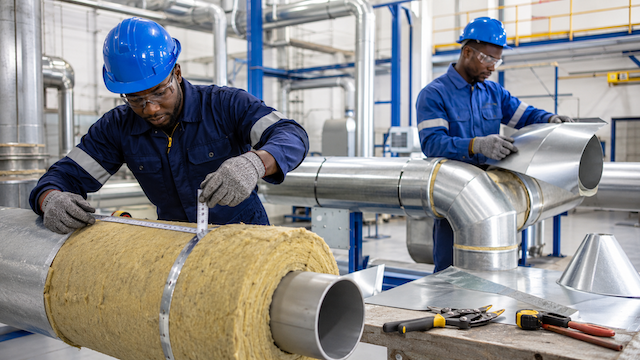
Introduction to Pipe Insulation
Pipe insulation is the process of covering pipes, fittings, valves, flanges, tanks, vessels, ducts, or equipment with insulating material to control heat loss, heat gain, condensation, noise, surface temperature, and energy waste.
In industrial and building services work, insulation is used on:
- Steam lines
- Hot water pipes
- Chilled water pipes
- Refrigeration lines
- Process pipes
- Oil and gas pipelines
- HVAC ducts
- Boilers and vessels
- Valves, flanges, bends, and pipe supports
Mechanical insulation systems include the materials and components used to insulate piping, equipment, vessels, ducts, and other mechanical items. The National Insulation Association describes mechanical insulation as an important part of commercial and industrial systems, supporting design, specification, installation, and maintenance.
Why Pipe Insulation Is Important
Pipe insulation is not only for appearance. It performs important technical and safety functions.
| Purpose | Explanation |
|---|---|
| Energy conservation | Reduces heat loss from hot pipes and heat gain into cold pipes |
| Condensation control | Prevents moisture forming on cold pipe surfaces |
| Personnel protection | Reduces risk of burns from hot surfaces or cold-contact injury |
| Process control | Helps maintain required fluid or gas temperature |
| Freeze protection | Helps reduce risk of freezing in cold conditions |
| Noise reduction | Reduces sound from fluid movement, vibration, or equipment |
| Corrosion control support | Helps protect pipe systems when correctly installed and maintained |
ROCKWOOL’s pipe insulation guidance notes that pipe insulation helps prevent heat loss from hot pipes and condensation on cold-water pipes, supporting efficient operation and reduced energy consumption.
Common Pipe Insulation Applications
Pipe insulation can be used in many sectors.
| Sector | Examples |
|---|---|
| Oil and gas | Process lines, tanks, vessels, valves, offshore systems |
| Construction | Plumbing, HVAC, chilled water, hot water systems |
| Marine | Engine room pipework, exhaust systems, chilled systems |
| Manufacturing | Steam lines, compressed air, process piping |
| Power plants | Boilers, turbines, steam systems, condensate lines |
| Food and beverage | Temperature-controlled process lines |
| Hospitals and hotels | Hot water, chilled water, steam, and HVAC systems |
| Cold rooms and refrigeration | Refrigerant pipes and cold insulation systems |
The type of insulation used depends on temperature, environment, pipe size, location, exposure to weather, risk of mechanical damage, and the purpose of the insulation.
Introduction to Tinsmith Technology
Tinsmith technology is the craft and technical skill of measuring, marking, cutting, shaping, joining, and installing thin sheet metal materials. In pipe insulation work, tinsmiths commonly fabricate and install protective metal cladding over insulation.
The term “tinsmith” traditionally referred to workers who shaped thin metal sheets. In modern industrial work, tinsmith skills are used in cladding, ducting, sheet metal fabrication, insulation protection, flashing, weatherproofing, jacketing, and maintenance work.
A tinsmith may work with:
- Aluminium sheets
- Galvanized steel sheets
- Stainless steel sheets
- Pre-coated metal sheets
- PVC cladding
- Sheet metal fasteners
- Rivets and screws
- Sealants and mastics
- Grooved, folded, and rolled metal sections
Relationship Between Pipe Insulation and Tinsmith Work
Pipe insulation and tinsmith work are closely connected. The pipe insulator installs the insulation material, while the tinsmith skill is needed to fabricate and fit the external protective covering.
A complete pipe insulation system may include:
| Layer | Function |
|---|---|
| Pipe surface | Carries the process fluid or gas |
| Insulation material | Controls heat, cold, condensation, or sound |
| Vapour barrier | Prevents moisture entry, especially on cold systems |
| Cladding or jacketing | Protects insulation from weather, damage, and contamination |
| Sealant or mastic | Seals joints and prevents water entry |
| Bands, screws, rivets, or clips | Secure the cladding in position |
Without proper cladding, insulation can become damaged by rain, sun, chemicals, impact, foot traffic, oil, or maintenance activity. Without proper insulation, cladding alone cannot deliver the required thermal protection.
Roles and Responsibilities of a Pipe Insulator
A pipe insulator is responsible for installing, protecting, repairing, and maintaining insulation systems on pipes and related equipment.
A pipe insulator should be able to:
- Identify the pipe or equipment to be insulated.
- Understand the insulation purpose: hot, cold, acoustic, cryogenic, or personnel protection.
- Select suitable insulation materials according to specification.
- Measure pipe diameter, length, bends, valves, flanges, and fittings.
- Cut insulation accurately.
- Fit insulation tightly without unnecessary gaps.
- Apply vapour barriers where required.
- Support insulation around pipe supports and hangers.
- Protect insulation from moisture and damage.
- Report defects, corrosion, or unsafe pipe conditions.
- Work safely around hot surfaces, sharp materials, and confined spaces.
- Follow drawings, specifications, and site procedures.
A good pipe insulator works neatly, safely, and accurately. Poor insulation work can cause energy loss, condensation, corrosion risk, poor appearance, and premature failure.
Roles and Responsibilities of a Tinsmith
A tinsmith is responsible for sheet metal fabrication and installation. In insulation work, the tinsmith fabricates and installs cladding over insulated pipes, bends, valves, reducers, tees, vessels, and equipment.
A tinsmith should be able to:
- Measure pipe and insulation dimensions accurately.
- Mark out sheet metal patterns.
- Cut sheet metal safely.
- Fold, bend, roll, groove, seam, and rivet sheet metal.
- Fabricate elbows, bends, reducers, offsets, boxes, and covers.
- Install cladding neatly over insulation.
- Seal joints against weather and moisture.
- Use hand tools and power tools safely.
- Maintain tools and equipment.
- Avoid sharp edges and poor finishing.
- Follow drawings, templates, and project specifications.
A good tinsmith combines accuracy, safety, practical creativity, and neat finishing.
Shared Responsibilities of Pipe Insulators and Tinsmiths
Pipe insulators and tinsmiths often work together or perform overlapping tasks.
Their shared responsibilities include:
- Following safety rules and permit requirements.
- Wearing correct PPE.
- Measuring accurately before cutting.
- Reading simple drawings and layouts.
- Protecting materials from damage.
- Keeping the work area clean.
- Using tools correctly.
- Reporting unsafe conditions.
- Maintaining quality workmanship.
- Avoiding waste of materials.
- Keeping records where required.
- Respecting site procedures and client property.
The quality of the final insulation system depends on both the insulation layer and the cladding finish.
Career Opportunities
Pipe insulation and tinsmith skills are useful in many industries. Skilled workers can find opportunities in construction, oil and gas, power plants, shipyards, HVAC companies, maintenance departments, fabrication workshops, and industrial service companies.
Common career paths include:
| Role | Description |
|---|---|
| Pipe insulation assistant | Supports insulation installation and material handling |
| Pipe insulator | Installs insulation on pipes, fittings, valves, and equipment |
| Tinsmith / sheet metal worker | Fabricates and installs sheet metal cladding and components |
| Cladding installer | Installs aluminium, stainless steel, or PVC cladding |
| HVAC insulation worker | Works on chilled water, ducting, and building services insulation |
| Industrial maintenance technician | Inspects and repairs insulation systems |
| Fabrication workshop assistant | Cuts, folds, rolls, and prepares sheet metal parts |
| Site supervisor | Coordinates insulation and cladding work teams |
| Quality control assistant | Checks materials, dimensions, finishes, and installation quality |
| Self-employed contractor | Provides insulation, cladding, repair, and maintenance services |
With experience, a learner can grow from basic workshop assistant to skilled artisan, supervisor, contractor, or small business owner.
Industries That Need These Skills
Pipe insulation and tinsmith skills are needed in:
- Oil and gas facilities
- Refineries
- Petrochemical plants
- Power generation plants
- Commercial buildings
- Hotels and hospitals
- Food processing factories
- Cold rooms and refrigeration systems
- Marine and ship repair
- Construction projects
- HVAC and mechanical services
- Maintenance companies
- Fabrication workshops
These skills remain useful because pipework, insulation, cladding, and mechanical systems require installation, inspection, repair, and replacement throughout their service life.
Industry Standards and Good Practice
Pipe insulation and tinsmith work should follow project specifications, safety procedures, manufacturer instructions, and applicable industry standards.
Standards help define:
- Insulation material selection
- Insulation thickness
- Temperature range
- Fire performance
- Vapour barrier requirements
- Cladding material
- Joint sealing
- Weatherproofing
- Inspection quality
- Documentation
- Safety requirements
BS 5422:2023 provides specification guidance for thermal insulation of pipework, ductwork, and equipment, covering applications such as energy conservation, condensation control, personnel protection, and process temperature control.
Industry bodies also continue to support competence, standards, and skills development in thermal insulation. TICA describes itself as a trade body representing contractors involved in hot and cold thermal insulation, and its technical resources address issues around building safety, competence, net zero, and skills shortages.
Workmanship Quality
Good workmanship is essential in insulation and tinsmith work.
Quality workmanship includes:
- Accurate measurement
- Clean cutting
- Tight insulation joints
- Correct material selection
- Neat cladding alignment
- Proper overlap direction
- Secure fastening
- Smooth finishing
- Good sealing against water
- No unnecessary gaps
- No exposed sharp edges
- No damage to pipe, insulation, or cladding
Poor workmanship can result in heat loss, condensation, water entry, corrosion, loose cladding, poor appearance, and repeated maintenance problems.
Corrosion Under Insulation Awareness
Corrosion Under Insulation, commonly called CUI, is a serious problem in industrial pipework. It occurs when moisture enters or remains under insulation and causes corrosion of the pipe surface, especially on steel pipework.
HSE notes that CUI is mainly associated with steel plant and pipework, and failures have occurred where localised corrosion progressed undetected beneath insulation.
Workers should watch for signs such as:
- Damaged cladding
- Open joints
- Missing sealant
- Wet insulation
- Rust staining
- Loose bands
- Water entry points
- Damaged vapour barrier
- Corroded pipe supports
A pipe insulator or tinsmith may not be responsible for engineering inspection, but they must report conditions that could allow moisture entry or corrosion.
Professional Ethics
Professional ethics means doing the work safely, honestly, and responsibly.
A pipe insulator or tinsmith should:
- Put safety first.
- Use specified materials.
- Avoid poor-quality shortcuts.
- Report defects honestly.
- Avoid hiding damaged insulation or corrosion.
- Respect client property and site rules.
- Avoid wasting materials.
- Work within their competence.
- Ask questions when drawings or specifications are unclear.
- Keep accurate records where required.
- Maintain good conduct with supervisors, clients, and coworkers.
Ethical workers build trust and reputation. Poor ethics can cause unsafe work, financial loss, rework, equipment damage, and loss of future opportunities.
Basic Safety Awareness
Pipe insulation and tinsmith work involves several hazards. These include sharp sheet metal edges, dust, fibres, hot surfaces, working at height, chemicals, adhesives, noise, power tools, confined spaces, and heavy materials.
Basic safety practices include:
- Wear correct PPE.
- Handle sheet metal carefully.
- Use gloves when cutting or handling sharp materials.
- Wear eye protection when cutting, drilling, or grinding.
- Use dust protection where required.
- Keep the work area clean.
- Store materials safely.
- Avoid working on hot lines without authorisation.
- Follow permit-to-work requirements.
- Keep fire risks under control.
- Report unsafe conditions immediately.
Safety is not separate from the trade. It is part of professional workmanship.
Real-Life Scenario
A maintenance team is asked to replace damaged cladding on an insulated chilled-water pipe. During removal, the worker notices that the insulation is wet and the pipe surface shows signs of rust.
The correct action is not to cover it quickly with new cladding.
The worker should report the condition to the supervisor or responsible maintenance personnel. Wet insulation and rust may indicate water entry and possible corrosion under insulation. Re-covering the area without inspection can hide a serious problem and allow further damage.
Common Mistakes Beginners Should Avoid
Avoid these mistakes:
- Cutting insulation without accurate measurement.
- Leaving gaps between insulation sections.
- Installing cladding without proper overlap.
- Ignoring damaged vapour barriers.
- Using the wrong material for hot or cold service.
- Leaving sharp sheet metal edges exposed.
- Allowing water entry through open cladding joints.
- Over-tightening bands and damaging insulation.
- Under-tightening fasteners and leaving cladding loose.
- Ignoring drawings or specifications.
- Hiding defects to finish quickly.
- Working without correct PPE.
What a Pipe Insulator or Tinsmith Should Never Do
A pipe insulator or tinsmith should never:
- Work without required PPE.
- Use damaged or unsuitable materials.
- Cover wet insulation without reporting it.
- Ignore signs of corrosion.
- Leave sharp edges exposed.
- Install cladding that allows water to enter.
- Use poor sealing on outdoor systems.
- Cut or grind without eye protection.
- Work on hot pipes without permission and controls.
- Modify drawings or specifications without approval.
- Leave waste materials scattered around the work area.
- Claim competence for tasks they cannot perform safely.
Quick Recap
Pipe insulation controls heat loss, heat gain, condensation, noise, surface temperature, and energy waste. Tinsmith technology focuses on sheet metal fabrication and cladding installation. Pipe insulators and tinsmiths work together to produce safe, durable, neat, and effective insulation systems. Their work is needed in construction, oil and gas, HVAC, marine, industrial, and maintenance environments. Professional practice requires safety, accurate measurement, good workmanship, ethical behaviour, quality materials, and awareness of problems such as water entry and corrosion under insulation.