
Introduction to Rigging and Lifting
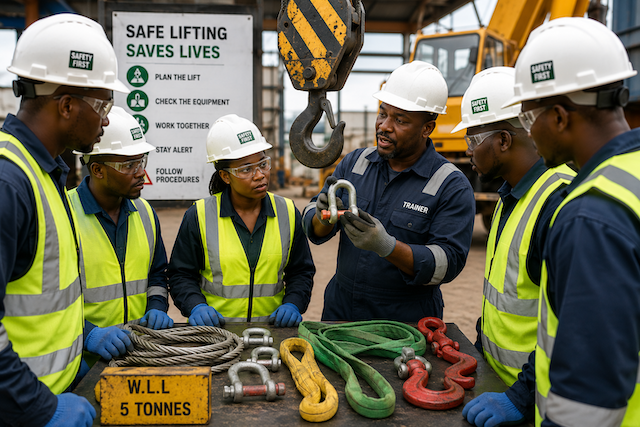
What Is Rigging and Lifting?
Rigging and lifting refer to the process of preparing, securing, attaching, and moving a load safely using lifting equipment such as cranes, hoists, slings, shackles, hooks, lifting beams, and other accessories.
In simple terms:
Rigging is how the load is prepared and connected for lifting.
Lifting is the controlled movement of the load from one position to another.
Rigging and lifting operations are common in construction, oil and gas, marine, logistics, warehouses, manufacturing, maintenance, and industrial work sites.
A lifting operation may look simple, but it can become dangerous when the load is too heavy, poorly balanced, wrongly attached, badly communicated, or lifted with defective equipment.
Why Rigging and Lifting Safety Matters
Lifting operations involve heavy loads, suspended objects, moving equipment, and people working around high-risk areas. A failed lift can cause serious injury, death, equipment damage, production delays, and financial loss.
Safe rigging and lifting helps to:
- Protect workers and bystanders.
- Prevent dropped loads.
- Prevent crane or equipment failure.
- Protect expensive materials and machinery.
- Improve teamwork and communication.
- Reduce workplace accidents.
- Ensure compliance with workplace safety rules.
The UK Health and Safety Executive notes that lifting operations can put people at great risk when they go wrong, so they must be properly planned, resourced, and organised by competent people.
Key Terms Every Beginner Should Know
| Term | Meaning |
|---|---|
| Load | The object or material being lifted |
| Rigger | A trained person who prepares, attaches, and controls the load for lifting |
| Sling | A lifting accessory used to connect the load to the crane hook or lifting device |
| Shackle | A metal connector used to join slings, lifting points, or other rigging components |
| Hook | A lifting attachment used to connect the load or rigging gear |
| Crane | A machine used to lift, lower, and move loads |
| Hoist | A device used to lift or lower a load |
| Lifting point | A certified point where lifting gear can be safely attached |
| Centre of gravity | The point where the load’s weight is balanced |
| Working Load Limit: WLL | The maximum load an item of lifting equipment is designed to safely lift |
| Safe Working Load: SWL | The safe load limit after considering working conditions and safety factors |
| Tag line | A rope used to help control a suspended load from a safe distance |
| Exclusion zone | A restricted area around a lifting operation where unauthorised persons must not enter |
Roles and Responsibilities of a Rigger
A rigger plays a critical role in safe lifting operations. The rigger is responsible for preparing the load and ensuring the correct lifting accessories and methods are used.
A rigger is not just someone who “ties a load.” A competent rigger understands load weight, lifting points, sling angles, equipment capacity, communication signals, and lifting hazards.
OSHA explains that a qualified rigger is determined by the nature of the load, the lift, the equipment being used, and the person’s knowledge and experience; a certified crane operator does not automatically qualify as a rigger.
Core Responsibilities of a Rigger
A rigger should be able to:
- Understand the lifting task before work begins.
- Identify the load to be lifted.
- Confirm the estimated or known weight of the load.
- Identify the load’s centre of gravity.
- Select the correct lifting equipment and accessories.
- Check the Working Load Limit of slings, shackles, hooks, and lifting devices.
- Inspect rigging equipment before use.
- Reject damaged or unsafe lifting gear.
- Attach the load correctly.
- Use proper sling angles and hitch methods.
- Keep people away from suspended loads.
- Use tag lines where required.
- Communicate clearly with the crane operator or lifting team.
- Follow standard hand signals or agreed communication methods.
- Stop the job if conditions become unsafe.
Responsibilities of the Lifting Team
A safe lift requires teamwork. Each person involved must understand their role and communicate properly.
| Role | Main Responsibility |
|---|---|
| Rigger | Prepares, attaches, and controls the load |
| Crane Operator | Operates the crane or lifting equipment safely |
| Signal Person/Banksman | Gives clear instructions and hand signals to the operator |
| Lifting Supervisor | Plans, coordinates, and supervises the lifting operation |
| HSE Officer/Safety Representative | Monitors safety controls and compliance |
| Site Workers/Bystanders | Stay outside exclusion zones and follow site instructions |
Important Rule
Only authorised and competent persons should participate directly in lifting operations. Untrained workers must not attach loads, signal crane operators, or enter lifting zones without instruction.
Industry Standards and Regulations
Rigging and lifting operations must follow applicable workplace regulations, company procedures, manufacturer instructions, and recognised industry standards.
Depending on the country, industry, and site, the rules may reference standards such as:
- OSHA lifting and rigging requirements.
- LOLER: Lifting Operations and Lifting Equipment Regulations.
- PUWER: Provision and Use of Work Equipment Regulations.
- BS 7121: Safe use of cranes.
- ASME B30 standards for cranes, hoists, slings, hooks, and rigging hardware.
- ISO standards related to lifting equipment and safety management.
- Company lifting procedures and permit-to-work systems.
- Manufacturer manuals and load charts.
LOLER places duties on people and organisations that own, operate, or control lifting equipment, including businesses whose employees use lifting equipment whether owned by the company or not.
OSHA also requires lifting and rigging assemblies to stay within rated capacities and manufacturer limitations; for multiple-lift rigging assemblies, OSHA states that the total load must not exceed the rated capacity of the hoisting equipment or the rigging capacity specified in the rigging rating chart.
Practical Meaning for Learners
For everyday rigging work, this means:
- Do not guess the capacity of lifting equipment.
- Do not use unmarked or damaged lifting accessories.
- Do not exceed the Working Load Limit.
- Do not ignore manufacturer instructions.
- Do not lift without proper planning.
- Do not allow untrained people to rig loads.
- Do not use lifting equipment that has not been inspected.
Basic Safety Principles in Rigging and Lifting
Safe lifting begins before the load leaves the ground.
The basic safety principles are:
1. Plan the Lift
Every lift should be planned based on the load, equipment, environment, people involved, and possible hazards.
The lifting plan should answer:
- What are we lifting?
- How heavy is it?
- Where is the centre of gravity?
- What equipment will be used?
- Is the lifting gear suitable?
- Who is in charge?
- What communication method will be used?
- Where will people stand?
- What can go wrong?
- What controls are in place?
HSE guidance states that a lifting plan should address the risks identified by risk assessment, resources required, procedures, and responsibilities so the lifting operation is carried out safely.
2. Know the Load Weight
Never lift a load if the weight is unknown or not properly estimated. Load weight may be found from:
- Manufacturer plate.
- Packing documents.
- Engineering drawing.
- Weighbridge result.
- Calculation.
- Competent supervisor confirmation.
If the load weight is uncertain, stop and verify before lifting.
3. Use the Right Equipment
The lifting gear must match the load, lifting method, environment, and load attachment points.
Do not use equipment simply because it is available. Use equipment because it is suitable.
4. Inspect Before Use
Before any lift, inspect slings, shackles, hooks, eye bolts, lifting beams, and other accessories.
Look for:
- Cuts
- Cracks
- Deformation
- Corrosion
- Broken wires
- Missing tags
- Heat damage
- Worn pins
- Damaged hooks
- Illegible markings
- Expired inspection status
If equipment is damaged, remove it from service and report it.
5. Protect the Load and Sling
Sharp edges can cut or damage slings. Use edge protection where necessary.
6. Control the Load
Use tag lines when appropriate. Keep hands away from pinch points. Never stand under a suspended load.
7. Maintain Clear Communication
Use one agreed signal person unless the lift plan says otherwise. Stop the lift immediately if communication is lost.
8. Keep the Area Clear
Set up an exclusion zone. Only authorised persons should remain inside the lifting area.
9. Stop Work When Unsafe
Any worker should be empowered to stop the operation if they observe unsafe conditions.
8. Hazard Identification and Risk Assessment
Hazard identification means recognising anything that can cause harm during a lifting operation.
Risk assessment means thinking through:
- What can go wrong?
- Who can be harmed?
- How serious could it be?
- How likely is it?
- What controls are needed?
Common Rigging and Lifting Hazards
| Hazard | Possible Consequence | Control Measure |
|---|---|---|
| Unknown load weight | Overloading, equipment failure | Confirm weight before lifting |
| Wrong sling selection | Sling failure, dropped load | Use correct sling type and WLL |
| Damaged lifting gear | Breakage during lift | Inspect and reject defective gear |
| Poor centre of gravity | Load tilting or spinning | Identify COG and rig correctly |
| Unsafe sling angle | Increased sling tension | Use correct sling angle and calculate tension |
| People under suspended load | Fatal injury if load falls | Establish exclusion zone |
| Poor communication | Unexpected crane movement | Use trained signal person |
| Wind or bad weather | Uncontrolled load movement | Stop lift if conditions are unsafe |
| Uneven ground | Crane instability | Check ground bearing and setup |
| Power lines | Electrocution | Maintain safe clearance |
| Pinch points | Crushed fingers or hands | Keep hands clear and use tools/tag lines |
| Poor lighting | Misjudgement and unsafe rigging | Improve visibility before lifting |
Basic Risk Control Hierarchy
When managing lifting hazards, use practical controls in this order:
Eliminate
Remove the hazard completely if possible.
Example: Move people away from the lifting area before the lift starts.
Substitute
Use a safer method or equipment.
Example: Use mechanical lifting instead of unsafe manual handling.
Engineer the Control
Use physical controls.
Example: Barriers, lifting beams, tag lines, edge protection, certified lifting points.
Administrative Control
Use procedures and communication.
Example: Lift plan, toolbox talk, permit-to-work, method statement, trained signal person.
PPE
Use personal protective equipment.
Example: Helmet, gloves, safety boots, high-visibility vest, eye protection.
PPE is important, but it should not be the only control. The main focus should be proper planning, suitable equipment, and safe work methods.
Essential PPE for Rigging and Lifting
A rigger should normally wear:
- Safety helmet
- Safety boots with toe protection
- High-visibility vest or coverall
- Hand gloves suitable for rigging work
- Eye protection where required
- Coverall or workwear
- Hearing protection where required
- Fall protection when working at height
PPE must fit properly and be suitable for the task. Loose clothing, jewellery, or items that can be caught in equipment should be avoided.
Real-Life Scenario
A team is asked to lift a metal fabrication frame using a mobile crane. The frame has no visible weight marking, and one sling has a damaged tag. The team is under pressure to complete the job quickly.
The correct action is to stop the job.
The rigger should:
- Confirm the load weight.
- Identify the centre of gravity.
- Remove the untagged or damaged sling from service.
- Select properly rated lifting gear.
- Confirm the lift plan.
- Establish an exclusion zone.
- Agree communication signals.
- Continue only when the lift is safe.
This is professional rigging behaviour. A good rigger does not rush a dangerous lift.
What a Rigger Should Never Do
A rigger should never:
- Stand under a suspended load.
- Allow others to walk under a suspended load.
- Use damaged, unmarked, or expired lifting gear.
- Guess the weight of a load.
- Exceed the Working Load Limit.
- Use a crane or lifting gear outside manufacturer instructions.
- Tie knots in slings to shorten them.
- Hammer shackles into position.
- Side-load a shackle or hook unless designed for it.
- Put hands between the load and lifting gear during tensioning.
- Ride on a load or hook.
- Leave a suspended load unattended.
- Continue lifting when communication is unclear.
- Ignore wind, poor ground condition, or overhead power lines.
- Take instructions from unauthorised persons during a lift.
Emergency Readiness During Lifting Operations
Before lifting begins, the team should know what to do if something goes wrong.
Emergency planning should consider:
- Dropped load
- Equipment failure
- Crane instability
- Injury to worker
- Load collision
- Fire or chemical release
- Contact with power line
- Severe weather
- Communication failure
The team should know:
- Who stops the lift.
- How to alert the operator.
- Where the emergency assembly point is.
- Who contacts emergency response.
- Where first aid support is located.
- How to isolate the area.
Practical Demonstration Activity
For this module, the trainer can set up a simple classroom or workshop activity.
Activity: Identify Safe and Unsafe Rigging Conditions
Display different lifting accessories such as:
- Web sling
- Chain sling
- Wire rope sling
- Shackle
- Hook
- Eye bolt
- Lifting beam
- Tag line
Ask learners to identify:
- Equipment name
- Use
- WLL marking
- Inspection tag
- Possible defects
- When to reject the equipment
Then present a simple lifting scenario and ask:
- What is the load?
- What is the estimated weight?
- Where is the centre of gravity?
- What equipment is needed?
- What hazards are present?
- What controls should be applied?
Quick Recap
Rigging and lifting involve preparing, securing, and moving loads safely using lifting equipment. A rigger must understand the load, select suitable equipment, inspect lifting accessories, communicate clearly, control the lifting area, and stop work when conditions are unsafe. Safe lifting depends on planning, competence, proper equipment, hazard identification, and teamwork.