Management of Medical Emergencies
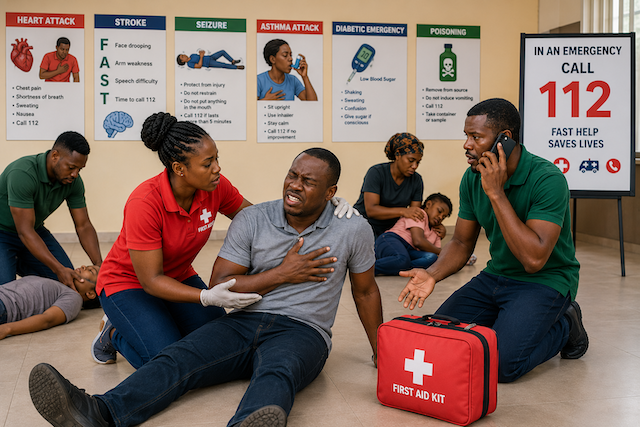
What Is a Medical Emergency?
A medical emergency is a sudden illness or health condition that may threaten a person’s life or cause serious harm if help is delayed.
Common medical emergencies include:
- Heart attack
- Stroke
- Seizures
- Diabetic emergencies
- Asthma attacks
- Fainting
- Shock
- Poisoning
In all medical emergencies, the first aider should stay calm, check the scene for danger, assess the person, call for help early, and give care within their level of training. Current first aid guidance from organisations such as the NHS, British Red Cross, Mayo Clinic, St John Ambulance, and Resuscitation Council UK all emphasise early recognition, early emergency call, and safe first aid support.
General Emergency Response Steps
For any medical emergency, follow these steps:
Step 1: Check for Danger
Make sure the scene is safe before approaching.
Step 2: Check Responsiveness
Ask clearly:
“Are you okay?”
“Can you hear me?”
Step 3: Call for Help
Call emergency services immediately if the person is unconscious, not breathing normally, has chest pain, stroke signs, seizure complications, poisoning, severe breathing difficulty, or signs of shock.
In Nigeria, call 112 where available.
Step 4: Check Airway and Breathing
If the person is unresponsive, open the airway and check breathing.
Step 5: Give Appropriate First Aid
Support the person based on the emergency.
Step 6: Monitor Until Help Arrives
Keep checking breathing, responsiveness, skin colour, pain, and general condition.
Heart Attack
What Is a Heart Attack?
A heart attack happens when blood flow to part of the heart is blocked. This can damage the heart muscle and become life-threatening.
A heart attack should always be treated as an emergency. The American Red Cross notes that symptoms may differ from person to person and may be more subtle in people with some medical conditions, including diabetes.
Common Signs and Symptoms
A person having a heart attack may have:
- Chest pain, pressure, tightness, heaviness, or squeezing
- Pain spreading to the arm, shoulder, neck, jaw, back, or stomach
- Shortness of breath
- Sweating
- Nausea or vomiting
- Dizziness or faintness
- Unusual tiredness or weakness
- Anxiety or feeling of doom
- Pale, cold, or clammy skin
Some people may not have severe chest pain. Symptoms can be mild, unusual, or mistaken for indigestion.
First Aid for Heart Attack
- Help the person sit down and rest.
- Keep them calm and comfortable.
- Loosen tight clothing around the neck or chest.
- Call emergency services immediately.
- Ask if they have prescribed heart medication, such as nitroglycerin, and help them take it only as directed.
- If they are not allergic and local guidance allows, they may chew aspirin, but only if they are conscious, able to swallow, and not advised by a doctor to avoid aspirin.
- Monitor breathing and responsiveness.
- Be ready to start CPR if they become unresponsive and are not breathing normally.
What NOT to Do
Do not:
- Tell the person to walk around.
- Allow them to drive themselves to hospital.
- Give food or drink.
- Ignore mild or unusual symptoms.
- Delay calling emergency services.
- Give medication that was not prescribed for them.
Stroke
What Is a Stroke?
A stroke happens when blood supply to part of the brain is blocked or when bleeding occurs in the brain. Stroke is a medical emergency because fast treatment can reduce brain damage and improve recovery.
Remember FAST
Use FAST to recognise possible stroke:
| Letter | Meaning | What to Check |
|---|---|---|
| F | Face | Is one side of the face drooping? |
| A | Arms | Can the person raise both arms? Is one arm weak? |
| S | Speech | Is speech slurred, confused, or strange? |
| T | Time | Time to call emergency services immediately |
Other Stroke Signs
The person may also have:
- Sudden weakness or numbness, especially on one side of the body
- Sudden confusion
- Trouble speaking or understanding speech
- Sudden trouble seeing
- Sudden dizziness or loss of balance
- Sudden severe headache
- Collapse or reduced consciousness
First Aid for Stroke
- Call emergency services immediately.
- Help the person sit or lie in a safe, comfortable position.
- Keep the head and shoulders slightly raised if possible.
- Reassure them calmly.
- Note the time symptoms started or when the person was last known to be well.
- Do not give food, drink, or medication.
- Monitor breathing and responsiveness.
- If they become unresponsive but are breathing normally, place them in the recovery position.
- If they stop breathing normally, start CPR.
The NHS first aid guidance identifies stroke as an emergency requiring urgent help.
What NOT to Do
Do not:
- Wait to see if symptoms disappear.
- Give food or drink.
- Give aspirin unless instructed by medical professionals.
- Allow the person to sleep without monitoring.
- Move them unnecessarily.
- Delay because symptoms seem mild.
Seizures: Epilepsy
What Is a Seizure?
A seizure happens when there is a sudden burst of abnormal electrical activity in the brain. Epilepsy is a condition that can cause repeated seizures, but seizures may also happen because of fever, head injury, low blood sugar, poisoning, alcohol withdrawal, or other medical conditions.
Common Signs and Symptoms
A person having a seizure may:
- Fall suddenly
- Lose consciousness
- Shake or jerk uncontrollably
- Stiffen
- Make unusual sounds
- Drool or foam at the mouth
- Bite the tongue
- Lose bladder control
- Become confused or sleepy afterward
- Stare blankly or become briefly unaware of surroundings
First Aid for a Seizure
- Stay calm.
- Protect the person from injury.
- Move dangerous objects away.
- Cushion the head with folded clothing or a soft item.
- Loosen tight clothing around the neck.
- Time the seizure.
- Do not restrain the person.
- Do not put anything in their mouth.
- After the seizure stops, check breathing.
- Place them in the recovery position if they are unresponsive but breathing normally.
- Stay with them until they recover or help arrives.
The British Red Cross provides first aid guidance for epileptic seizures and emphasises keeping the person safe, not restraining them, and not putting anything in their mouth.
Call Emergency Services If:
- The seizure lasts longer than 5 minutes.
- Another seizure starts soon after the first.
- The person is injured.
- The person has difficulty breathing after the seizure.
- The person is pregnant.
- The person has diabetes.
- The seizure happens in water.
- It is the person’s first known seizure.
- The person does not regain consciousness.
- You are unsure what to do.
What NOT to Do
Do not:
- Hold the person down.
- Put a spoon, cloth, finger, or any object in the mouth.
- Give food, drink, or medicine during the seizure.
- Move the person unless they are in danger.
- Leave them alone immediately after the seizure.
Diabetic Emergencies
What Is a Diabetic Emergency?
A diabetic emergency happens when a person’s blood sugar becomes too low or too high. The most urgent first aid situation is usually low blood sugar, also called hypoglycaemia, because it can quickly lead to confusion, collapse, seizure, or unconsciousness.
Low Blood Sugar: Hypoglycaemia
Common Signs and Symptoms
The person may have:
- Hunger
- Sweating
- Shaking
- Weakness
- Dizziness
- Headache
- Irritability or confusion
- Fast heartbeat
- Pale, clammy skin
- Blurred vision
- Behaviour that looks like drunkenness
- Collapse or seizure in severe cases
First Aid for Low Blood Sugar
If the person is conscious and able to swallow:
- Help them sit down.
- Give a fast-acting sugar drink or food.
- Suitable options include glucose tablets, fruit juice, regular soft drink, sugar dissolved in water, or sweets.
- Wait about 10 to 15 minutes.
- If they improve, give a longer-lasting carbohydrate such as bread, biscuits, rice, or a meal.
- Advise medical review if needed.
The British Red Cross includes diabetic emergency as a first aid skill and recommends helping the person take something sugary when they are alert and able to swallow.
If the Person Is Unconscious or Cannot Swallow
- Do not give food or drink.
- Call emergency services immediately.
- Place them in the recovery position if breathing normally.
- Monitor breathing.
- Start CPR if they stop breathing normally.
High Blood Sugar: Hyperglycaemia
High blood sugar may develop more slowly and can also be serious.
Signs may include:
- Extreme thirst
- Frequent urination
- Dry mouth
- Weakness
- Nausea or vomiting
- Fruity-smelling breath
- Deep or laboured breathing
- Confusion
- Drowsiness
If unsure whether the emergency is low or high blood sugar, and the person is conscious and able to swallow, giving sugar is usually the safer first aid option because untreated low blood sugar can worsen quickly.
What NOT to Do
Do not:
- Give food or drink to an unconscious person.
- Give insulin unless you are trained, authorised, and it belongs to the person.
- Ignore confusion or abnormal behaviour.
- Leave the person alone.
- Delay emergency help if they do not improve.
Asthma Attack
What Is an Asthma Attack?
An asthma attack happens when the airways become narrow, swollen, and filled with mucus, making breathing difficult.
A severe asthma attack can become life-threatening.
Common Signs and Symptoms
A person having an asthma attack may have:
- Difficulty breathing
- Wheezing
- Coughing
- Tightness in the chest
- Difficulty speaking full sentences
- Anxiety or panic
- Fast breathing
- Blue or grey lips or fingertips in severe cases
- Exhaustion
- Little or no improvement after using an inhaler
First Aid for Asthma Attack
- Help the person sit upright.
- Keep them calm.
- Help them use their reliever inhaler, usually blue, if they have one.
- Encourage slow, steady breathing.
- Loosen tight clothing.
- Call emergency services if symptoms are severe or not improving.
- Continue to support and monitor them.
British Red Cross first aid guidance includes asthma attack care and emphasises helping the person sit upright and use their inhaler.
Call Emergency Services Immediately If:
- The person is struggling to breathe.
- They cannot speak in full sentences.
- Their lips or fingertips become blue or grey.
- The inhaler is not helping.
- They become exhausted, drowsy, or confused.
- They collapse.
- You are worried.
What NOT to Do
Do not:
- Make the person lie flat.
- Tell them to “calm down” without helping.
- Delay calling emergency help if symptoms are severe.
- Give someone else’s medication unless directed by emergency professionals or local protocol.
- Leave them alone.
Fainting
What Is Fainting?
Fainting is a brief loss of consciousness caused by reduced blood flow to the brain. A person may recover quickly, but fainting should still be taken seriously, especially if it happens suddenly, repeatedly, during exercise, or with chest pain or injury.
Mayo Clinic explains that fainting may be harmless or may be caused by a serious condition, so loss of consciousness should be treated as a medical emergency until the person recovers and the cause is known.
Common Signs Before Fainting
A person may feel:
- Dizzy
- Weak
- Light-headed
- Nauseous
- Sweaty
- Warm
- Blurred vision
- Ringing in the ears
- Pale or clammy
First Aid for Fainting
If the person feels faint but is still conscious:
- Help them lie down.
- Raise their legs slightly if there is no injury.
- Loosen tight clothing.
- Keep the area cool and well ventilated.
- Reassure them.
- Do not let them stand up quickly.
If the person has fainted:
- Check responsiveness and breathing.
- If breathing normally, keep them lying down.
- Raise the legs slightly if safe.
- Monitor them closely.
- If they do not recover quickly, call emergency services.
- If unresponsive but breathing normally, place them in the recovery position.
- If not breathing normally, start CPR.
What NOT to Do
Do not:
- Slap, shake, or pour water on the person.
- Force them to stand or walk immediately.
- Give food or drink while they are not fully alert.
- Ignore injuries from a fall.
- Assume it is minor if fainting happens repeatedly.
Shock
What Is Shock?
Shock is a life-threatening condition where the body’s organs do not receive enough blood and oxygen. It can happen after severe bleeding, burns, major injury, allergic reaction, dehydration, heart problems, infection, or poisoning.
Mayo Clinic describes shock as a sudden drop in blood flow that can lead to organ damage or death if not treated.
Common Signs and Symptoms
A person in shock may have:
- Pale, cold, clammy skin
- Fast, weak pulse
- Rapid breathing
- Weakness or dizziness
- Confusion or restlessness
- Nausea or vomiting
- Thirst
- Blue or grey lips or fingers
- Collapse or unconsciousness
First Aid for Shock
- Call emergency services immediately.
- Treat the cause if possible, such as controlling bleeding.
- Help the person lie down.
- Raise the legs slightly if there is no injury and it does not cause pain.
- Keep them warm with a blanket or clothing.
- Loosen tight clothing.
- Do not give food or drink.
- Monitor breathing and responsiveness.
- If they become unresponsive but are breathing normally, place them in the recovery position.
- If they stop breathing normally, start CPR.
What NOT to Do
Do not:
- Give food, drink, or alcohol.
- Let the person stand or walk.
- Raise the legs if you suspect head, chest, abdominal, pelvic, leg, or spinal injury.
- Overheat the person.
- Delay emergency help.
- Focus only on visible injuries and ignore signs of shock.
Poisoning
What Is Poisoning?
Poisoning happens when a harmful substance enters the body through swallowing, breathing, injection, skin contact, or eye contact.
Possible poisons include:
- Household cleaning chemicals
- Pesticides
- Medicines
- Alcohol or drugs
- Carbon monoxide
- Contaminated food
- Poisonous plants
- Snake or insect venom
- Industrial chemicals
Poisoning can mimic other emergencies such as stroke, seizure, alcohol intoxication, or diabetic emergencies. Mayo Clinic lists possible symptoms including burns around the mouth, chemical-smelling breath, vomiting, difficulty breathing, drowsiness, confusion, or altered mental state.
Common Signs and Symptoms
The person may have:
- Nausea or vomiting
- Stomach pain
- Burns or stains around the mouth
- Chemical smell on breath or clothing
- Difficulty breathing
- Coughing or choking
- Drowsiness
- Confusion
- Seizures
- Headache or dizziness
- Skin irritation or burns
- Collapse
First Aid for Poisoning
- Check the scene for danger.
- Do not expose yourself to fumes, chemicals, or contaminated materials.
- Call emergency services immediately.
- If safe, move the person away from the source of poison.
- If poison is on the skin, remove contaminated clothing and rinse the skin with clean running water.
- If poison is in the eyes, rinse gently with clean water.
- If poison was swallowed, do not force vomiting.
- Keep the container, label, plant, medicine pack, or chemical sample for medical responders.
- Monitor breathing and responsiveness.
- If unconscious but breathing normally, place the person in the recovery position.
- If not breathing normally, start CPR.
What NOT to Do
Do not:
- Make the person vomit unless instructed by medical professionals.
- Give food, drink, milk, palm oil, alcohol, or herbal mixtures.
- Smell chemical containers closely.
- Enter a toxic environment without proper protection.
- Delay calling emergency services.
- Throw away the container or label.
- Give CPR mouth-to-mouth if poison is around the mouth; use a barrier device if trained.
Real-Life Scenario
During a training programme, a participant suddenly complains of chest tightness and pain spreading to the left arm. He is sweating and looks anxious.
The correct response is to:
- Stop the activity immediately.
- Help him sit down comfortably.
- Reassure him.
- Call emergency services.
- Ask if he has prescribed heart medication.
- Monitor breathing and responsiveness.
- Prepare to start CPR if he becomes unresponsive and stops breathing normally.
This is better than asking him to “rest small” or allowing him to walk around.
General What NOT to Do in Medical Emergencies
A first aider should not:
- Panic or abandon the casualty.
- Delay calling emergency services.
- Give food or drink to an unconscious or seriously ill person.
- Give prescription medication that is not the person’s own.
- Move the person unnecessarily.
- Ignore mild symptoms that may be serious.
- Allow crowding around the casualty.
- Take photos or videos.
- Try to diagnose the condition instead of giving safe first aid.
13. When to Call Emergency Services Immediately
Call emergency services immediately if the person:
- Is unconscious or not responding.
- Is not breathing normally.
- Has chest pain or suspected heart attack.
- Has signs of stroke.
- Has a seizure lasting more than 5 minutes.
- Has repeated seizures.
- Has severe breathing difficulty.
- Has suspected poisoning.
- Shows signs of shock.
- Has blue or grey lips or fingers.
- Has sudden confusion or weakness.
- Collapses suddenly.
- Gets worse or you are unsure what to do.
Quick Recap
Medical emergencies can become life-threatening quickly. The first aider’s role is to recognise warning signs, call for help early, keep the person safe, give simple first aid, and monitor them until professional help arrives. For heart attack, stroke, seizure, diabetic emergency, asthma attack, fainting, shock, and poisoning, quick action can save a life.