
Lifting Equipment and Accessories
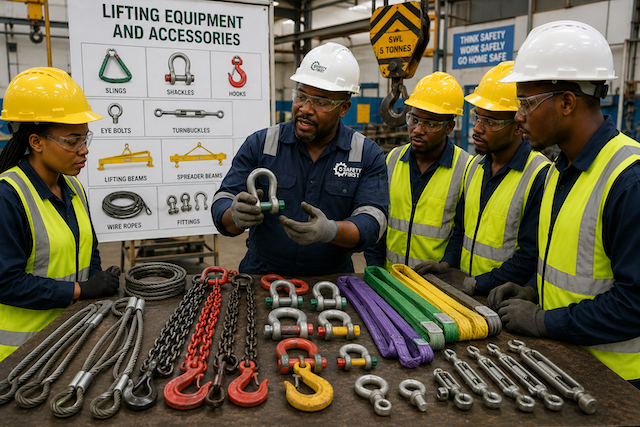
Introduction to Lifting Equipment and Accessories
Lifting equipment and accessories are the tools used to connect, support, secure, lift, lower, and move loads safely.
In rigging and lifting, every component matters. A lifting operation is only as strong as its weakest part. If one sling, shackle, hook, eye bolt, or wire rope fails, the entire load can drop.
Common lifting accessories include:
- Slings
- Shackles
- Hooks
- Eye bolts
- Turnbuckles
- Lifting beams
- Spreader beams
- Wire ropes
- Fittings and connectors
Before using any lifting accessory, a rigger must confirm that it is suitable for the load, properly rated, correctly inspected, and free from defects. OSHA requires rigging equipment for material handling to be inspected before use on each shift and removed from service if defective.
Basic Rules for Selecting Lifting Accessories
Before choosing any lifting gear, ask these questions:
- What is the weight of the load?
- Where is the centre of gravity?
- What lifting points are available?
- What type of load is being lifted?
- Are there sharp edges?
- Is the load hot, oily, wet, fragile, or unstable?
- What is the lifting angle?
- What is the Working Load Limit?
- Has the equipment been inspected?
- Is the equipment suitable for the environment?
Never select lifting gear by appearance alone. Always check the marking, tag, certificate, manufacturer guidance, and condition of the equipment.
Types of Slings
A sling is a lifting accessory used to connect the load to the hook of a crane, hoist, or other lifting device.
The three common types of slings are:
- Wire rope slings
- Chain slings
- Synthetic webbing slings
Each type has advantages, limitations, and inspection requirements. OSHA’s sling-use guidance explains that sling selection, use, and maintenance are important for reducing injuries and fatalities related to improper sling use.
4. Wire Rope Slings
What Are Wire Rope Slings?
Wire rope slings are made from strands of steel wire twisted around a core. They are strong, flexible, and commonly used in construction, oil and gas, marine, industrial lifting, and heavy equipment handling.
Common Uses
Wire rope slings are suitable for:
- Heavy loads
- Construction materials
- Steel structures
- Machinery
- Industrial equipment
- Marine lifting
- Rough working environments
Advantages
Wire rope slings are:
- Strong and durable
- More heat-resistant than synthetic slings
- Suitable for rugged environments
- Less likely to stretch than synthetic slings
- Available in different configurations
Limitations
Wire rope slings can be damaged by:
- Kinking
- Crushing
- Broken wires
- Corrosion
- Bird-caging
- Sharp bends
- Shock loading
- Poor storage
Inspection Points
Before use, check for:
- Broken wires
- Kinks
- Flattened areas
- Crushed sections
- Rust or corrosion
- Damaged end fittings
- Missing or unreadable tag
- Distortion or bird-caging
- Heat damage
- Excessive wear
Remove from Service If:
- The sling has no identification tag.
- There are excessive broken wires.
- The rope is kinked, crushed, or severely distorted.
- There is heavy corrosion.
- End fittings are cracked, bent, or damaged.
- The sling has been shock-loaded or overloaded.
Chain Slings
What Are Chain Slings?
Chain slings are made from high-strength alloy steel chain links. They are commonly used for heavy-duty lifting, especially where loads are hot, abrasive, sharp-edged, or rough.
Only alloy steel chain slings designed and rated for lifting should be used for rigging operations.
Common Uses
Chain slings are suitable for:
- Heavy machinery
- Steel loads
- Hot loads
- Foundry work
- Fabrication yards
- Loads with rough surfaces
- Industrial maintenance
Advantages
Chain slings are:
- Very strong
- Durable
- Heat-resistant
- Adjustable with correct fittings
- Repairable by competent persons
- Good for rugged industrial work
Limitations
Chain slings are heavy and can damage delicate loads. They may also fail if used with damaged links, twisted chains, wrong angles, or improper hooks.
Inspection Points
Before use, check for:
- Stretched links
- Bent links
- Cracked links
- Gouges or cuts
- Excessive wear
- Twisted chain
- Damaged hooks
- Missing identification tag
- Heat damage
- Corrosion
- Damaged master link or connectors
Remove from Service If:
- Any link is cracked, stretched, bent, twisted, or badly worn.
- The tag is missing or unreadable.
- The chain has been overloaded.
- Hooks, master links, or connectors are damaged.
- There is severe corrosion or heat damage.
Synthetic Webbing Slings
What Are Synthetic Webbing Slings?
Synthetic webbing slings are made from materials such as polyester or nylon. They are lightweight, flexible, and useful for lifting loads that need surface protection.
Common Uses
Synthetic webbing slings are suitable for:
- Painted loads
- Finished materials
- Pipes
- Light and medium loads
- Fragile or polished surfaces
- Loads that may be damaged by chain or wire rope
Advantages
Synthetic webbing slings are:
- Lightweight
- Easy to handle
- Flexible
- Less likely to scratch the load
- Useful for delicate materials
- Easy to store and transport
Limitations
Synthetic slings can be damaged by:
- Sharp edges
- Heat
- Chemicals
- Cuts
- Abrasion
- UV exposure
- Welding sparks
- Oil or chemical contamination
Inspection Points
Before use, check for:
- Cuts
- Tears
- Holes
- Abrasion
- Burn marks
- Chemical damage
- Broken stitching
- Knots
- Missing or unreadable tag
- Damaged eyes
- Excessive wear
Remove from Service If:
- The sling is cut, torn, burnt, or chemically damaged.
- Stitching is broken.
- The identification tag is missing.
- The sling has knots.
- There is heavy abrasion.
- The sling has been overloaded.
Important Safety Tip
Never use synthetic webbing slings over sharp edges without proper edge protection.
Choosing the Right Sling
| Sling Type | Best For | Avoid When |
|---|---|---|
| Wire rope sling | Heavy-duty lifting, construction, marine, machinery | Load has delicate surface or tight bends |
| Chain sling | Hot, sharp, heavy, abrasive loads | Load is fragile or easily damaged |
| Synthetic webbing sling | Light/medium loads, delicate surfaces, painted materials | Sharp edges, high heat, chemicals, sparks |
Practical Example
If you are lifting a painted machine part, a synthetic webbing sling may protect the surface better than a chain sling.
If you are lifting hot steel, a chain sling may be more suitable than a synthetic sling.
If you are lifting heavy industrial equipment in a rough environment, a wire rope sling may be appropriate.
Shackles and Their Applications
What Is a Shackle?
A shackle is a metal connector used to join lifting accessories together. It may connect a sling to a lifting point, a sling to a hook, or different rigging components together.
Common types include:
- Bow shackle
- Dee shackle
- Screw pin shackle
- Bolt-type shackle
Shackles are part of the lifting connection system and must be properly rated, inspected, and used correctly.
Bow Shackles
Bow shackles have a larger rounded shape. They are useful where multiple sling legs need to be connected.
Common Uses
- Multi-leg sling connections
- Connecting slings to lifting points
- Wider rigging arrangements
Dee Shackles
Dee shackles are narrower and more suitable for straight-line pulls.
Common Uses
- Single-leg lifting
- Straight-line connections
- Load attachment points
Screw Pin Shackles
Screw pin shackles are easy to install and remove, making them useful for temporary lifting arrangements.
Safety Note
The pin must be properly tightened before use.
Bolt-Type Shackles
Bolt-type shackles use a bolt, nut, and cotter pin. They are more secure for long-term or repeated lifting operations.
Common Uses
- Long-duration lifts
- Repeated lifting operations
- More permanent rigging setups
Shackle Inspection Points
Before use, check for:
- Correct WLL marking
- Correct pin
- Bent body
- Bent or damaged pin
- Cracks
- Worn threads
- Corrosion
- Distortion
- Missing nut or cotter pin
- Signs of overloading
- Pin not fitting properly
Remove from Service If:
- The WLL marking is missing or unreadable.
- The body or pin is bent.
- Threads are damaged.
- There are cracks or severe corrosion.
- The pin is not original or does not fit properly.
- The shackle has been side-loaded outside manufacturer guidance.
Hooks and Safety Latches
What Is a Hook?
A hook is a lifting attachment used to connect lifting gear to a load, sling, chain, or lifting device.
Hooks are used on cranes, hoists, chain blocks, slings, and other lifting systems.
Safety Latch
A safety latch helps prevent the sling or attachment from accidentally coming out of the hook. The latch is not designed to carry the load. It is only a retaining device.
Common Types of Hooks
- Crane hook
- Sling hook
- Grab hook
- Clevis hook
- Self-locking hook
Inspection Points
Before use, check for:
- Cracks
- Bent hook
- Twisted hook
- Worn throat opening
- Missing or damaged safety latch
- Damaged hook tip
- Corrosion
- Heat damage
- Missing marking
- Free movement of swivel where fitted
Remove from Service If:
- The hook is cracked, bent, or twisted.
- The throat opening is stretched.
- The safety latch is missing or not working.
- The hook has been overloaded.
- The hook is badly worn or corroded.
Important Hook Safety Rules
- Never load the tip of the hook.
- Load should sit correctly in the bowl of the hook.
- Do not use a hook with a broken safety latch.
- Do not weld, heat, bend, or modify a hook.
- Do not side-load a hook unless designed for it.
Eye Bolts and Turnbuckles
Eye Bolts
An eye bolt is a bolt with a looped head used as a lifting or securing point.
Eye bolts must be selected carefully because not all eye bolts are designed for lifting. Some are only for light-duty positioning or tie-down use.
Common Types
- Shoulder eye bolt
- Plain eye bolt
- Swivel eye bolt
Uses
Eye bolts may be used to:
- Create a lifting point
- Attach slings to equipment
- Lift machinery parts
- Support controlled load movement
Eye Bolt Safety Rules
- Use only rated lifting eye bolts.
- Ensure the eye bolt is fully threaded into the load.
- Use the correct thread size and depth.
- Avoid side loading unless the eye bolt is designed for angular loading.
- Use shoulder eye bolts for angular lifts where permitted.
- Do not use bent, cracked, or poorly seated eye bolts.
Eye Bolt Inspection Points
Check for:
- Cracks
- Bent eye
- Damaged threads
- Corrosion
- Missing WLL marking
- Poor seating
- Wrong thread engagement
- Signs of overloading
Turnbuckles
A turnbuckle is a device used to adjust tension or length in a rigging system. It usually has a body with threaded end fittings.
Turnbuckles are often used for tensioning, alignment, stabilisation, and securing—not usually as the main lifting point unless specifically rated and approved for that lifting use.
Common End Fittings
- Eye and eye
- Hook and hook
- Jaw and jaw
- Eye and jaw
Uses
Turnbuckles may be used to:
- Adjust tension
- Align loads
- Secure structural components
- Stabilise rigging setups
- Support controlled positioning
Turnbuckle Inspection Points
Check for:
- Bent body
- Damaged threads
- Cracks
- Corrosion
- Missing lock nuts or securing pins
- Wrong end fittings
- Overextension
- Signs of overloading
Safety Rules
- Do not use a turnbuckle beyond its rated capacity.
- Ensure adequate thread engagement.
- Secure lock nuts or pins where required.
- Do not side-load unless designed for it.
- Do not use damaged or modified turnbuckles.
Lifting Beams and Spreader Beams
What Are Lifting Beams and Spreader Beams?
Lifting beams and spreader beams are below-the-hook lifting devices used to improve load control, distribute load forces, and protect the load during lifting.
They are useful when lifting long, wide, flexible, or uneven loads.
Lifting Beam
A lifting beam is usually loaded in bending. It has one or more top lifting points and bottom lifting points for connecting slings or hooks.
Common Uses
- Lifting loads with low headroom
- Lifting loads that need multiple pick points
- Lifting equipment or machinery
- Supporting loads that may bend or deform
Spreader Beam
A spreader beam is usually loaded in compression. It uses slings from the crane hook to both ends of the beam and bottom slings from the beam to the load.
Common Uses
- Lifting long loads
- Reducing sling angles
- Spreading load forces
- Protecting fragile or flexible loads
- Lifting pipes, beams, tanks, and large fabricated items
Difference Between Lifting Beam and Spreader Beam
| Item | Lifting Beam | Spreader Beam |
|---|---|---|
| Main force | Bending | Compression |
| Headroom | Better for low headroom | Requires more headroom |
| Use | Multiple lifting points | Long/wide loads |
| Main benefit | Controlled lift in limited space | Reduces sling angle and load stress |
Inspection Points
Before use, check for:
- Identification plate
- WLL/SWL marking
- Cracks
- Bent structure
- Damaged lifting lugs
- Damaged attachment points
- Corrosion
- Missing bolts or pins
- Deformation
- Expired inspection status
- Incorrect configuration
Safety Rules
- Use only certified lifting or spreader beams.
- Confirm the beam capacity.
- Confirm the correct lifting points.
- Do not modify the beam.
- Do not exceed the rated load.
- Ensure the beam is suitable for the load length and weight.
- Use the correct sling arrangement.
- Follow the manufacturer’s instructions.
HSE notes that safe lifting depends greatly on the continued safety of lifting equipment and accessories, and failures can cause serious or fatal injuries.
Wire Ropes and Fittings
What Is Wire Rope?
Wire rope is made from multiple steel wires twisted into strands, which are then twisted around a core. Wire ropes are used in cranes, hoists, winches, slings, and many lifting systems.
Wire Rope Components
A wire rope includes:
- Individual wires
- Strands
- Core
- Lay direction
- End fittings or terminations
Common Wire Rope Fittings
Common fittings include:
- Thimbles
- Ferrules
- Wire rope clips
- Sockets
- Swage fittings
- Wedge sockets
- Turnback eyes
Wire Rope Inspection Points
Check for:
- Broken wires
- Kinks
- Flattening
- Crushing
- Bird-caging
- Corrosion
- Heat damage
- Reduced diameter
- Damaged end fittings
- Worn areas
- Poor lubrication
- Distortion
- Evidence of shock loading
Wire Rope Safety Rules
- Do not use kinked or crushed wire rope.
- Do not exceed the rated capacity.
- Avoid sharp bends.
- Protect wire rope from sharp edges.
- Store properly to prevent corrosion.
- Do not drag wire rope across rough ground.
- Use correct fittings and terminations.
- Do not use improvised wire rope connections.
General Inspection Checklist for Lifting Accessories
Before any lift, inspect all accessories.
Use this checklist:
| Item | What to Check |
|---|---|
| Identification | Tag, WLL, size, manufacturer marking |
| Condition | Cracks, cuts, corrosion, deformation |
| Fittings | Pins, bolts, nuts, latches, threads |
| Compatibility | Correct size and connection |
| Capacity | Suitable WLL for the load and angle |
| Inspection status | Valid colour code, certificate, or inspection record |
| Cleanliness | Free from oil, mud, chemical contamination |
| Storage condition | No signs of poor storage or damage |
| Suitability | Correct equipment for the task |
If in doubt, do not use the equipment. Report it to the supervisor or competent person.
Colour Coding and Inspection Tags
Many sites use colour coding to show that lifting gear has passed inspection for a period.
Examples may include:
- Monthly colour code
- Quarterly colour code
- Six-monthly inspection colour
- Inspection tag or sticker
Important rule:
Colour coding does not replace pre-use inspection.
Even if equipment has the correct colour code, the rigger must still inspect it before use.
Common Mistakes with Lifting Accessories
Avoid these common unsafe practices:
- Using unmarked lifting gear.
- Using a sling with no tag.
- Using a shackle without checking the pin.
- Mixing incompatible components.
- Exceeding WLL.
- Ignoring sling angle effects.
- Using synthetic slings on sharp edges without protection.
- Tying knots in slings.
- Hammering shackles or hooks into position.
- Loading the tip of a hook.
- Side-loading hooks or shackles incorrectly.
- Using eye bolts for angular lifts when not rated.
- Using damaged wire rope.
- Assuming all accessories are covered by crane inspection.
LOLER guidance treats lifting accessories such as slings, shackles, round slings, and webbing slings as equipment used to connect the load to lifting equipment, meaning they require their own inspection and control system.
Real-Life Scenario
A team is preparing to lift a steel tank. The rigger selects two synthetic webbing slings because they are easy to handle. During the pre-lift check, the rigger notices the tank has sharp metal edges.
The correct action is not to continue immediately.
The rigger should:
- Stop the lift preparation.
- Confirm the load weight.
- Check the sling WLL.
- Use proper edge protection or select a more suitable sling.
- Confirm the sling angle.
- Inspect shackles and lifting points.
- Establish the exclusion zone.
- Proceed only after the lift is safe.
This prevents sling cuts, dropped loads, and serious injury.
What a Rigger Should Never Do
A rigger should never:
- Use damaged or unmarked lifting accessories.
- Use equipment without checking WLL.
- Use lifting accessories beyond their rated capacity.
- Use makeshift or improvised lifting gear.
- Use a hook with a broken safety latch.
- Use a shackle with the wrong pin.
- Use a synthetic sling over sharp edges without protection.
- Tie knots in slings.
- Shorten chains with bolts or unsafe methods.
- Weld or modify lifting accessories.
- Stand under a suspended load.
- Allow unauthorised persons into the lifting zone.
- Ignore inspection findings.
- Use equipment simply because “it worked before.”
Quick Recap
Lifting equipment and accessories are essential parts of every safe rigging operation. Slings, shackles, hooks, eye bolts, turnbuckles, beams, wire ropes, and fittings must be selected correctly, inspected before use, and used within their rated capacity. Defective, unmarked, damaged, or unsuitable lifting gear must never be used. Safe lifting begins with the right equipment in the right condition for the right task.