
Practical Rigging Techniques
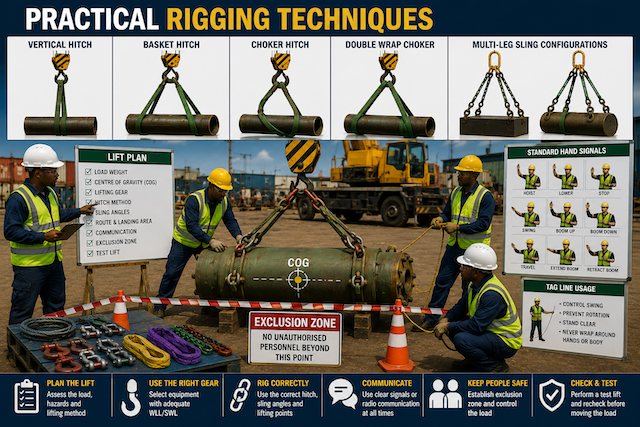
Introduction to Practical Rigging Techniques
Practical rigging techniques are the hands-on methods used to connect lifting gear to a load safely and correctly.
Good rigging is not only about choosing strong equipment. It is about using the equipment properly, controlling the load, protecting the sling, maintaining balance, and preventing movement during lifting.
A safe rigging setup should:
- Match the weight and shape of the load.
- Use suitable lifting points.
- Keep the hook above the centre of gravity.
- Use the correct sling type and hitch method.
- Keep sling angles within safe limits.
- Protect slings from sharp edges.
- Prevent the load from slipping, rotating, or tilting.
- Keep people away from the suspended load.
Before any rigging method is used, the sling, shackle, hook, lifting point, and all accessories must be inspected and suitable for the task. OSHA states that rigging equipment for material handling must be inspected before use on each shift and removed from service if defective.
Correct Slinging Methods
A slinging method is the way a sling is attached to support and lift a load. The method selected depends on the load’s shape, weight, lifting points, centre of gravity, surface condition, and stability.
Common slinging methods include:
- Vertical hitch
- Basket hitch
- Choker hitch
- Double wrap choker hitch
- Bridle hitch
- Multi-leg sling configuration
The correct slinging method should allow the load to lift smoothly, remain balanced, and stay secure throughout the operation.
General Rules for Correct Slinging
Before lifting, always apply these basic rules:
Confirm the Load Weight
Never lift based on guesswork. Use load markings, drawings, documents, weighing records, calculations, or supervisor confirmation.
Identify the Centre of Gravity
The hook should be positioned above the centre of gravity. If the hook is off-centre, the load may tilt or swing.
Select the Right Sling
Choose the sling based on the load type.
| Sling Type | Suitable Use |
|---|---|
| Wire rope sling | Heavy-duty loads, rough industrial environments |
| Chain sling | Hot, sharp, heavy, or abrasive loads |
| Synthetic webbing sling | Delicate, painted, or finished surfaces |
Check the Sling Capacity
Always confirm the sling’s Working Load Limit. Capacity can change depending on the hitch type and sling angle. OSHA sling guidance provides different rated load tables for vertical, choker, and basket hitch arrangements.
Protect the Sling
Use edge protection where there are sharp corners, rough edges, or abrasive surfaces.
Keep the Sling Straight
Do not twist, knot, crush, or bunch the sling. A twisted or knotted sling can lose strength and may fail under load.
Perform a Test Lift
Lift the load slightly and check balance, sling seating, load movement, and stability before continuing.
Vertical Hitch
What Is a Vertical Hitch?
A vertical hitch is a simple rigging method where one sling leg runs directly from the lifting hook to the load.
It is sometimes called a straight lift.
Best Used For
A vertical hitch may be used when:
- The load has a certified single lifting point.
- The load is stable when lifted from one point.
- The load will not rotate uncontrollably.
- The lift is straight and controlled.
- The sling is loaded in line with the lifting point.
Advantages
A vertical hitch is:
- Simple to set up.
- Easy to inspect.
- Useful for straight-line lifting.
- Suitable where the load has one approved lifting point.
- Usually based on the sling’s vertical rated capacity.
Limitations
A vertical hitch provides limited load control. A single vertical sling can allow the load to rotate, especially if the load is not naturally stable. CCOHS notes that a single rope sling load may rotate in a twisting action, and a tag line should be used where needed to control twisting and rotation.
Safety Rules for Vertical Hitch
- Use only with a suitable and rated lifting point.
- Ensure the sling is vertical and not side-loaded.
- Do not use for loose materials.
- Do not use for long or unbalanced loads unless properly controlled.
- Use a tag line where rotation is possible.
- Keep hands away from the load during tensioning.
- Stop if the load begins to spin or tilt.
Basket Hitch
What Is a Basket Hitch?
A basket hitch is a sling arrangement where the sling passes underneath the load and both ends are connected to the hook or lifting device.
The load is supported from below, like sitting in a basket.
Best Used For
A basket hitch may be used for:
- Balanced loads
- Cylindrical loads
- Bundled materials when properly secured
- Loads that can be supported underneath
- Loads with smooth, stable support surfaces
- Loads where wider support is needed
Advantages
A basket hitch:
- Provides better load support than a single vertical hitch.
- Can improve stability when correctly applied.
- Can reduce the tendency of the load to twist compared with a single vertical hitch.
- Distributes contact over a wider area.
CCOHS states that basket hitches provide relatively good control and help eliminate the tendency of the load to twist compared with a vertical hitch.
Limitations
A basket hitch can be unsafe if the load is difficult to balance or can slide out of the sling.
Safety Rules for Basket Hitch
- Ensure the load is properly balanced in the sling.
- Keep both sling legs equal where required.
- Prevent the sling from sliding along the load.
- Use edge protection on sharp corners.
- Confirm the sling angle and capacity.
- Do not use a basket hitch if the load can slip out.
- Do not allow sling legs to cross, twist, or bunch.
- Keep the load level during the lift.
Important Capacity Note
A basket hitch may increase lifting capacity only when the sling legs are vertical or near vertical and the load is properly seated. As sling angles reduce, the capacity is reduced because sling tension increases. Always follow the manufacturer’s load chart.
Choker Hitch
What Is a Choker Hitch?
A choker hitch is a sling arrangement where the sling wraps around the load and one end passes through the other, tightening around the load as tension is applied.
It is called a choker because the sling grips the load.
Best Used For
A choker hitch may be used for:
- Pipes
- Bars
- Timbers
- Bundled materials
- Irregular loads
- Loads that need gripping action
- Loads where a basket hitch may not control movement properly
Advantages
A choker hitch:
- Helps grip the load.
- Reduces the chance of the load slipping.
- Can be useful for round or irregular loads.
- Provides better control than a single vertical hitch in some situations.
Limitations
A choker hitch reduces sling capacity. It can also damage the sling or load if applied incorrectly.
OSHA sling tables note that choker hitch ratings depend on specific conditions, including choke angle. CCOHS also explains that the choker hitch should be pulled tight before the lift and not pulled down during the lift.
Safety Rules for Choker Hitch
- Pull the choke tight before lifting.
- Position the choke point correctly.
- Do not force the choke down during lifting.
- Do not use on fragile loads that can be crushed.
- Avoid choking over sharp edges without protection.
- Do not twist or knot the sling.
- Check the reduced sling capacity for choker use.
- Ensure the load cannot slide out.
- Do not use a choker hitch where the load needs full surface protection.
Double Wrap Choker Hitch
A double wrap choker hitch wraps around the load more than once before choking. It provides more contact area and better control than a single choker.
It is useful for loads that may slip, such as pipes, bundles, or smooth materials.
Safety rules still apply: confirm the sling capacity, avoid sharp edges, and make sure the load is stable before lifting.
Multi-Leg Sling Configurations
What Is a Multi-Leg Sling Configuration?
A multi-leg sling configuration uses two, three, or four sling legs connected to the load at different lifting points.
It is commonly used for large, heavy, irregular, or uneven loads.
Common Types
| Configuration | Description |
|---|---|
| Two-leg sling | Two sling legs attached to two lifting points |
| Three-leg sling | Three sling legs attached to three lifting points |
| Four-leg sling | Four sling legs attached to four lifting points |
| Bridle sling | Multi-leg sling connected to a master link at the hook |
Best Used For
Multi-leg slings are useful for:
- Loads with multiple lifting points
- Large machinery
- Fabricated structures
- Skids and frames
- Loads that require better balance
- Loads with uneven weight distribution
Important Safety Point
Do not assume all sling legs carry equal weight.
If the load is uneven, the sling lengths are unequal, or the centre of gravity is off-centre, one or two legs may carry most of the load. This can overload the sling even when the total load appears to be within capacity.
Safety Rules for Multi-Leg Slings
- Confirm all lifting points are rated.
- Keep the hook above the centre of gravity.
- Use matching sling lengths where required.
- Check sling angles.
- Confirm the capacity of the sling assembly.
- Avoid very low sling angles.
- Protect slings from sharp edges.
- Do not allow one leg to become slack.
- Do not assume four legs share the load equally.
- Perform a test lift before full movement.
Sling Angle Warning
As the sling angle reduces, the tension in each sling leg increases. Low sling angles can overload the sling legs and lifting points.
Where the angle is too low, use a spreader beam, lifting beam, or alternative rigging arrangement.
Balancing Uneven Loads
What Is an Uneven Load?
An uneven load is a load where the weight is not equally distributed.
Examples include:
- A machine with a heavy motor on one side
- A tank with liquid inside
- A steel frame with extra attachments on one end
- A container with unknown contents
- A long load with different materials attached
- Equipment with an off-centre centre of gravity
Why Uneven Loads Are Dangerous
Uneven loads may:
- Tilt suddenly
- Rotate during lifting
- Overload one sling leg
- Slip out of the sling
- Strike nearby workers or objects
- Become difficult to land safely
- Damage lifting points or equipment
How to Balance an Uneven Load
1. Identify the Heavy Side
Look for motors, gearboxes, attachments, liquid, dense materials, or thick sections.
2. Locate the Centre of Gravity
The centre of gravity will usually be closer to the heavier side.
3. Position the Hook Above the Centre of Gravity
The load will try to hang directly below the hook. If the hook is not above the COG, the load will tilt.
4. Adjust Sling Lengths or Lifting Points
Use suitable lifting points and sling lengths to help balance the load.
5. Use a Lifting Beam or Spreader Beam Where Needed
Beams can help distribute forces and improve control.
6. Conduct a Test Lift
Lift only a few centimetres. Check if the load is level, secure, and stable.
7. Lower and Adjust If Needed
If the load tilts, lower it immediately. Do not try to “manage it in the air.”
Practical Rule
If a load tilts during the test lift, the rigging is not correct. Lower the load, reassess, and adjust the setup.
Practical Load Securing
What Is Load Securing?
Load securing means making sure the load remains stable, controlled, and attached throughout the lifting operation.
A properly secured load should not:
- Slip
- Roll
- Rotate unexpectedly
- Break apart
- Slide out of the sling
- Shift internally
- Drop loose materials
- Damage the sling
Load Securing Methods
Depending on the load, securing may involve:
- Correct hitch selection
- Multiple sling legs
- Tag lines
- Edge protection
- Blocking or packing
- Lashing loose parts
- Using certified lifting points
- Using lifting beams or spreader beams
- Removing loose materials before lifting
- Securing doors, lids, covers, or attachments
Securing Loose or Bundled Loads
Loose or bundled loads such as pipes, rods, timber, and scaffolding materials require special care.
Before lifting:
- Bundle the materials properly.
- Use a hitch that prevents slipping.
- Consider double wrap choker where appropriate.
- Use suitable packing or spacers.
- Do not lift loose materials that can fall out.
- Keep people away from the load path.
Securing Loads With Sharp Edges
Sharp edges can cut synthetic slings and damage wire rope slings.
Use:
- Edge protectors
- Wear sleeves
- Corner pads
- Packing material
- Alternative sling type where required
Securing Loads With Moving Parts
Machinery and equipment may have parts that move during lifting.
Before lifting:
- Secure loose panels.
- Close and secure doors.
- Lock or tie moving arms.
- Drain liquids if required.
- Remove unsecured attachments.
- Confirm internal parts cannot shift.
Choosing the Right Hitch
Use the table below as a basic guide.
| Load Type | Possible Hitch Method | Key Safety Concern |
|---|---|---|
| Load with one rated lifting point | Vertical hitch | Rotation and stability |
| Balanced box or crate | Basket hitch | Load sliding out |
| Pipe or round load | Choker or double wrap choker | Reduced capacity and slipping |
| Long steel beam | Two-leg sling or spreader beam | Sling angle and balance |
| Heavy machine | Multi-leg sling | Centre of gravity and lifting points |
| Fragile painted load | Synthetic sling with protection | Surface damage and sharp edges |
| Uneven equipment | Adjustable multi-leg sling | One sling leg overloaded |
| Bundle of materials | Double wrap choker or approved method | Loose items falling |
This table is only a guide. Always follow the lift plan, manufacturer information, site procedure, and competent supervision.
Pre-Lift Slinging Checklist
Before lifting, confirm the following:
| Check | Yes / No |
|---|---|
| Load weight is known | |
| Centre of gravity is identified | |
| Correct sling type is selected | |
| Sling WLL is suitable | |
| Hitch method is suitable | |
| Sling angle is acceptable | |
| Shackles and hooks are rated | |
| Lifting points are approved | |
| Slings are protected from sharp edges | |
| Load is secured against slipping | |
| Loose parts are removed or secured | |
| Tag lines are fitted if required | |
| Exclusion zone is established | |
| Communication is clear | |
| Test lift is completed |
If any answer is “No,” stop and correct the issue before continuing.
Real-Life Scenario
A team needs to lift a bundle of steel pipes. The pipes are smooth and may slide if lifted with a simple basket hitch. One worker suggests using a single sling to save time.
The correct approach is to stop and reassess.
A safer method may include:
- Confirming the weight of the pipe bundle.
- Checking the sling and shackle capacity.
- Using a hitch that provides better grip, such as a suitable choker or double wrap choker arrangement.
- Ensuring the bundle is properly secured.
- Protecting the sling from sharp or rough edges.
- Using tag lines for control.
- Establishing an exclusion zone.
- Performing a test lift.
- Lowering and adjusting if the bundle shifts.
The goal is not just to lift the load, but to lift it without slipping, rotating, or dropping materials.
Common Rigging Technique Mistakes
Avoid these unsafe practices:
- Using the wrong hitch for the load.
- Lifting with an unknown load weight.
- Ignoring the centre of gravity.
- Using a vertical hitch on a load that can rotate.
- Using a basket hitch on a load that can slide out.
- Forgetting that choker hitch reduces sling capacity.
- Using synthetic slings on sharp edges without protection.
- Twisting, knotting, or bunching slings.
- Allowing sling legs to cross incorrectly.
- Using low sling angles without checking capacity.
- Assuming all legs in a multi-leg sling share weight equally.
- Lifting loose bundles without securing them.
- Trying to correct a badly balanced load while it is suspended.
- Standing near pinch points during tensioning.
- Continuing a lift after the load tilts during the test lift.
What a Rigger Should Never Do
A rigger should never:
- Stand under a suspended load.
- Allow others to stand under the load.
- Use damaged, unmarked, or unsuitable slings.
- Use a sling with a missing tag.
- Tie knots in slings.
- Shorten slings with bolts or makeshift methods.
- Hammer shackles or hooks into position.
- Load the tip of a hook.
- Place fingers between sling and load during tensioning.
- Use a choker hitch without checking reduced capacity.
- Use a basket hitch if the load can slide out.
- Lift an unstable load without correcting the rigging.
- Use a multi-leg sling without checking sling angles.
- Lift loose materials that can fall.
- Ignore sling protection on sharp edges.
Quick Recap
Practical rigging techniques focus on attaching and securing loads correctly. Vertical hitches are simple but offer limited control. Basket hitches support loads from below but require good balance. Choker hitches grip loads but reduce sling capacity. Multi-leg sling configurations improve control but require careful attention to sling angles, load sharing, and centre of gravity. A safe rigger always confirms the load weight, selects the correct hitch, protects the sling, secures the load, performs a test lift, and stops immediately if the load is unstable.