
Safety in Lifting Operations
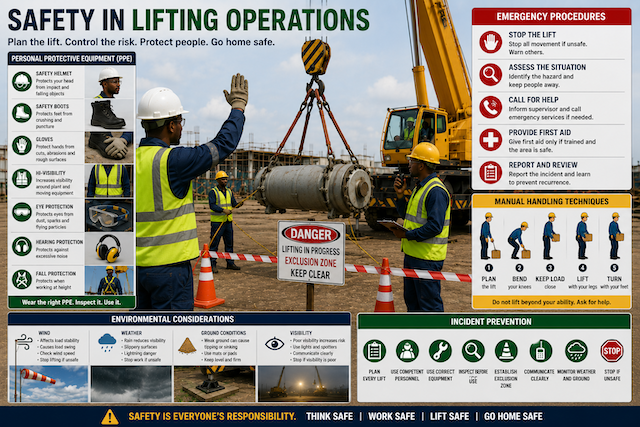
Introduction to Safety in Lifting Operations
Safety in lifting operations means controlling the risks that can cause injury, equipment damage, dropped loads, crane instability, collision, or fatal accidents.
Every lifting operation must be planned, supervised, and carried out safely by competent people. Lifting equipment and accessories must also be strong enough, inspected, examined, and suitable for the task.
A safe lifting operation depends on:
- Proper planning
- Correct lifting equipment
- Competent workers
- Clear communication
- Suitable PPE
- Safe manual handling
- Good environmental assessment
- Emergency readiness
- Strong incident prevention habits
Safety is not something added after the lift starts. It begins before the load is attached.
Personal Protective Equipment: PPE
Personal Protective Equipment, or PPE, protects workers from hazards that may occur during lifting operations. PPE does not remove the hazard, but it helps reduce the risk of injury when used correctly.
Common PPE for lifting operations includes:
| PPE | Purpose |
|---|---|
| Safety helmet | Protects the head from falling objects, bumps, and impact |
| Safety boots | Protects the feet from dropped objects, sharp materials, and crushing injuries |
| High-visibility vest or coverall | Makes workers visible to crane operators, vehicle drivers, and other workers |
| Hand gloves | Protects the hands from cuts, abrasions, wire rope strands, and rough surfaces |
| Eye protection | Protects the eyes from dust, flying particles, sparks, or chemical splash |
| Hearing protection | Protects hearing in noisy work environments |
| Coverall or workwear | Protects the body from dirt, sharp surfaces, and minor contact injuries |
| Fall protection | Protects workers when working at height |
| Respiratory protection | Used where dust, fumes, or hazardous atmosphere may be present |
PPE must be suitable for the task, properly worn, and kept in good condition.
PPE Safety Rules
Workers involved in lifting operations should:
- Wear the required PPE before entering the lifting area.
- Use safety helmets with chin straps where required by site procedure.
- Wear gloves suitable for rigging work.
- Avoid loose clothing, jewellery, or items that may get caught in equipment.
- Wear high-visibility clothing when working around cranes, vehicles, or moving loads.
- Use eye protection when handling wire ropes, cutting bands, or working near dust or sparks.
- Replace damaged PPE immediately.
- Keep PPE clean and fit for use.
- Follow site-specific PPE requirements.
PPE should never be treated as the only safety control. Safe planning, competent rigging, good communication, and exclusion zones are more important than relying only on PPE.
Emergency Procedures
Emergency procedures are the planned actions workers must take when something goes wrong during a lifting operation.
Possible emergencies include:
- Dropped load
- Sling failure
- Crane instability
- Load swing
- Worker injury
- Person trapped or crushed
- Equipment failure
- Contact with power lines
- Fire or explosion
- Severe weather
- Loss of communication
- Collision with a structure or vehicle
Every worker involved in lifting operations should know what to do before the lift begins.
Basic Emergency Response During Lifting
If an emergency occurs:
- Stop the lift immediately if safe to do so.
- Warn everyone nearby.
- Keep people away from the load and danger zone.
- Do not rush toward a suspended or unstable load.
- Lower the load only if it is safe and controlled.
- Do not touch equipment that may be electrically energised.
- Report the emergency to the supervisor or lift coordinator.
- Call emergency services where required.
- Provide first aid only when the area is safe.
- Preserve the scene for investigation if required.
- Do not restart the lift until authorised.
If communication is lost, unclear, or conflicting, the lifting operation should stop immediately.
Power Line Emergency
Contact with overhead power lines is one of the most dangerous crane-related emergencies. Electricity may pass through the crane, load, rigging gear, tag line, and the ground.
OSHA requires the work zone to be assessed to determine whether any part of the equipment, load line, or load could come closer than the permitted minimum approach distance to a power line.
If a crane or load contacts a power line:
- Do not touch the crane, load, rope, or rigging gear.
- Do not approach the equipment.
- Warn others to stay away.
- The operator should remain in the cab if safe.
- Call emergency services and the power company.
- Treat the area around the crane as dangerous.
- Only trained emergency responders or authorised electrical personnel should manage the situation.
Never assume a power line is safe because it looks insulated or inactive.
Manual Handling Techniques
Manual handling means lifting, carrying, pushing, pulling, lowering, or moving items by hand or body force.
In lifting operations, manual handling may happen when workers move slings, shackles, hooks, beams, tag lines, packing materials, tools, and smaller loads.
Poor manual handling can cause:
- Back injury
- Shoulder strain
- Hand injury
- Foot injury
- Muscle strain
- Crush injury
- Slips and falls
- Pinch-point injuries
Safe Manual Handling Principles
Before handling any item manually, assess the task.
Ask:
- Is the item too heavy for one person?
- Is mechanical assistance available?
- Is the route clear?
- Is the ground dry and stable?
- Are there sharp edges?
- Can the item be gripped safely?
- Is help needed?
- Is the item awkward, long, unstable, or hot?
- Is PPE required?
Correct Manual Lifting Technique
When lifting manually:
- Stand close to the item.
- Place feet apart for balance.
- Bend the knees, not the back.
- Keep the back as straight as possible.
- Grip the item firmly.
- Keep the load close to the body.
- Lift smoothly without jerking.
- Avoid twisting while carrying.
- Turn with the feet, not the waist.
- Lower the load carefully.
- Ask for help if the item is heavy or awkward.
Manual Handling in Rigging Work
Rigging work often involves heavy accessories. Chain slings, wire rope slings, shackles, hooks, and lifting beams can cause injury if handled carelessly.
Safe practices include:
- Use mechanical assistance for heavy rigging gear.
- Use team lifting where appropriate.
- Store gear at a comfortable height where possible.
- Avoid dragging wire ropes or slings across rough ground.
- Keep fingers away from pinch points.
- Do not place hands between the sling and load during tensioning.
- Use tag lines instead of hands to control suspended loads.
- Wear suitable gloves when handling wire rope or chain.
- Keep the work area clean to prevent trips.
Manual handling should not be rushed. Many injuries happen before the crane even starts lifting.
Environmental Considerations: Wind, Weather, Ground Conditions
The environment can seriously affect lifting operations. A lift that is safe in calm, dry, level conditions may become unsafe during wind, rain, poor visibility, unstable ground, or lightning.
Environmental conditions must be assessed before and during the lift.
Wind
Wind can push the crane boom, the load, the rigging gear, and tag lines. Large, flat, wide, or lightweight loads are especially affected because they have more surface area for the wind to act on.
Wind can cause:
- Load swing
- Load rotation
- Poor tag line control
- Increased crane loading
- Loss of balance
- Collision with structures
- Difficulty landing the load
- Unsafe conditions for workers
Wind planning should consider crane characteristics, load shape, projected surface area, weather forecasts, gusts, and control measures. Recent lifting-operation guidance on wind notes that wind acts on both the crane structure and the load, and planning should ensure the crane is made safe before wind conditions exceed in-service limits.
Wind Safety Rules
- Check weather conditions before lifting.
- Follow the crane manufacturer’s wind limits.
- Consider gusts, not only average wind speed.
- Be extra careful with large surface-area loads.
- Use tag lines only when they can be controlled safely.
- Stop the lift if the load becomes difficult to control.
- Do not continue because of schedule pressure.
- Secure the crane and load if weather worsens.
Rain and Wet Conditions
Rain can affect lifting operations by reducing visibility, making surfaces slippery, weakening ground conditions, and increasing the risk of slips and falls.
Rain may also affect:
- Sling grip
- Load surface condition
- Electrical safety
- Ground bearing capacity
- Access routes
- Visibility of signals
- Worker footing
Safe practices include:
- Slow down work activities.
- Improve visibility where possible.
- Keep walking areas clear.
- Check for slippery surfaces.
- Reassess ground condition.
- Use radios if hand signals are hard to see.
- Stop lifting during unsafe rain, storm, or lightning conditions.
Lightning and Storms
Crane booms and lifting equipment can create serious lightning risk because of their height and metal structure.
If lightning is present or approaching:
- Stop lifting operations.
- Lower or secure the load if safe.
- Move workers to a safe shelter.
- Stay away from cranes, loads, rigging gear, and open areas.
- Resume work only when it is safe according to site procedure.
Poor Visibility
Poor visibility can come from darkness, dust, fog, smoke, rain, glare, or poor lighting.
Poor visibility increases the risk of:
- Wrong signals
- Collision
- Poor load control
- People entering danger zones
- Misjudging distances
- Unsafe landing of the load
Controls include:
- Adequate lighting
- Clear radio communication
- Spotters where required
- Clean crane windows and mirrors
- High-visibility clothing
- Slower movement
- Stopping the lift if visibility is inadequate
Ground Conditions
Ground condition is critical, especially for mobile cranes, crawler cranes, forklifts, and lifting equipment using outriggers or stabilisers.
Weak or unstable ground can cause:
- Outrigger sinking
- Crane tilting
- Loss of stability
- Load swing
- Equipment overturning
- Serious injury or death
Ground conditions that require attention include:
- Soft soil
- Wet ground
- Backfilled areas
- Trenches
- Underground tanks
- Drains
- Slopes
- Voids
- Uncompacted ground
- Concrete slabs with unknown strength
- Edges near excavations
Ground Safety Rules
Before lifting:
- Confirm the ground can support the crane and load.
- Use suitable outrigger mats or crane pads where required.
- Avoid setting outriggers over drains, voids, trenches, or weak surfaces.
- Keep the crane level within manufacturer limits.
- Monitor ground movement during lifting.
- Stop work if outriggers sink, pads move, or ground cracks.
- Reassess the lift after rain or ground disturbance.
OSHA power line planning also considers conditions such as wind, lighting, and other factors that affect the ability to stop equipment, load line, and load before electrical contact occurs. This reinforces the need to consider the environment before and during lifting.
Incident Prevention
Incident prevention means taking action before something goes wrong.
Most lifting incidents are preventable. They often happen because of poor planning, wrong equipment, weak communication, unsafe positioning, ignored warnings, or pressure to rush the job.
Common Causes of Lifting Incidents
| Cause | Possible Result |
|---|---|
| Poor lift planning | Confusion, overload, unsafe route |
| Unknown load weight | Crane or rigging overload |
| Wrong lifting gear | Sling or accessory failure |
| Damaged equipment | Dropped load |
| Poor communication | Unexpected crane movement |
| No exclusion zone | Workers struck or crushed |
| Bad weather | Load swing or loss of control |
| Weak ground | Crane instability |
| Standing under suspended load | Fatal injury if load falls |
| Rushing the job | Missed checks and unsafe decisions |
| Incompetent personnel | Incorrect rigging and poor judgement |
Incident Prevention Controls
To prevent incidents:
- Plan the lift properly.
- Conduct risk assessment before lifting.
- Use competent personnel.
- Confirm load weight.
- Identify centre of gravity.
- Select the correct lifting gear.
- Inspect all equipment before use.
- Use the correct hitch method.
- Confirm sling angles and WLL.
- Establish exclusion zones.
- Use clear hand signals or radio communication.
- Control the load with tag lines where required.
- Keep people away from suspended loads.
- Monitor weather and ground conditions.
- Stop work when conditions become unsafe.
- Report defects and near misses.
- Learn from previous incidents.
OSHA states that rigging equipment must be inspected before use on each shift and removed from service if defective. This is one of the simplest but most important incident-prevention controls.
Stop Work Authority
Every worker involved in lifting operations should understand stop work authority.
Stop work authority means the right and responsibility to stop a task when something appears unsafe.
Stop the lift if:
- The load weight is unknown.
- The lifting gear is damaged.
- The load is unstable.
- Sling angles are unsafe.
- Communication is unclear.
- A person enters the exclusion zone.
- Weather conditions become unsafe.
- The ground condition changes.
- The crane alarm sounds.
- The operator or rigger has safety concerns.
- The lift plan is not being followed.
Stopping an unsafe lift is not a delay. It is a safety action.
Real-Life Scenario
A lifting team is preparing to move a large steel tank. The workers have selected the lifting gear and completed the rigging setup. As the crane begins the test lift, wind increases and the tank starts rotating. One worker tries to hold the load by hand while another person enters the exclusion zone to help.
The correct response is to stop the lift immediately.
The load should be lowered safely, the exclusion zone should be cleared, and the team should reassess wind conditions, tag line use, load control, and the lift plan. No worker should try to physically stop a swinging suspended load.
Common Safety Mistakes in Lifting Operations
Avoid these unsafe practices:
- Starting work without a lift plan.
- Wearing incomplete or damaged PPE.
- Handling heavy rigging gear with poor body posture.
- Standing under suspended loads.
- Entering the exclusion zone without authorisation.
- Ignoring wind, rain, poor visibility, or unstable ground.
- Continuing when tag lines are not controlling the load.
- Touching a suspended load without instruction.
- Placing hands near pinch points.
- Using damaged rigging gear.
- Continuing after communication is lost.
- Allowing schedule pressure to override safety.
- Ignoring near misses.
- Treating emergency procedures as an afterthought.
What a Worker Should Never Do
A worker should never:
- Stand under a suspended load.
- Walk through a lifting zone without permission.
- Ignore PPE requirements.
- Touch damaged electrical equipment or power-line-contacted machinery.
- Wrap a tag line around the hand, wrist, arm, or body.
- Try to stop a swinging load with the body.
- Use damaged slings, shackles, hooks, or rigging gear.
- Lift manually beyond personal capability.
- Work around cranes during unsafe weather.
- Ignore weak or sinking ground.
- Continue lifting when communication fails.
- Remove barriers or warning signs without authorisation.
- Bypass safety procedures.
- Rush a lift to save time.
Quick Recap
Safety in lifting operations depends on proper PPE, emergency readiness, safe manual handling, environmental awareness, and strong incident-prevention habits. Workers must understand the hazards around lifting equipment, suspended loads, weather, ground conditions, and manual handling tasks. Every lift should be planned, checked, controlled, and stopped immediately if conditions become unsafe.