
Electrical Tools and Equipment
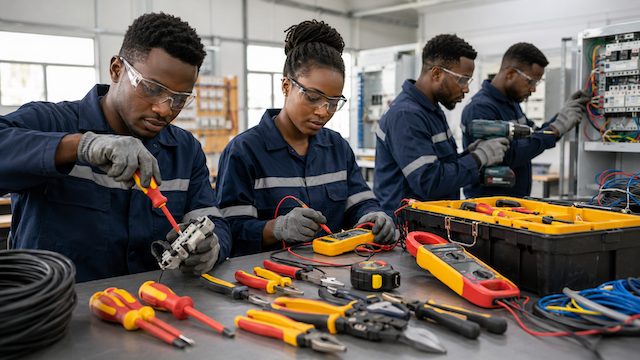
Introduction to Electrical Tools and Equipment
Electrical tools and equipment are used to install, test, repair, maintain, and troubleshoot electrical systems safely and efficiently.
A skilled electrical worker must know the correct tool for each task, how to use it safely, how to inspect it before use, and how to maintain it after use. Using the wrong tool or using a damaged tool can lead to electric shock, burns, fire, poor workmanship, equipment damage, or serious injury.
Hand and power tools can be hazardous when used or maintained improperly, so special attention must be given to tool safety, inspection, and correct use. OSHA explains that hand and power tools can cause severe injuries when used or maintained incorrectly.
Identification of Electrical Tools
Electrical work requires different categories of tools. Some are used for cutting and gripping, some for fastening, some for measuring, and others for testing electrical conditions.
Common categories include:
- Hand tools
- Power tools
- Measuring instruments
- Testing instruments
- Cable preparation tools
- Installation tools
- Safety equipment
Common Electrical Hand Tools
| Tool | Main Use |
|---|---|
| Insulated screwdriver | Tightening or loosening electrical terminals and screws |
| Pliers | Gripping, bending, twisting, and holding wires |
| Side cutters | Cutting wires and small conductors |
| Long-nose pliers | Holding wires in tight spaces |
| Wire stripper | Removing insulation from conductors without damaging the copper |
| Cable cutter | Cutting larger cables cleanly |
| Crimping tool | Fixing lugs, ferrules, and terminals to cable ends |
| Utility knife | Trimming insulation, trunking, or packaging materials |
| Hacksaw | Cutting conduit, trunking, or cable tray |
| Hammer | Fixing clips, plugs, and light-duty installation supports |
| Spanner set | Tightening nuts, bolts, glands, and fixings |
| Allen key set | Tightening hex socket screws |
| Measuring tape | Measuring cable routes, mounting heights, and distances |
| Spirit level | Ensuring fittings, panels, and accessories are straight |
| Fish tape / draw wire | Pulling cables through conduit or trunking |
| Hole saw | Cutting circular holes for conduit, glands, or accessories |
| Conduit bender | Bending metal or PVC conduit accurately |
Insulated Tools
Insulated tools are designed to reduce the risk of electric shock when working near electrical conductors. They usually have protective handles rated for specific voltage levels.
Insulated tools should not be used as an excuse to work live. The safest practice is still to isolate the circuit before work begins.
When using insulated tools:
- Check the insulation for cuts, cracks, burns, or wear.
- Use tools rated for the electrical environment.
- Keep tools dry and clean.
- Do not modify tool handles.
- Do not use damaged insulated tools.
- Store them separately to protect the insulation.
Cable Preparation Tools
Cable preparation must be done carefully because poor cable preparation can cause loose connections, overheating, short circuits, or fire.
Common cable preparation tools include:
| Tool | Use |
|---|---|
| Wire stripper | Removes insulation from small conductors |
| Cable stripper | Removes outer sheath from larger cables |
| Cable cutter | Cuts cable cleanly without crushing |
| Crimping tool | Attaches terminals, ferrules, and lugs |
| Lug crimper | Crimps large cable lugs |
| Ferrule crimper | Secures fine-stranded wires before termination |
| Heat gun | Shrinks heat-shrink sleeves or insulation covers |
| Deburring tool | Removes sharp edges from conduit or trunking |
Safe Use of Hand Tools
Hand tools may look simple, but they can cause injury if used incorrectly.
Common injuries from hand tools include:
- Cuts
- Puncture wounds
- Hand strain
- Eye injury
- Electric shock
- Burns
- Pinched fingers
- Damage to cables and terminals
OSHA requires hand and power tools to be maintained in a safe condition, whether supplied by the employer or by workers themselves.
Hand Tool Safety Rules
When using hand tools:
- Use the correct tool for the task.
- Inspect the tool before use.
- Do not use tools with cracked handles, loose heads, damaged jaws, or worn tips.
- Use insulated tools where electrical contact is possible.
- Keep cutting tools sharp and controlled.
- Cut away from the body.
- Keep hands away from cutting edges.
- Wear eye protection when cutting, drilling, or striking.
- Do not use screwdrivers as chisels or pry bars.
- Do not use pliers as spanners.
- Do not force a tool beyond its design.
- Keep tools dry, clean, and free from oil.
- Store tools safely after use.
Screwdrivers
Screwdrivers are among the most common electrical tools. Electricians use them for terminals, accessories, switchgear, panels, and fittings.
Safe Use
- Use the correct size and type of screwdriver.
- Use insulated screwdrivers for electrical work.
- Do not use a damaged or rounded screwdriver tip.
- Do not hold small parts in your hand while applying force.
- Do not use a screwdriver as a chisel, punch, or lever.
- Do not over-tighten terminals.
Over-tightening can damage terminals, while under-tightening can cause loose connections and overheating.
Pliers and Cutters
Pliers are used for gripping, bending, twisting, pulling, and cutting. Different pliers have different purposes.
Safe Use
- Use side cutters only for suitable wire sizes.
- Do not cut live conductors.
- Keep fingers away from cutting jaws.
- Do not use pliers on hardened steel unless designed for it.
- Do not use pliers as a hammer.
- Use insulated pliers where electrical risk exists.
- Replace pliers with damaged handles or worn jaws.
Wire Strippers
Wire strippers remove insulation without damaging the conductor.
Safe Use
- Select the correct stripping hole for the cable size.
- Do not cut into the copper conductor.
- Avoid removing too much insulation.
- Keep stripped wire length suitable for the terminal.
- Do not use teeth, knives, or side cutters where a stripper is available.
Damaging the conductor during stripping can reduce its current-carrying ability and create a weak connection.
Power Tools
Power tools make electrical installation work faster and easier. However, they introduce risks such as electric shock, rotating parts, flying particles, noise, vibration, dust, and mechanical injury.
Common power tools used in electrical work include:
| Power Tool | Use |
|---|---|
| Electric drill | Drilling holes in walls, panels, metal, or wood |
| Cordless drill/driver | Drilling and fastening screws |
| Angle grinder | Cutting metal conduit, tray, trunking, or brackets |
| Rotary hammer drill | Drilling into concrete or masonry |
| Jigsaw | Cutting boards, panels, or trunking |
| Heat gun | Applying heat-shrink sleeves or softening materials |
| Cable pulling machine | Pulling large cables through ducts or trays |
| Battery crimping tool | Crimping larger cable lugs |
| Portable lighting | Providing temporary work illumination |
Safe Use of Power Tools
Before using a power tool:
- Read and follow the manufacturer’s instructions.
- Inspect the tool, plug, cable, battery, chuck, guard, and switch.
- Check that guards are fitted and working.
- Use the correct drill bit, blade, disc, or accessory.
- Confirm the tool is suitable for the environment.
- Keep the work area dry and clear.
- Wear suitable PPE.
- Secure the workpiece where needed.
- Keep hands away from moving parts.
- Disconnect the tool before changing bits, blades, or discs.
- Do not carry a tool by its cable.
- Do not use damaged tools.
- Do not use power tools in wet conditions unless properly rated and protected.
OSHA construction standards require hand and power tools to be maintained in safe condition, and power-operated tools designed for guards must have the guards in place when used.
Electrical Safety for Portable Power Tools
Portable electrical tools can become dangerous if the cable, plug, casing, insulation, or internal wiring is damaged.
Before use, check for:
- Damaged plug
- Loose plug pins
- Cracked casing
- Exposed wires
- Damaged cable insulation
- Burn marks
- Loose switch
- Missing guard
- Strange noise or smell
- Overheating
- Wrong voltage rating
- Missing earth connection where required
HSE guidance on portable electrical equipment recommends a maintenance approach based on user checks, formal visual inspection, and testing where appropriate.
Battery-Powered Tools
Battery-powered tools reduce some risks associated with trailing cables, but they still require safe use.
Safe practices include:
- Use only the correct battery and charger.
- Do not use damaged batteries.
- Keep batteries away from water and excessive heat.
- Do not crush, open, or modify batteries.
- Remove the battery before changing accessories.
- Store batteries safely.
- Stop using a battery that swells, leaks, overheats, or smells unusual.
Measuring Instruments
Measuring instruments help electrical workers confirm values such as voltage, current, resistance, continuity, insulation resistance, frequency, and power consumption.
Using the wrong measuring instrument or wrong setting can be dangerous.
Common measuring instruments include:
| Instrument | Main Use |
|---|---|
| Digital multimeter | Measures voltage, resistance, continuity, and sometimes current |
| Clamp meter | Measures current without disconnecting the conductor |
| Insulation resistance tester | Checks insulation quality of cables and equipment |
| Continuity tester | Checks whether a circuit path is complete |
| Voltage tester | Confirms presence or absence of voltage |
| Socket tester | Checks basic socket wiring condition |
| Earth resistance tester | Tests earthing system resistance |
| Phase sequence meter | Checks phase rotation in three-phase systems |
| Power meter | Measures power usage |
| Lux meter | Measures light level |
| Infrared thermometer | Measures surface temperature without contact |
| Thermal camera | Detects hot spots in electrical panels or equipment |
Digital Multimeter
A digital multimeter is one of the most important electrical measuring instruments.
It may be used to measure:
- AC voltage
- DC voltage
- Resistance
- Continuity
- Current, depending on model
- Diode condition
- Frequency, depending on model
Safe Use
- Inspect the meter before use.
- Inspect test leads and probes.
- Select the correct function and range.
- Use the correct input socket.
- Confirm the meter rating is suitable for the circuit.
- Keep fingers behind probe guards.
- Do not touch exposed metal probe tips.
- Test on a known live source before and after proving dead.
- Do not measure resistance on a live circuit.
- Do not measure current with leads connected incorrectly.
Clamp Meter
A clamp meter measures current by clamping around a single conductor.
Important Rule
Clamp around one conductor only, not the whole cable containing live and neutral together. Clamping around both may give a false or zero reading because the magnetic fields cancel.
Safe Use
- Use the correct AC or DC current setting.
- Clamp around only one conductor.
- Keep hands behind the safety barrier.
- Do not exceed the meter rating.
- Do not use a damaged clamp meter.
- Avoid measuring near exposed live parts unless properly trained and protected.
Insulation Resistance Tester
An insulation resistance tester checks whether cable or equipment insulation is in good condition.
It applies a test voltage and measures resistance. Poor insulation may indicate damage, moisture, contamination, or ageing.
Safe Use
- Use only on isolated circuits.
- Disconnect sensitive electronic equipment before testing.
- Confirm the circuit is dead.
- Warn people before testing.
- Do not touch conductors during the test.
- Discharge the circuit after testing.
- Follow local testing standards and procedures.
Voltage Tester
A voltage tester is used to confirm whether voltage is present.
Safe Use
- Use an approved voltage tester.
- Prove the tester on a known live source before use.
- Test the circuit.
- Prove the tester again after use.
- Do not rely only on non-contact testers for safe isolation.
- Use the correct tester for the voltage level.
Care and Maintenance of Tools
Tool care is essential for safety, accuracy, and professional workmanship.
A well-maintained tool lasts longer, works better, and reduces the risk of injury.
Poorly maintained tools can cause:
- Electric shock
- Poor connections
- Damaged cables
- Inaccurate measurements
- Slipping and hand injury
- Fire
- Equipment failure
General Tool Maintenance Rules
To maintain tools properly:
- Clean tools after use.
- Store tools in a dry toolbox or tool bag.
- Keep tools organised.
- Protect insulated handles from cuts and impact.
- Keep cutting edges sharp.
- Lightly oil moving joints where appropriate.
- Keep measuring instruments in protective cases.
- Remove damaged tools from service.
- Calibrate measuring instruments where required.
- Keep batteries charged and stored correctly.
- Do not leave tools exposed to rain, dust, or chemicals.
- Do not throw tools into panels, trays, or toolboxes carelessly.
Tool Inspection Checklist
Before use, check:
| Item | What to Check |
|---|---|
| Handles | Cracks, cuts, burns, loose grip, damaged insulation |
| Cutting edges | Dull, chipped, cracked, or misaligned blades |
| Jaws | Worn teeth, misalignment, cracks, stiffness |
| Screwdriver tips | Rounded, broken, bent, or damaged tips |
| Power cord | Cuts, exposed wires, crushed insulation |
| Plug | Loose pins, cracked body, burn marks |
| Tool body | Cracks, missing screws, loose parts |
| Switch | Sticking, loose, or not working properly |
| Guards | Missing, loose, or damaged |
| Test leads | Cracked insulation, exposed metal, loose probes |
| Battery | Swelling, leakage, overheating, damaged casing |
| Meter display | Clear readings and working display |
| Calibration label | Valid calibration where required |
If a tool is unsafe, do not use it.
Storage of Electrical Tools
Proper storage protects tools from damage and keeps the work area safe.
Good storage practices include:
- Store tools in a clean and dry place.
- Keep insulated tools separate from sharp objects.
- Use toolboxes, tool bags, racks, or shadow boards.
- Keep measuring instruments in protective cases.
- Coil test leads loosely without damaging them.
- Keep batteries away from heat and moisture.
- Store sharp tools with covers where possible.
- Do not leave tools on ladders, panels, or elevated surfaces.
- Keep tools away from unauthorised users.
- Return tools after use.
Real-Life Scenario
A technician is asked to test a socket. He picks up a multimeter with damaged test leads and exposed metal near the probe handle. The meter still powers on, so he considers using it.
This is unsafe.
Damaged test leads can expose the user to electric shock or arc flash. The correct action is to remove the damaged leads from service, report the defect, and use properly rated test leads in good condition.
A tool that works is not always a tool that is safe.
Common Mistakes With Electrical Tools
Avoid these unsafe practices:
- Using damaged insulated tools.
- Using ordinary tools where insulated tools are required.
- Using screwdrivers as chisels or pry bars.
- Cutting live wires.
- Measuring voltage with the meter set to current mode.
- Measuring resistance on a live circuit.
- Using a multimeter with damaged leads.
- Using power tools without guards.
- Using the wrong drill bit, blade, or disc.
- Carrying power tools by the cable.
- Leaving tools inside electrical panels.
- Storing tools in wet or dirty conditions.
- Using uncalibrated instruments where accuracy is required.
- Allowing untrained persons to use electrical test instruments.
What an Electrical Worker Should Never Do
An electrical worker should never:
- Use damaged tools or test instruments.
- Work with tools that are wet, cracked, burnt, or defective.
- Use a tool beyond its rated capacity.
- Bypass safety guards on power tools.
- Touch exposed live parts with any tool.
- Use a non-insulated tool near live conductors.
- Assume a meter is safe without checking its leads and rating.
- Leave sharp tools loose in a tool bag.
- Use incorrect meter settings on live circuits.
- Modify power tools, plugs, guards, or insulated handles.
- Store tools where they can fall, rust, or become damaged.
- Ignore sparks, overheating, unusual noise, or burning smell from a tool.
Quick Recap
Electrical tools and equipment must be correctly identified, safely used, inspected, maintained, and stored. Hand tools, power tools, and measuring instruments all have specific purposes and risks. Safe electrical work requires the right tool for the task, proper PPE, careful inspection, correct use of measuring instruments, and immediate removal of defective tools from service.