
Electrical Machines
Introduction to Electrical Machines
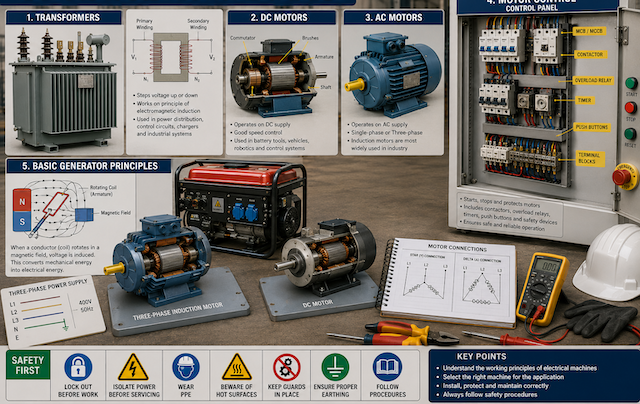
Electrical machines are devices that convert electrical energy into mechanical energy, mechanical energy into electrical energy, or electrical energy from one voltage level to another.
In electrical installation and maintenance, the most common electrical machines include transformers, motors, and generators. These machines are used in homes, workshops, factories, offices, hospitals, water systems, production lines, and power systems.
A good technician should understand how these machines work, how they are connected, how they are protected, and how to identify basic faults safely.
Transformers
A transformer is an electrical machine used to change AC voltage from one level to another. It can step voltage up or step voltage down.
A transformer works by electromagnetic induction. When AC supply flows through the primary winding, it creates a changing magnetic field in the core. This changing magnetic field induces voltage in the secondary winding.
Transformers are widely used in power distribution, control circuits, chargers, welding machines, stabilisers, UPS systems, and industrial panels.
Main Parts of a Transformer
| Part | Function |
|---|---|
| Primary winding | Receives the input voltage |
| Secondary winding | Provides the output voltage |
| Magnetic core | Carries magnetic flux between windings |
| Insulation | Separates windings and prevents short circuits |
| Transformer oil | Provides cooling and insulation in oil-filled transformers |
| Tank/enclosure | Protects internal parts |
| Bushings/terminals | Provide external electrical connections |
| Tap changer | Adjusts output voltage in some transformers |
Step-Up and Step-Down Transformers
A step-up transformer increases voltage. It is used where voltage needs to be raised for transmission or special applications.
A step-down transformer reduces voltage. It is commonly used to reduce high voltage to a safer or usable level for buildings, machines, control circuits, and appliances.
| Transformer Type | Function | Example Use |
|---|---|---|
| Step-up transformer | Increases voltage | Power transmission |
| Step-down transformer | Reduces voltage | Distribution, control panels, chargers |
| Isolation transformer | Separates circuits electrically | Safety and equipment protection |
| Current transformer | Reduces high current for metering/protection | Meters and protection relays |
| Voltage transformer | Reduces high voltage for metering/protection | Instrumentation and protection |
Transformer Safety and Maintenance
Transformers must be handled carefully because they may operate at dangerous voltage levels.
Basic safety practices include:
- Isolate before inspection or maintenance.
- Confirm absence of voltage before touching terminals.
- Keep transformer ventilation clear.
- Avoid overloading the transformer.
- Check for overheating, noise, vibration, or burning smell.
- Inspect terminals for looseness, corrosion, or damage.
- Keep oil-filled transformers free from leaks.
- Ensure proper earthing of the transformer body.
- Protect transformers with suitable fuses, breakers, or relays.
- Keep unauthorised persons away from transformer areas.
Common transformer faults include overheating, insulation failure, oil leakage, humming noise, loose connections, burnt windings, and output voltage problems.
DC Motors
A DC motor converts direct current electrical energy into mechanical rotation. DC motors are used where speed control, simple direction control, or battery-powered operation is required.
DC motors are found in battery-powered tools, small machines, electric vehicles, robotics, control systems, conveyors, fans, pumps, and electronic equipment.
Main Parts of a DC Motor
| Part | Function |
|---|---|
| Armature | Rotating part that carries current |
| Field winding / magnets | Produces magnetic field |
| Commutator | Reverses current direction in the armature |
| Brushes | Transfer current to the rotating commutator |
| Shaft | Transfers mechanical output |
| Bearings | Support rotation |
| Frame | Holds and protects motor parts |
| Cooling fan | Helps remove heat |
How a DC Motor Works
When current flows through the armature inside a magnetic field, force is produced and the motor rotates. The commutator helps maintain rotation by changing the current direction at the right time.
The speed of a DC motor can often be controlled by adjusting the supply voltage or using an electronic speed controller.
Types of DC Motors
| Type | Key Feature | Common Use |
|---|---|---|
| Permanent magnet DC motor | Uses permanent magnets | Small tools, fans, robotics |
| Series DC motor | High starting torque | Cranes, traction, heavy starting loads |
| Shunt DC motor | Good speed regulation | Machines requiring steady speed |
| Compound DC motor | Combines series and shunt features | Industrial drives |
| Brushless DC motor | Electronic commutation, efficient | Drones, fans, electric vehicles |
DC Motor Maintenance
Common maintenance checks include:
- Inspect brushes for wear.
- Check commutator condition.
- Ensure terminals are tight.
- Listen for abnormal noise.
- Check bearings.
- Keep ventilation clear.
- Check for overheating.
- Inspect cables and insulation.
- Confirm correct supply voltage.
- Remove dust and carbon deposits where appropriate.
A DC motor should not be operated if it smells burnt, sparks excessively, overheats, or has damaged wiring.
AC Motors
An AC motor converts alternating current electrical energy into mechanical rotation. AC motors are the most common motors used in domestic, commercial, and industrial installations.
They are used in fans, pumps, compressors, conveyors, mixers, blowers, elevators, machine tools, air conditioners, and production equipment.
Main Parts of an AC Motor
| Part | Function |
|---|---|
| Stator | Stationary part that produces magnetic field |
| Rotor | Rotating part driven by the magnetic field |
| Windings | Carry current and create magnetic field |
| Shaft | Transfers mechanical output |
| Bearings | Support the rotating shaft |
| Frame | Protects and supports motor parts |
| Terminal box | Connection point for supply cables |
| Cooling fan | Removes heat during operation |
Single-Phase and Three-Phase AC Motors
AC motors may be single-phase or three-phase.
| Motor Type | Common Use |
|---|---|
| Single-phase motor | Fans, small pumps, domestic appliances, small machines |
| Three-phase motor | Industrial pumps, compressors, conveyors, production machines |
Single-phase motors often need starting components such as capacitors or auxiliary windings. Three-phase motors are commonly used in industry because they run smoothly, provide good torque, and are efficient for higher-power applications.
Common Types of AC Motors
| Type | Common Use |
|---|---|
| Induction motor | Pumps, fans, conveyors, compressors |
| Synchronous motor | Constant-speed industrial applications |
| Universal motor | Some portable tools and appliances |
| Capacitor-start motor | Single-phase equipment requiring starting torque |
| Shaded-pole motor | Small fans and low-power devices |
AC Motor Safety and Maintenance
AC motors should be installed and maintained properly to prevent overheating, vibration, insulation failure, and mechanical damage.
Basic checks include:
- Confirm correct voltage and frequency.
- Check motor nameplate before connection.
- Confirm correct phase sequence for three-phase motors.
- Ensure proper earthing.
- Check overload protection.
- Inspect cable glands and terminal connections.
- Keep ventilation openings clear.
- Check for abnormal noise or vibration.
- Inspect bearings and alignment.
- Avoid repeated starting without allowing cooling time.
- Isolate and lock out before maintenance.
If a three-phase motor rotates in the wrong direction, two phases may need to be interchanged by a competent person after safe isolation.
Motor Control
Motor control means starting, stopping, protecting, reversing, or controlling the speed of a motor.
Motor control is important because motors can draw high current during starting and may become dangerous if they are not properly controlled.
Common Motor Control Devices
| Device | Function |
|---|---|
| Switch | Simple manual control |
| Contactor | Electrically switches motor supply |
| Overload relay | Protects motor from overload |
| Motor starter | Controls starting and protection |
| Push button | Start, stop, or reset control |
| Emergency stop | Stops machine operation during danger |
| Timer | Provides time delay |
| Limit switch | Stops or controls movement at a set position |
| Relay | Controls switching logic |
| VFD | Controls motor speed and frequency |
| Soft starter | Reduces starting stress and current |
Motor Starters
A motor starter is used to start and protect a motor. It may include a contactor, overload relay, control buttons, and protective devices.
Common motor starters include:
| Starter Type | Description |
|---|---|
| Direct-on-line starter | Starts motor directly at full voltage |
| Star-delta starter | Reduces starting current in larger three-phase motors |
| Soft starter | Gradually increases voltage during starting |
| Variable Frequency Drive | Controls motor speed and starting smoothly |
| Manual motor starter | Provides manual switching and overload protection |
Direct-on-line starters are simple and common for smaller motors. Larger motors may need star-delta, soft starter, or VFD control to reduce starting current and mechanical stress.
Motor Protection
Motor protection prevents damage caused by electrical and mechanical faults.
Common motor protection includes:
- Overload protection
- Short-circuit protection
- Earth-fault protection
- Phase failure protection
- Phase reversal protection
- Undervoltage protection
- Overvoltage protection
- Thermal protection
- Mechanical overload protection
A motor that trips repeatedly should not simply be reset again and again. The cause must be investigated.
Basic Generator Principles
A generator converts mechanical energy into electrical energy. It works on the principle of electromagnetic induction.
When a conductor moves through a magnetic field, voltage is induced. In a generator, mechanical rotation is used to produce electrical output.
Generators are commonly used for backup power, remote sites, construction sites, industrial facilities, hospitals, offices, telecom systems, and homes.
Main Parts of a Generator
| Part | Function |
|---|---|
| Engine / prime mover | Provides mechanical rotation |
| Alternator | Produces electrical power |
| Rotor | Rotating magnetic field component |
| Stator | Stationary winding where voltage is induced |
| Voltage regulator | Helps maintain output voltage |
| Fuel system | Supplies fuel to the engine |
| Cooling system | Removes heat |
| Control panel | Starts, stops, and monitors the generator |
| Battery | Starts the engine |
| Exhaust system | Removes combustion gases |
| Earthing terminal | Provides grounding connection |
AC and DC Generators
Most practical power generators produce AC output. A DC generator produces direct current but is less common in modern power supply systems.
| Generator Type | Output | Common Use |
|---|---|---|
| AC generator / alternator | Alternating current | Homes, industries, power systems |
| DC generator | Direct current | Battery charging and specialised systems |
Generator Safety
Generators must be installed and operated safely to prevent electric shock, fire, carbon monoxide poisoning, equipment damage, and back-feeding into the supply network.
Basic generator safety includes:
- Place fuel-powered generators in well-ventilated outdoor areas.
- Never run a petrol or diesel generator inside a room.
- Use proper changeover switches or transfer switches.
- Do not back-feed power through a socket.
- Ensure proper earthing where required.
- Keep generator dry and protected from rain.
- Do not overload the generator.
- Allow cooling before refuelling.
- Keep fuel away from heat and sparks.
- Inspect cables and plugs before use.
- Use competent persons for generator connection.
- Follow manufacturer instructions.
Back-feeding is extremely dangerous because it can energise utility lines and expose workers or neighbours to electric shock.
Real-Life Scenario
A small workshop uses a three-phase motor to run a compressor. The motor starts but trips after a few minutes. One worker suggests increasing the breaker rating to stop the tripping.
This is unsafe.
A tripping motor may be overloaded, poorly connected, overheating, losing a phase, drawing high current, or suffering mechanical resistance. The correct action is to isolate the motor, inspect the circuit, check the motor nameplate, test current, check overload settings, inspect terminals, confirm mechanical load condition, and correct the fault before restarting.
Common Mistakes With Electrical Machines
Avoid these unsafe practices:
- Connecting a motor without checking the nameplate.
- Ignoring motor rotation direction.
- Bypassing overload protection.
- Resetting a tripped motor repeatedly without investigation.
- Running a motor with poor ventilation.
- Using the wrong starter for the motor.
- Operating a transformer beyond its rating.
- Ignoring transformer oil leakage or overheating.
- Connecting a generator without a proper changeover system.
- Running generators indoors.
- Working on motors without isolation.
- Touching rotating parts.
- Ignoring abnormal noise, vibration, smell, or heat.
What an Electrical Worker Should Never Do
An electrical worker should never:
- Work on electrical machines without isolating the supply.
- Bypass motor overloads, emergency stops, or protective devices.
- Touch moving shafts, belts, pulleys, or fans.
- Use a transformer or motor with damaged insulation.
- Ignore overheating, smoke, sparks, or burning smell.
- Reverse motor phases without confirming safe isolation.
- Connect a generator directly into building wiring without proper transfer protection.
- Operate machines without guards.
- Reset protective devices repeatedly without fault finding.
- Leave exposed terminals uncovered.
- Ignore earthing requirements.
Quick Recap
Electrical machines include transformers, motors, and generators. Transformers change AC voltage levels, motors convert electrical energy into mechanical rotation, and generators convert mechanical energy into electrical energy. DC motors are useful where direct current and speed control are needed, while AC motors are widely used in domestic, commercial, and industrial systems. Motor control devices start, stop, protect, and regulate motors. Safe work on electrical machines requires isolation, proper protection, earthing, correct connection, maintenance, and careful attention to abnormal signs such as heat, noise, vibration, smell, or tripping.