
Introduction to Instrumentation and Control
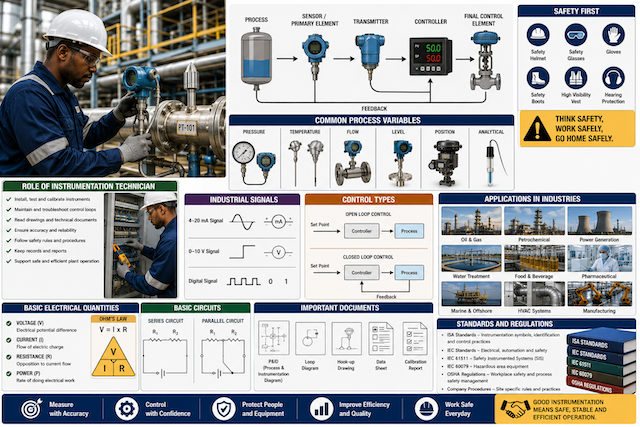
Introduction to Instrumentation and Control
Instrumentation and Control, often written as I&C, is the field that deals with measuring, monitoring, controlling, and protecting industrial processes.
Instrumentation focuses on measuring process conditions such as pressure, temperature, flow, level, speed, position, vibration, and chemical properties. Control focuses on using those measurements to keep the process operating safely, efficiently, and within the required limits.
In a simple process, an instrument may measure the temperature of a tank. The control system compares the measured temperature with the required temperature and then adjusts a valve, heater, or pump to maintain the desired condition.
The International Society of Automation describes process automation and control as the use of hardware, software, systems, and methods to measure, regulate, manipulate, and visualize industrial processes for consistency, efficiency, and safety.
Why Instrumentation and Control Is Important
Instrumentation and control systems help industries operate safely, accurately, and efficiently. Without proper instruments, operators would not know what is happening inside tanks, pipelines, boilers, vessels, reactors, compressors, pumps, and production systems.
I&C systems help to:
- Monitor process conditions.
- Control production variables.
- Improve product quality.
- Reduce waste and energy loss.
- Protect equipment from damage.
- Warn operators of abnormal conditions.
- Shut down unsafe processes automatically.
- Support maintenance and troubleshooting.
- Improve plant reliability and productivity.
In process industries, small changes in pressure, temperature, level, or flow can affect safety, product quality, and equipment performance.
Basic Instrumentation and Control System
A basic instrumentation and control system usually has four main parts.
| Part | Function |
|---|---|
| Sensor / primary element | Detects the process condition |
| Transmitter | Converts the measurement into a signal |
| Controller | Compares the measurement with the desired value |
| Final control element | Adjusts the process, such as a valve, motor, or actuator |
Example:
A level transmitter measures the level of liquid in a tank. The controller compares the level with the desired set point. If the level is too high or too low, the controller sends a signal to a control valve or pump to correct it.
Common Process Variables
Process variables are the conditions that are measured and controlled in industrial systems.
Common process variables include:
| Variable | What It Means | Example Instrument |
|---|---|---|
| Pressure | Force applied by gas or liquid inside a pipe or vessel | Pressure gauge, pressure transmitter |
| Temperature | Degree of hotness or coldness | RTD, thermocouple, temperature transmitter |
| Flow | Movement rate of liquid, gas, or steam | Flow meter, flow transmitter |
| Level | Height or quantity of material in a tank or vessel | Level transmitter, level switch |
| Position | Location or movement of equipment | Position sensor, valve positioner |
| Speed | Rotational or movement rate | Speed sensor, tachometer |
| Vibration | Mechanical movement or oscillation | Vibration sensor |
| pH / conductivity | Chemical condition of a liquid | Analytical transmitter |
Pressure, temperature, flow, and level are the most common variables in process instrumentation.
Applications in Process Industries
Instrumentation and control systems are used in many industries where materials are processed, moved, stored, heated, cooled, mixed, compressed, treated, or packaged.
Common industries include:
| Industry | Applications |
|---|---|
| Oil and gas | Pressure monitoring, flow measurement, shutdown systems, control valves |
| Petrochemical | Reactor control, temperature monitoring, level control, safety systems |
| Power generation | Boiler control, turbine monitoring, steam flow, temperature control |
| Water treatment | Flow measurement, level control, dosing systems, pump control |
| Food and beverage | Temperature control, filling systems, process monitoring |
| Pharmaceutical | Batch control, clean process monitoring, pressure and temperature control |
| Manufacturing | Machine control, automation, quality monitoring |
| Marine and offshore | Process control, safety shutdown, tank level monitoring |
| Cement and mining | Conveyor control, level measurement, motor control |
| HVAC and utilities | Chilled water, steam, air pressure, and building control systems |
In high-risk process industries, instrumentation may also be part of safety systems that protect people, equipment, and the environment. OSHA’s Process Safety Management standard focuses on managing hazards associated with highly hazardous chemicals through technologies, procedures, and management practices.
Examples of Instrumentation in Real Workplaces
Instrumentation is found in many industrial operations.
Examples include:
- A pressure transmitter monitoring a compressed air line.
- A temperature sensor controlling a furnace.
- A flow meter measuring water entering a treatment plant.
- A level transmitter monitoring a diesel storage tank.
- A control valve adjusting steam flow to a heat exchanger.
- A gas detector warning of flammable gas leakage.
- A PLC receiving signals from field instruments and controlling equipment.
- A safety shutdown system stopping a process when limits are exceeded.
Instrumentation helps operators see what is happening in the process and respond before problems become serious.
Manual Control and Automatic Control
In manual control, a human operator observes the process and makes adjustments. For example, an operator may read a pressure gauge and manually open or close a valve.
In automatic control, instruments and controllers perform the adjustment continuously. For example, a pressure transmitter sends a signal to a controller, and the controller automatically adjusts a control valve.
| Control Type | Description | Example |
|---|---|---|
| Manual control | Operator observes and adjusts the process | Operator opens a valve by hand |
| Automatic control | Controller adjusts the process automatically | Controller adjusts a control valve |
Automatic control improves consistency, speed, safety, and process stability.
Roles and Responsibilities of Instrumentation Technicians
Instrumentation technicians install, inspect, calibrate, test, troubleshoot, maintain, and repair instruments and control systems.
Their work may involve field instruments, control panels, transmitters, sensors, valves, junction boxes, cables, PLC input/output modules, signal loops, impulse tubing, and documentation.
Main Duties of an Instrumentation Technician
An instrumentation technician may be responsible for:
- Installing field instruments correctly.
- Reading basic P&IDs, loop diagrams, and wiring drawings.
- Terminating instrument cables.
- Checking 4–20 mA loops.
- Calibrating pressure, temperature, flow, and level instruments.
- Setting up transmitters.
- Inspecting control valves and positioners.
- Testing alarms and shutdown signals.
- Troubleshooting faulty instruments.
- Carrying out preventive maintenance.
- Replacing faulty sensors, transmitters, and accessories.
- Completing calibration reports and maintenance records.
- Following safety rules, permits, and site procedures.
Instrumentation technicians often work closely with electricians, process operators, mechanical technicians, control engineers, safety personnel, and maintenance supervisors.
Skills Required for Instrumentation Technicians
A good instrumentation technician should develop both technical and professional skills.
| Skill Area | Examples |
|---|---|
| Technical knowledge | Instruments, signals, sensors, valves, PLC I/O, calibration |
| Electrical basics | Voltage, current, resistance, continuity, earthing, circuit diagrams |
| Measurement knowledge | Pressure, temperature, flow, level, accuracy, error, units |
| Drawing interpretation | P&IDs, loop diagrams, wiring diagrams, hook-up drawings |
| Tool use | Multimeter, loop calibrator, hand pump, pressure calibrator |
| Safety awareness | PPE, LOTO, PTW, hazardous areas, safe testing |
| Communication | Reporting faults, explaining findings, working with operators |
| Documentation | Calibration sheets, maintenance records, test reports |
| Problem-solving | Fault diagnosis, signal tracing, logical troubleshooting |
Instrumentation work requires accuracy. A wrong connection, wrong range, wrong calibration, or wrong signal can affect the whole process.
Safety Rules and PPE
Instrumentation work often takes place in industrial environments with electrical hazards, pressurised systems, chemicals, heat, rotating equipment, height, confined spaces, noise, and hazardous areas.
Safety must come before speed. No instrument job is important enough to justify unsafe work.
Basic Safety Rules
Instrumentation technicians should follow these safety rules:
- Wear the required PPE.
- Understand the job before starting.
- Obtain permit to work where required.
- Isolate electrical and process energy before work.
- Follow Lockout/Tagout procedures.
- Confirm zero pressure before opening impulse lines or process connections.
- Use the correct tools and test equipment.
- Do not work on live circuits unless authorised and controlled.
- Do not bypass alarms or shutdown systems without approval.
- Keep the work area clean and safe.
- Report leaks, damaged cables, exposed wires, and unsafe conditions.
- Follow site procedures for hazardous areas.
- Restore instruments and covers properly after maintenance.
- Record all work done.
OSHA’s lockout/tagout standard is intended to prevent injury from unexpected energisation, startup, or release of stored energy during servicing and maintenance.
Common PPE for Instrumentation Work
| PPE | Purpose |
|---|---|
| Safety helmet | Protects the head from impact and falling objects |
| Safety goggles | Protects eyes from particles, splashes, and dust |
| Flame-resistant clothing | Helps protect against flash fire or arc flash where required |
| Safety boots | Protects feet from impact, slips, and site hazards |
| Gloves | Protects hands from cuts, chemicals, heat, or electrical risk depending on type |
| Hearing protection | Protects against high noise areas |
| Face shield | Protects face during high-risk tasks |
| Respirator | Protects from dust, fumes, or vapours where required |
| High-visibility vest | Improves visibility in busy work areas |
| Fall protection | Required when working at height |
PPE must be suitable for the task. General gloves may not protect against chemicals. Ordinary clothing may not protect against flame. A dust mask may not protect against toxic gas.
Instrumentation Hazards
Instrumentation technicians may face several hazards in the field.
| Hazard | Example |
|---|---|
| Electrical shock | Working in panels, junction boxes, or signal circuits |
| Pressure release | Opening impulse lines without isolation |
| Chemical exposure | Working on transmitters connected to process fluids |
| Hot surfaces | Instruments mounted on steam or hot process lines |
| Fire and explosion | Working in hazardous areas with flammable gases |
| Stored energy | Pneumatic actuators, hydraulic systems, spring-loaded valves |
| Working at height | Instruments installed on vessels, racks, or elevated platforms |
| Confined spaces | Tank, vessel, or enclosed area work |
| Wrong isolation | Working on the wrong instrument or line |
| Bypassed safety systems | Disabling alarms or trips without control |
A technician must understand both the instrument and the process it is connected to.
Introduction to Standards and Regulations
Standards and regulations provide rules and guidance for safe, consistent, and professional instrumentation work. They help ensure that instruments are identified correctly, installed safely, calibrated accurately, and maintained properly.
Standards may cover:
- Instrument symbols and identification
- Wiring and signal practices
- Calibration methods
- Safety instrumented systems
- Hazardous area equipment
- Control system design
- Electrical safety
- Documentation
- Maintenance procedures
ISA standards are widely used in automation and instrumentation. ISA states that its standards help automation professionals improve safety, cybersecurity, efficiency, and operations across many industry segments.
Common Standards and References in I&C
| Standard / Reference | Area of Use |
|---|---|
| ISA standards | Instrument symbols, control documentation, automation practices |
| ISA-5.1 | Instrumentation symbols and identification |
| IEC standards | Electrical, automation, control, and safety systems |
| IEC 61511 | Safety instrumented systems for process industries |
| IEC 60529 | IP ratings for electrical enclosures |
| IEC 60079 | Equipment for explosive atmospheres |
| OSHA regulations | Workplace safety and process safety management |
| Company procedures | Site-specific work methods and safety rules |
| Manufacturer manuals | Installation, calibration, and maintenance instructions |
IEC 61511-1 gives requirements for the specification, design, installation, operation, and maintenance of safety instrumented systems in the process industry sector.
Instrument Tags and Identification
Instruments are usually identified with tag numbers. A tag number helps workers know what the instrument measures and where it belongs in the process.
Example:
PT-101
This may mean:
| Part | Meaning |
|---|---|
| P | Pressure |
| T | Transmitter |
| 101 | Loop or equipment number |
Other examples include:
| Tag | Possible Meaning |
|---|---|
| TT | Temperature Transmitter |
| FT | Flow Transmitter |
| LT | Level Transmitter |
| PI | Pressure Indicator |
| TIC | Temperature Indicating Controller |
| XV | On/off valve |
| CV | Control valve |
Instrument tag formats may vary by company or project. Always confirm with the project legend or P&ID.
Instrument Documentation
Instrumentation work depends heavily on documentation. A technician should know how to use and update basic documents.
Common documents include:
| Document | Purpose |
|---|---|
| P&ID | Shows process equipment, instruments, valves, and control loops |
| Loop diagram | Shows wiring and signal path for one instrument loop |
| Hook-up drawing | Shows instrument mounting and process connection details |
| Datasheet | Shows instrument range, type, material, and technical details |
| Calibration sheet | Records calibration results and adjustments |
| Cause and effect chart | Shows shutdown, alarm, and trip relationships |
| Cable schedule | Shows cable number, type, route, and termination points |
| Junction box drawing | Shows field cable terminations |
| I/O list | Shows PLC or DCS input and output points |
| Maintenance record | Shows inspection, fault, and repair history |
Working without the correct document can lead to wrong connections, wrong calibration, or unsafe operation.
Real-Life Scenario
A technician is asked to remove a pressure transmitter from a process line. The transmitter appears small and simple, so the technician considers loosening it immediately.
This is unsafe.
The transmitter may still be connected to a pressurised, hot, toxic, or flammable process. The correct approach is to identify the instrument tag, confirm the process service, obtain the required permit, isolate the process connection, depressurise the impulse line, confirm zero pressure, isolate electrical signal where required, and only then remove the instrument safely.
Instrumentation work is not only electrical; it is also connected to the process.
Common Beginner Mistakes
Avoid these mistakes:
- Working on the wrong instrument tag.
- Ignoring the process connection.
- Opening impulse lines without isolation.
- Bypassing alarms or trips without approval.
- Connecting signal wires incorrectly.
- Confusing 4–20 mA signal with voltage signal.
- Calibrating without checking instrument range.
- Ignoring hazardous area requirements.
- Using the wrong test equipment.
- Failing to record calibration results.
- Leaving junction boxes or panels open.
- Ignoring damaged cables, glands, or earth connections.
- Assuming a small instrument is low-risk.
What an Instrumentation Technician Should Never Do
An instrumentation technician should never:
- Work without understanding the process hazard.
- Remove an instrument from a live process without isolation.
- Bypass safety systems without written authorisation.
- Ignore permit-to-work requirements.
- Use damaged test leads or unsafe tools.
- Work inside panels without electrical safety controls.
- Leave instrument covers, junction boxes, or panel doors open.
- Change instrument range or settings without approval.
- Hide calibration errors.
- Ignore alarms, leaks, overheating, or abnormal readings.
- Hand over work without testing and documentation.
Quick Recap
Instrumentation and Control is the field of measuring, monitoring, controlling, and protecting industrial processes. It is used in oil and gas, power generation, water treatment, manufacturing, petrochemical, food, pharmaceutical, marine, and utility systems. Instrumentation technicians install, calibrate, test, troubleshoot, and maintain field instruments, signals, control valves, panels, and control loops. Good I&C work requires technical skill, safety awareness, proper PPE, correct documentation, and understanding of standards. A professional technician must always consider both the electrical side and the process side of the instrument.