
Injury Management
Introduction to Injury Management
Injury management is one of the most important areas of first aid. Injuries can happen at home, in school, at work, on the road, during sports, in workshops, at construction sites, in factories, or during community activities.
A first aider does not replace a doctor, nurse, or emergency medical responder. The role of the first aider is to give safe immediate care, prevent the injury from getting worse, reduce pain where possible, protect the casualty, and arrange medical help when needed.
Injury management includes care for bleeding, wounds, fractures, sprains, burns, head injuries, eye injuries, chest and abdominal injuries, amputations, crush injuries, and suspected spinal injuries. Severe bleeding, breathing problems, unconsciousness, and shock should always be treated as priorities. NHS first aid guidance emphasises checking safety first, then dealing with life-threatening problems such as unconsciousness, difficulty breathing, and severe bleeding.
General Principles of Injury Management
When managing any injury, follow a calm and structured approach.
- Check the scene for danger.
- Use PPE where available.
- Check the casualty’s response.
- Call for help if the injury is serious.
- Control life-threatening bleeding.
- Maintain airway and breathing.
- Keep the casualty still and comfortable.
- Protect the injured area.
- Prevent shock.
- Monitor the casualty until help arrives.
- Record and report what happened.
Do not rush into treatment without checking safety. A first aider must avoid becoming another casualty.
Primary Survey Before Treating Injuries
Before focusing on a visible injury, check for life-threatening problems using a simple primary survey.
| Step | What to Check |
|---|---|
| Danger | Is the scene safe? |
| Response | Is the casualty conscious and responding? |
| Airway | Is the airway open? |
| Breathing | Is the casualty breathing normally? |
| Circulation | Is there severe bleeding or signs of shock? |
A large wound may look frightening, but breathing and severe bleeding are immediate priorities.
Infection Control During Injury Care
Many injuries involve blood or body fluids. Protect yourself and the casualty.
Use:
- Disposable gloves.
- Face shield or eye protection if splashing is possible.
- Clean dressings.
- Hand hygiene.
- Safe disposal of contaminated materials.
If gloves are not available, use a clean plastic bag, clean cloth, or other barrier where possible. Wash hands thoroughly after care.
Do not touch blood or open wounds with bare hands if avoidable.
Bleeding
Bleeding occurs when blood vessels are damaged. It may be minor or life-threatening.
Types of bleeding include:
| Type | Description |
|---|---|
| Capillary bleeding | Slow oozing from small vessels |
| Venous bleeding | Steady dark-red flow from veins |
| Arterial bleeding | Bright-red blood that may spurt with the heartbeat |
| Internal bleeding | Bleeding inside the body, not always visible |
Severe external bleeding can quickly become life-threatening and should be controlled immediately.
Signs of Severe Bleeding
Severe bleeding may include:
- Blood flowing heavily from a wound.
- Blood soaking through clothing or bandages.
- Blood pooling on the ground.
- Spurting blood.
- Partial or complete amputation.
- Casualty becoming pale, weak, dizzy, confused, or unconscious.
- Fast breathing or fast pulse.
- Signs of shock.
The British Red Cross advises applying pressure to a heavily bleeding wound and calling emergency help when bleeding is severe.
First Aid for Severe Bleeding
To manage severe bleeding:
- Check safety and wear gloves if available.
- Help the casualty sit or lie down.
- Expose the wound if possible.
- Apply firm direct pressure to the wound using a sterile dressing or clean cloth.
- Ask the casualty to apply pressure if they can.
- Call emergency services.
- Keep pressure on the wound.
- Apply a firm bandage over the dressing.
- If blood soaks through, add another dressing on top.
- Treat for shock.
- Monitor breathing and response.
Do not remove the first dressing if blood soaks through. Removing it may disturb clotting and increase bleeding.
Direct Pressure
Direct pressure is the main method for controlling most external bleeding.
How to apply direct pressure:
- Place a clean dressing or cloth directly over the wound.
- Press firmly with your hand.
- Maintain pressure continuously.
- If possible, raise the injured part above the level of the heart, unless a fracture or spinal injury is suspected.
- Secure with a bandage once bleeding is controlled.
Direct pressure helps the blood clot and reduces blood loss.
Embedded Objects in a Wound
Sometimes an object such as glass, metal, wood, or a knife may be stuck in a wound.
Do not remove an embedded object.
What to do:
- Apply pressure around the object, not directly on it.
- Use bulky dressings to support the object.
- Bandage around the object to keep it stable.
- Call emergency help.
- Keep the casualty still.
Removing an embedded object can cause worse bleeding and further damage.
Nosebleed
A nosebleed is usually not serious, but heavy or prolonged bleeding needs medical attention.
First aid steps:
- Sit the casualty upright.
- Ask them to lean forward.
- Pinch the soft part of the nose.
- Encourage breathing through the mouth.
- Maintain pressure for about 10 minutes.
- Avoid talking, sniffing, or blowing the nose.
- Seek medical help if bleeding continues, follows a head injury, or is very heavy.
Do not tilt the head backward. Blood may run into the throat and cause choking or vomiting.
Wounds
A wound is an injury where the skin or body tissue is damaged. Wounds may be open or closed and may involve bleeding, pain, swelling, bruising, infection risk, or deeper damage. The American Red Cross classifies wounds as open or closed, and both can involve bleeding.
Common wound types include:
| Wound Type | Description |
|---|---|
| Abrasion | Scrape on the skin surface |
| Laceration | Cut or tear in the skin |
| Puncture | Deep narrow wound from a pointed object |
| Avulsion | Skin or tissue partly torn away |
| Amputation | Body part partly or completely cut off |
| Bruise | Bleeding under the skin |
| Crush wound | Tissue damaged by force or pressure |
First Aid for Minor Cuts and Scrapes
For minor wounds:
- Wash your hands.
- Wear gloves if available.
- Rinse the wound with clean running water.
- Remove small loose dirt if easy to do.
- Apply gentle pressure if bleeding.
- Cover with a sterile dressing or clean plaster.
- Advise the casualty to keep the wound clean.
- Watch for signs of infection.
Seek medical care if the wound is deep, dirty, from a bite, caused by rusty metal, heavily bleeding, or if the casualty’s tetanus protection may not be up to date.
Signs of Wound Infection
A wound may become infected if germs enter the damaged tissue.
Signs include:
- Increasing pain.
- Redness spreading around the wound.
- Swelling.
- Warmth around the wound.
- Pus or discharge.
- Bad smell.
- Fever.
- Red streaks from the wound.
- Wound not healing.
A first aider should advise medical attention if infection is suspected.
Amputation
An amputation is when a body part such as a finger, toe, hand, or limb is partly or completely cut off. This is a serious emergency.
First aid steps:
- Call emergency services immediately.
- Control bleeding with direct pressure.
- Treat for shock.
- Do not clean or scrub the amputated part.
- Wrap the part in clean moist gauze or cloth.
- Place it in a waterproof plastic bag.
- Place the bag on ice or in cold water.
- Do not place the amputated part directly on ice.
- Send it with the casualty to hospital.
Time matters. Keep the casualty and amputated part safe until medical help takes over.
Internal Bleeding
Internal bleeding may occur after trauma, falls, road accidents, crush injuries, stab wounds, fractures, or blunt force.
Signs may include:
- Pain or tenderness.
- Swelling or bruising.
- Pale, cool, clammy skin.
- Weakness or dizziness.
- Fast breathing.
- Thirst.
- Confusion.
- Vomiting blood.
- Coughing blood.
- Blood in urine or stool.
- Abdominal swelling.
- Signs of shock.
Internal bleeding is a medical emergency. Call for help, keep the casualty still, and monitor breathing and response.
Shock
Shock occurs when the body’s vital organs do not receive enough oxygen-rich blood. It can happen after severe bleeding, burns, major injuries, allergic reactions, heart problems, infection, or fluid loss.
Signs of shock include:
- Pale, cold, clammy skin.
- Weakness.
- Dizziness or faintness.
- Fast breathing.
- Fast weak pulse.
- Nausea or vomiting.
- Thirst.
- Restlessness or confusion.
- Collapse or unconsciousness.
Shock is life-threatening and requires urgent help.
First Aid for Shock
To manage shock:
- Call emergency services.
- Treat the cause if possible, such as controlling bleeding.
- Help the casualty lie down.
- Keep them warm with a blanket or clothing.
- Reassure them.
- Do not give food or drink.
- Monitor breathing and response.
- Be ready to start CPR if they become unresponsive and are not breathing normally.
Do not raise the legs if this causes pain or if you suspect spinal, pelvic, leg, chest, or abdominal injury.
Fractures and Broken Bones
A fracture is a break or crack in a bone. It may be closed or open.
| Type | Meaning |
|---|---|
| Closed fracture | Bone is broken but skin is not open |
| Open fracture | Broken bone is associated with an open wound |
| Dislocation | Bone is forced out of its normal joint position |
| Sprain | Ligament injury around a joint |
| Strain | Muscle or tendon injury |
Broken bones should be kept as still as possible. NHS Inform advises keeping a suspected fracture as still as possible until the casualty gets safely to hospital.
Signs of a Fracture
Possible signs include:
- Pain at the injury site.
- Swelling.
- Bruising.
- Deformity or unusual shape.
- Difficulty moving the limb.
- Inability to bear weight.
- Tenderness.
- Shortening or twisting of a limb.
- Grinding sensation or sound at the time of injury.
- Open wound with bone visible.
- Numbness, tingling, or coldness below the injury.
Do not force movement to confirm a fracture.
First Aid for Fractures
To manage a suspected fracture:
- Keep the casualty still.
- Support the injured part in the position found.
- Do not try to straighten the limb.
- Control bleeding if there is an open wound.
- Cover open wounds with sterile dressing.
- Immobilise the injury if trained and if movement is necessary.
- Apply a cold pack wrapped in cloth to reduce swelling, if available.
- Check circulation below the injury.
- Treat for shock.
- Seek medical help.
St John Ambulance identifies a fracture as a break or crack in a bone and advises first aid based on keeping the injury supported and getting medical help where needed.
Open Fracture
An open fracture is a serious injury because the broken bone may be exposed or associated with an open wound.
First aid steps:
- Call emergency services.
- Do not push the bone back in.
- Do not wash the wound deeply.
- Cover the wound with sterile dressing.
- Apply pressure around the wound if bleeding.
- Immobilise the injured part.
- Treat for shock.
- Monitor breathing and response.
Avoid moving the casualty unless there is danger.
Sprains and Strains
Sprains and strains are common in sports, falls, slips, and workplace incidents.
Signs may include:
- Pain.
- Swelling.
- Bruising.
- Reduced movement.
- Tenderness.
- Difficulty using the joint or muscle.
Initial care can follow the simple approach: rest, protect, cool, support, and seek medical advice if severe.
First Aid for Sprains and Strains
Use this approach:
- Stop activity.
- Rest the injured part.
- Apply a cold pack wrapped in cloth for short periods.
- Compress gently with a bandage if trained.
- Elevate the injury if comfortable.
- Seek medical help if pain is severe, movement is limited, or fracture is suspected.
Do not apply ice directly to skin. Do not massage a fresh injury.
Dislocations
A dislocation occurs when a bone is forced out of its normal joint position. Common sites include shoulder, finger, elbow, kneecap, and jaw.
Signs include:
- Severe pain.
- Deformity.
- Swelling.
- Inability to move the joint normally.
- Numbness or tingling.
First aid:
- Do not try to put the joint back.
- Support the joint in the position found.
- Apply cold pack wrapped in cloth.
- Seek urgent medical help.
- Check circulation below the injury.
Trying to reduce a dislocation without training can damage nerves, blood vessels, and ligaments.
Burns and Scalds
A burn is damage to the skin or deeper tissue caused by heat, chemicals, electricity, radiation, or friction. A scald is caused by hot liquid or steam.
Burns can be painful and may lead to infection, shock, scarring, or life-threatening complications.
Common causes include:
- Fire.
- Hot water.
- Steam.
- Hot oil.
- Chemicals.
- Electricity.
- Sun exposure.
- Hot metal.
- Friction.
Types of Burns
| Burn Type | Cause |
|---|---|
| Thermal burn | Fire, hot liquid, steam, hot object |
| Chemical burn | Acid, alkali, corrosive substance |
| Electrical burn | Electrical current passing through the body |
| Radiation burn | Sunburn or radiation exposure |
| Friction burn | Skin rubbed against a rough surface |
Different burns may require different safety precautions.
First Aid for Thermal Burns and Scalds
For burns and scalds:
- Move the casualty away from the heat source if safe.
- Cool the burn under cool running water for at least 20 minutes.
- Remove jewellery or tight clothing near the burn before swelling begins.
- Do not remove clothing stuck to the skin.
- Cover the burn with cling film or a sterile non-stick dressing.
- Keep the casualty warm.
- Seek medical help for serious burns.
NHS guidance advises cooling a burn with cool or lukewarm running water for 20 minutes, removing nearby jewellery or clothing unless stuck to the skin, and not applying creams, lotions, or sprays.
What Not to Put on Burns
Do not apply:
- Butter.
- Oil.
- Toothpaste.
- Raw egg.
- Creams.
- Lotions.
- Ointments.
- Ice directly.
- Cotton wool.
- Adhesive dressing directly on the burn.
These can worsen damage, introduce infection, or make medical treatment harder.
When Burns Need Urgent Medical Help
Seek urgent medical help for:
- Burns larger than the casualty’s hand.
- Burns on the face, hands, feet, genitals, or major joints.
- Deep burns.
- Chemical burns.
- Electrical burns.
- Burns with breathing difficulty.
- Burns in babies, children, elderly persons, or vulnerable persons.
- Burns that go all the way around a limb.
- Burns with signs of shock.
- Burns caused by explosion or inhalation of smoke.
When in doubt, seek medical care.
Chemical Burns
Chemical burns may be caused by acids, alkalis, cleaners, industrial chemicals, battery acid, cement, pesticides, or other corrosive substances.
First aid steps:
- Protect yourself first.
- Wear gloves or avoid direct contact.
- Remove contaminated clothing carefully.
- Brush off dry powder chemicals before rinsing, if safe.
- Rinse the affected area with running water for at least 20 minutes.
- Avoid spreading the chemical to unaffected areas.
- Call emergency services or poison information support where available.
- Keep the chemical container or name for medical responders if safe.
NHS guidance advises wearing protective gloves, removing affected clothing, and rinsing chemical burns with cool running water for at least 20 minutes.
Electrical Burns and Electric Shock
Electrical injuries can cause burns at entry and exit points, heart rhythm problems, breathing problems, unconsciousness, and internal damage.
First aid steps:
- Do not touch the casualty if they are still in contact with electricity.
- Switch off power if safe.
- Call emergency services.
- Once safe, check response and breathing.
- Start CPR if unresponsive and not breathing normally.
- Treat visible burns.
- Monitor until help arrives.
All significant electrical injuries should be medically assessed, even if the casualty looks well.
Head Injury
Head injuries can occur from falls, road accidents, sports, assaults, falling objects, or workplace incidents.
Signs may include:
- Headache.
- Dizziness.
- Confusion.
- Nausea or vomiting.
- Bleeding from scalp.
- Loss of consciousness.
- Memory loss.
- Seizure.
- Unequal pupils.
- Clear fluid or blood from ear or nose.
- Worsening drowsiness.
- Weakness or numbness.
A head injury can become serious even if the casualty initially appears okay.
First Aid for Head Injury
For a head injury:
- Check response and breathing.
- Control scalp bleeding with gentle pressure around the wound.
- Keep the casualty still and resting.
- Apply a cold pack wrapped in cloth for swelling.
- Monitor for worsening symptoms.
- Call emergency services if the injury is serious.
Do not apply direct pressure if you suspect a skull fracture. Use gentle support around the wound.
Eye Injuries
Eye injuries may involve dust, chemicals, sharp objects, blows, or burns.
General first aid:
- Do not rub the eye.
- Wash hands before helping.
- Rinse minor dust with clean water.
- For chemical exposure, flush with clean running water continuously.
- Do not remove embedded objects.
- Cover both eyes if serious injury is suspected to reduce movement.
- Seek urgent medical help.
Chemical eye injuries require immediate flushing and urgent medical care.
Chest Injuries
Chest injuries may affect breathing and can be life-threatening.
Signs include:
- Chest pain.
- Difficulty breathing.
- Open wound on chest.
- Blood or air bubbling from wound.
- Coughing blood.
- Pale or bluish skin.
- Unequal chest movement.
- Shock.
First aid:
- Call emergency services.
- Help the casualty rest in a comfortable position, often semi-sitting if breathing is easier.
- Cover an open chest wound with a sterile dressing.
- Monitor breathing.
- Be ready to start CPR if breathing stops.
Do not give food or drink.
Abdominal Injuries
Abdominal injuries may involve internal bleeding or damage to organs.
Signs may include:
- Abdominal pain.
- Tenderness.
- Swelling or bruising.
- Nausea or vomiting.
- Weakness.
- Signs of shock.
- Open wound.
- Organs protruding.
First aid:
- Call emergency services.
- Help the casualty lie still.
- Cover open wounds with sterile dressing.
- Do not push organs back inside.
- Cover protruding organs with a moist sterile dressing if available.
- Treat for shock.
- Do not give food or drink.
Crush Injury
A crush injury happens when a body part is compressed by a heavy object, building collapse, machinery, vehicle, or fallen material.
Risks include:
- Severe bleeding.
- Fractures.
- Internal injury.
- Shock.
- Kidney damage from prolonged compression.
- Sudden deterioration after release.
First aid:
- Ensure scene safety.
- Call emergency services.
- Do not remove a heavy object unless it is safe and necessary for immediate life-saving care.
- Control visible bleeding.
- Keep the casualty still and warm.
- Monitor breathing and response.
- Treat for shock.
Crush injuries require urgent medical attention.
Suspected Spinal Injury
A spinal injury may involve damage to the neck, back, or spinal cord. It can happen after falls, road accidents, diving accidents, sports injuries, violence, or heavy impact.
Suspect spinal injury if:
- The casualty fell from height.
- There was a road traffic crash.
- There is neck or back pain.
- There is weakness, numbness, or tingling.
- The casualty cannot move limbs normally.
- There is loss of bladder or bowel control.
- The casualty is unconscious after trauma.
- There is a head injury with neck pain.
St John Ambulance advises keeping the casualty still and supporting the head and neck if spinal injury is suspected, while maintaining airway and calling for emergency help.
First Aid for Suspected Spinal Injury
To care for a suspected spinal injury:
- Tell the casualty not to move.
- Call emergency services.
- Support the head and neck in the position found.
- Keep the casualty still.
- Do not twist or bend the neck or back.
- Monitor breathing and response.
- Keep the casualty warm.
- Only move the casualty if there is immediate danger or they need airway support.
If the casualty is unresponsive but breathing normally, airway comes first. If the airway cannot be maintained on their back, they may need to be carefully placed in the recovery position with spinal support if helpers are available.
Bandaging Basics
Bandages are used to hold dressings in place, support injuries, reduce swelling, and control bleeding.
Types include:
- Roller bandage.
- Triangular bandage.
- Elastic bandage.
- Crepe bandage.
- Adhesive dressing.
- Sterile wound dressing.
Bandages should be firm but not too tight.
Checking Circulation After Bandaging
After applying a bandage, check circulation below the bandage.
Look for:
- Fingers or toes becoming pale, blue, cold, numb, or swollen.
- Tingling.
- Increased pain.
- Inability to move fingers or toes.
If any of these occur, loosen the bandage and seek medical help.
Splinting Basics
A splint helps reduce movement of an injured limb. It may be a commercial splint or an improvised object such as a padded board, folded cardboard, rolled newspaper, or another firm support.
Splinting principles:
- Splint only if trained or if movement is necessary.
- Support the injury in the position found.
- Immobilise the joints above and below the injury where possible.
- Pad hard surfaces.
- Do not tie directly over the injury.
- Check circulation before and after splinting.
- Do not try to straighten a deformed limb.
Splinting should reduce pain and prevent further injury.
Pain and Reassurance
Pain can make a casualty anxious, restless, or frightened.
A first aider should:
- Speak calmly.
- Explain what you are doing.
- Encourage the casualty to remain still.
- Protect their privacy.
- Avoid unnecessary movement.
- Keep them warm.
- Ask permission before touching where possible.
- Keep bystanders away.
- Reassure them that help is coming.
Calm communication is part of good first aid.
When to Call Emergency Services
Call emergency services for:
- Severe bleeding.
- Unconsciousness.
- Breathing difficulty.
- Suspected spinal injury.
- Major burns.
- Chemical or electrical burns.
- Open fracture.
- Major head injury.
- Chest or abdominal injury.
- Amputation.
- Crush injury.
- Signs of shock.
- Severe pain or deformity.
- Injury from major trauma.
- Casualty deteriorating.
When unsure, seek medical help.
Handover to Medical Responders
When medical help arrives, provide clear information:
- Casualty’s name if known.
- What happened.
- Time of injury.
- First aid given.
- Bleeding control measures.
- Changes in condition.
- Pain location.
- Allergies or medical conditions if known.
- Medications if known.
- Time emergency call was made.
- Any hazards at the scene.
Good handover helps the casualty receive faster and better care.
Common Injury Management Mistakes
Avoid these mistakes:
- Ignoring scene safety.
- Touching blood without protection.
- Delaying pressure on severe bleeding.
- Removing embedded objects.
- Removing the first blood-soaked dressing.
- Tilting the head back during a nosebleed.
- Moving a suspected fracture unnecessarily.
- Trying to straighten a broken limb.
- Putting butter, oil, or toothpaste on burns.
- Using ice directly on burns.
- Moving a suspected spinal injury unnecessarily.
- Giving food or drink to a seriously injured casualty.
- Failing to monitor for shock.
- Forgetting to call emergency services.
What a First Aider Should Never Do
A first aider should never:
- Put themselves in danger.
- Ignore severe bleeding.
- Remove deeply embedded objects.
- Push exposed bone back into the wound.
- Force a painful limb to move.
- Move a casualty with suspected spinal injury unless absolutely necessary.
- Apply a bandage so tight that circulation is cut off.
- Apply creams, oils, or traditional remedies to serious burns.
- Give alcohol, food, or drink to a seriously injured casualty.
- Leave a deteriorating casualty alone.
- Hide important details from medical responders.
Real-Life Scenario
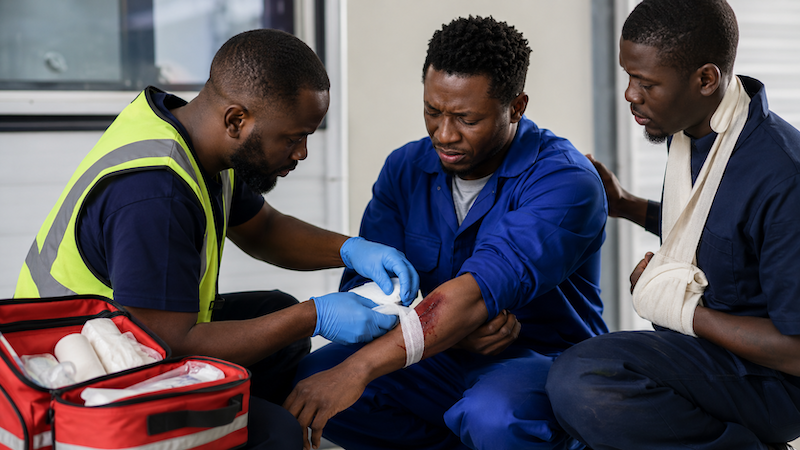
A worker slips while carrying metal equipment and falls heavily. He has a deep cut on his forearm with heavy bleeding and complains of severe pain in his wrist.
The first aider checks that the area is safe, wears gloves, and asks a bystander to call emergency services. The first aider applies firm direct pressure to the bleeding wound with a clean dressing. When the bleeding reduces, the dressing is secured with a bandage. The wrist is supported in the position found without trying to straighten it. The casualty is helped to lie down, kept warm, and monitored for signs of shock.
When responders arrive, the first aider explains what happened, how long the bleeding lasted, what care was given, and that a wrist injury is suspected.
The key lesson is that bleeding control comes first, then support the injury, prevent shock, and hand over clearly.
Practical Skills to Demonstrate
Learners should practise:
- Wearing gloves correctly.
- Applying direct pressure to bleeding.
- Applying a wound dressing.
- Bandaging a limb.
- Supporting an injured arm with a sling.
- Checking circulation after bandaging.
- Supporting a suspected fracture.
- Cooling a simulated burn.
- Managing an embedded object using padding.
- Keeping a casualty still for suspected spinal injury.
- Giving a clear emergency handover.
Practical Skill Checklist
| Skill | Competent |
|---|---|
| Checks scene safety | |
| Uses PPE or barrier protection | |
| Controls severe bleeding with direct pressure | |
| Applies dressing and bandage correctly | |
| Does not remove embedded objects | |
| Supports suspected fracture in position found | |
| Checks circulation after bandaging | |
| Cools burn correctly | |
| Avoids unsafe burn remedies | |
| Recognises signs of shock | |
| Keeps casualty still when spinal injury is suspected | |
| Calls emergency help when required | |
| Gives clear handover |
Quick Recap
Injury management involves giving safe immediate care for bleeding, wounds, fractures, burns, sprains, dislocations, head injuries, chest injuries, abdominal injuries, crush injuries, amputations, and suspected spinal injuries. The first aider should always check scene safety, protect against infection, manage life-threatening bleeding, maintain airway and breathing, prevent shock, support injured parts, avoid unnecessary movement, and call emergency services for serious injuries. Direct pressure is the main method for controlling severe bleeding. Burns should be cooled under running water for at least 20 minutes. Fractures should be supported in the position found. Suspected spinal injuries should be kept still unless movement is needed for safety or airway protection. Good injury management is calm, safe, practical, and focused on preventing the injury from getting worse.