Burns and Environmental Emergencies
Introduction to Burns and Environmental Emergencies
Burns and environmental emergencies can happen at home, in workplaces, schools, kitchens, farms, workshops, construction sites, roadsides, and outdoor environments. They may be caused by heat, chemicals, electricity, sunlight, hot weather, cold weather, or prolonged exposure to harsh environmental conditions.
A first aider must act quickly, calmly, and safely. The goal is to stop the burning or exposure, cool or warm the casualty appropriately, protect the injured area, prevent the condition from getting worse, and arrange medical help when required.
This module covers thermal burns, chemical burns, electrical burns, sunburn, heat exhaustion, heat stroke, and hypothermia.
General First Aid Priorities
For all burns and environmental emergencies, follow these basic priorities:
- Check the scene for danger.
- Protect yourself first.
- Remove the casualty from the source of harm if safe.
- Call emergency help if the condition is serious.
- Give immediate first aid.
- Monitor breathing, response, and signs of shock.
- Keep the casualty calm and reassured.
- Do not apply harmful traditional remedies.
- Hand over clearly to medical responders.
A first aider should never put themselves in danger to help someone else.
Thermal Burns
Thermal burns are caused by heat. They may result from fire, hot water, steam, hot oil, hot metal, explosions, cooking accidents, hot engines, or industrial equipment.
A burn is usually caused by dry heat such as flame or hot metal, while a scald is caused by wet heat such as hot water or steam. Both can damage the skin and deeper tissues.
Signs of Thermal Burns
Signs may include:
- Pain.
- Redness.
- Swelling.
- Blisters.
- Peeling skin.
- White, waxy, brown, or charred skin.
- Clothing stuck to the skin.
- Shock in serious burns.
- Breathing difficulty if smoke or hot gases were inhaled.
The severity of a burn depends on the depth, size, location, cause, age of the casualty, and whether breathing is affected.
First Aid for Thermal Burns
For thermal burns and scalds:
- Make the area safe.
- Move the casualty away from the heat source if safe.
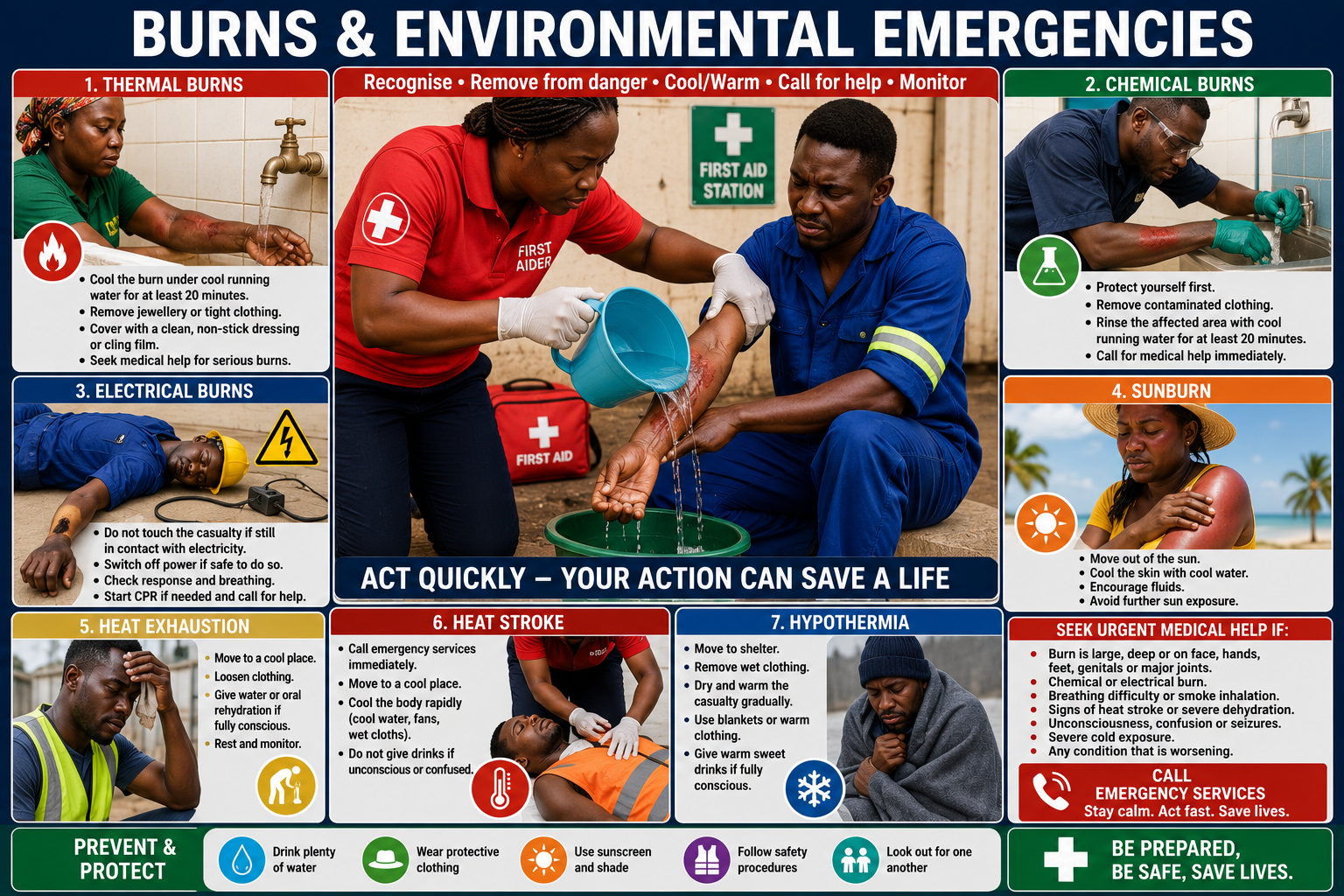
- Cool the burn under cool running water for at least 20 minutes.
- Remove jewellery, belts, watches, or tight clothing near the burn before swelling begins.
- Do not remove clothing that is stuck to the skin.
- Cover the burn with cling film or a sterile non-stick dressing.
- Keep the casualty warm, but avoid warming the burned area.
- Call emergency help for serious burns.
- Monitor breathing and signs of shock.
The British Red Cross advises cooling burns under cold running water for at least 20 minutes because cooling reduces pain, swelling, and the risk of scarring.
What Not to Do for Burns
Do not:
- Apply butter.
- Apply oil.
- Apply toothpaste.
- Apply raw egg.
- Apply creams or lotions to serious burns.
- Use ice directly on the burn.
- Burst blisters.
- Remove clothing stuck to the skin.
- Cover the burn with fluffy cotton wool.
- Delay cooling while looking for special dressings.
- Put adhesive tape directly on burned skin.
Wrong treatment can worsen tissue damage and increase infection risk.
Covering a Burn
After cooling the burn, cover it loosely.
Good options include:
- Cling film laid over the burn.
- Sterile non-stick dressing.
- Clean plastic bag for a hand or foot burn.
- Clean cloth if nothing else is available.
Do not wrap cling film tightly around a limb because swelling may occur. NHS guidance advises cooling burns with running water, removing nearby clothing or jewellery unless stuck, and laying cling film over the burn after cooling.
When Burns Need Urgent Medical Help
Seek urgent medical help for:
- Burns larger than the casualty’s palm.
- Deep burns.
- Burns on the face, hands, feet, genitals, or major joints.
- Burns that go around a limb.
- Chemical burns.
- Electrical burns.
- Burns in babies, children, elderly people, or vulnerable people.
- Burns with breathing difficulty.
- Burns caused by explosion.
- Burns with signs of shock.
- Burns where clothing is stuck to the skin.
- Burns with white, charred, leathery, or painless areas.
When in doubt, seek medical care.
Smoke Inhalation
A casualty exposed to fire, smoke, or explosion may have airway damage, even if the skin burn looks small.
Signs of smoke inhalation may include:
- Coughing.
- Difficulty breathing.
- Hoarse voice.
- Soot around mouth or nose.
- Burns around the face.
- Singed nose hairs.
- Confusion.
- Chest tightness.
- Wheezing.
- Loss of consciousness.
Call emergency services urgently. Keep the casualty sitting upright if breathing is difficult and monitor them closely.
Chemical Burns
Chemical burns are caused by corrosive or irritating substances such as acids, alkalis, cleaning agents, pesticides, cement, battery acid, industrial chemicals, fuel additives, or laboratory chemicals.
Chemical burns can continue damaging tissue until the chemical is removed or diluted. Protect yourself first because the chemical can also harm the first aider.
Signs of Chemical Burns
Signs may include:
- Burning pain.
- Redness.
- Blistering.
- Skin irritation.
- White or blackened skin.
- Chemical smell.
- Clothing stained or wet with chemical.
- Eye pain or watering.
- Breathing difficulty if fumes were inhaled.
- Nausea, coughing, or dizziness.
Chemical exposure to the eyes, face, airway, or large areas of skin is an emergency.
First Aid for Chemical Burns
For chemical burns:
- Check safety and avoid contact with the chemical.
- Wear gloves or use a barrier if available.
- Remove the casualty from the source if safe.
- Brush off dry chemical powder carefully before rinsing, if safe.
- Remove contaminated clothing and jewellery.
- Rinse the affected area with cool running water for at least 20 minutes.
- Avoid spreading the chemical to unaffected skin.
- Call emergency services or poison advice support if available.
- Keep the chemical container or label for responders, if safe.
- Monitor breathing and signs of shock.
NHS guidance advises wearing protective gloves, removing contaminated clothing, and rinsing chemical burns with cool running water for at least 20 minutes.
Chemical Burns to the Eye
Chemical eye exposure is urgent.
First aid steps:
- Protect yourself.
- Hold the eyelids open gently.
- Rinse the eye continuously with clean running water.
- Allow water to flow away from the unaffected eye.
- Remove contact lenses only if easy to do.
- Continue rinsing while arranging urgent medical help.
- Do not let the casualty rub the eye.
Chemical eye burns can cause permanent damage and need urgent medical care.
Electrical Burns
Electrical burns occur when electric current passes through the body. They may cause visible skin burns, deep internal injury, heart rhythm problems, breathing problems, muscle damage, falls, and unconsciousness.
Electrical injuries can be more serious than they appear. A small mark on the skin may hide deeper tissue damage.
Dangers of Electrical Injuries
Electrical injury may cause:
- Burns at entry and exit points.
- Cardiac arrest.
- Irregular heartbeat.
- Breathing difficulty.
- Muscle spasms.
- Seizures.
- Falls from height.
- Spinal injury.
- Confusion or unconsciousness.
- Internal tissue damage.
Treat significant electrical injury as serious.
First Aid for Electrical Burns and Electric Shock
For electrical injury:
- Do not touch the casualty if they are still in contact with electricity.
- Switch off power if safe.
- Call emergency services.
- Once safe, check response and breathing.
- Start CPR if the casualty is unresponsive and not breathing normally.
- Cool visible burns with cool running water if safe and practical.
- Cover burns with a sterile non-stick dressing or clean covering.
- Treat for shock.
- Monitor the casualty until help arrives.
Never approach high-voltage electrical incidents unless the power has been confirmed isolated by competent personnel.
Lightning Strike
Lightning is a form of electrical injury. A person struck by lightning does not remain electrically charged, so they can be touched once the scene is safe.
First aid:
- Move to safety if there is ongoing lightning risk.
- Call emergency services.
- Check response and breathing.
- Start CPR if needed.
- Treat burns or injuries.
- Monitor until help arrives.
Multiple casualties may occur during lightning incidents. Give priority to those who are unresponsive and not breathing normally.
Sunburn
Sunburn is skin damage caused by ultraviolet radiation from the sun. It can happen during outdoor work, sports, travel, farming, construction, driving, or long exposure without protection.
Sunburn may seem minor, but severe sunburn can cause blistering, dehydration, heat illness, and increased long-term skin risk.
Signs of Sunburn
Signs may include:
- Red, painful skin.
- Warm or hot skin.
- Swelling.
- Tenderness.
- Blisters.
- Peeling after a few days.
- Headache.
- Fever or chills in severe cases.
- Nausea or dizziness.
- Signs of dehydration.
Severe sunburn with blistering, fever, confusion, or dehydration needs medical attention.
First Aid for Sunburn
For sunburn:
- Move the casualty out of the sun.
- Cool the skin with cool water or cool wet cloths.
- Encourage small sips of water if fully conscious and able to drink.
- Use light, loose clothing.
- Do not burst blisters.
- Avoid further sun exposure.
- Seek medical help for severe blistering, fever, confusion, dehydration, or sunburn in babies and young children.
Mayo Clinic advises staying out of the sun while sunburn heals and using cool damp towels for sunburned eyes, while avoiding rubbing the eyes.
Preventing Sunburn
Prevention includes:
- Avoid prolonged exposure during the hottest part of the day.
- Wear wide-brimmed hats.
- Wear long, light clothing.
- Use sunscreen where available.
- Use shade.
- Drink water regularly.
- Protect children and outdoor workers carefully.
- Reapply sunscreen after sweating or washing.
Sun protection is especially important for people working outdoors.
Heat Exhaustion
Heat exhaustion occurs when the body becomes overheated, often from high temperature, heavy sweating, dehydration, physical work, poor ventilation, or prolonged sun exposure. It is serious because it can progress to heat stroke if not managed quickly.
Heat exhaustion can happen during outdoor labour, sports, crowded events, farming, construction, workshops, kitchens, factories, or poorly ventilated rooms.
Signs of Heat Exhaustion
Signs may include:
- Heavy sweating.
- Headache.
- Dizziness.
- Weakness.
- Tiredness.
- Thirst.
- Nausea or vomiting.
- Muscle cramps.
- Fast pulse.
- Cool, pale, or clammy skin.
- Irritability.
- Reduced urine output.
- Fainting.
The CDC lists headache, nausea, dizziness, weakness, thirst, heavy sweating, elevated body temperature, and decreased urine output as signs of heat exhaustion.
First Aid for Heat Exhaustion
For heat exhaustion:
- Move the casualty to a cool place.
- Help them rest.
- Loosen tight clothing.
- Cool the body with fans, wet cloths, misting, or cool water.
- Give small sips of cool water or oral rehydration drink if fully conscious.
- Stop physical activity.
- Monitor closely.
- Seek medical help if symptoms worsen, do not improve, or the casualty becomes confused or less responsive.
The NHS advises cooling someone with heat exhaustion and giving fluids; heatstroke symptoms include very high temperature, hot skin, fast breathing, fast heartbeat, confusion, and restlessness.
Heat Stroke
Heat stroke is a life-threatening emergency. It happens when the body can no longer control its temperature. The body temperature rises dangerously, and the brain, heart, kidneys, muscles, and other organs can be damaged.
Heat stroke can happen after heat exhaustion, but it can also happen suddenly during extreme heat or heavy physical work.
Signs of Heat Stroke
Signs may include:
- Confusion.
- Restlessness or unusual behaviour.
- Loss of consciousness.
- Seizures.
- Very high body temperature.
- Hot skin.
- Fast breathing.
- Fast heartbeat.
- Severe headache.
- Vomiting.
- Weakness or collapse.
- No sweating or heavy sweating may both occur, depending on the situation.
Heat stroke is a medical emergency. Mayo Clinic describes heatstroke as life-threatening because it can damage the brain and other vital organs, and it may happen from strenuous activity in heat or being in a hot place too long.
First Aid for Heat Stroke
For suspected heat stroke:
- Call emergency services immediately.
- Move the casualty to a cooler place if safe.
- Remove unnecessary clothing.
- Cool the body rapidly.
- Use cool water, wet cloths, fans, ice packs wrapped in cloth, or immersion where trained and safe.
- Place ice packs or cold cloths around the neck, armpits, and groin if available.
- Do not give drink if the casualty is confused, drowsy, fitting, or unconscious.
- Monitor breathing and response.
- Be ready to start CPR if they become unresponsive and are not breathing normally.
Do not delay cooling while waiting for help. Severe heat illness requires active cooling, not just drinking water. CDC heat-stress first-aid guidance emphasises cooling the body as quickly as possible for suspected severe heat illness.
Heat Exhaustion vs Heat Stroke
| Feature | Heat Exhaustion | Heat Stroke |
|---|---|---|
| Seriousness | Serious but usually reversible with cooling | Life-threatening emergency |
| Mental state | Usually alert, tired, dizzy, weak | Confused, restless, fitting, or unconscious |
| Skin | Often heavy sweating, cool or clammy | Hot skin may occur; sweating may or may not be present |
| Action | Move to cool place, cool body, give fluids if alert | Call emergency help, cool rapidly, monitor airway |
| Fluids | Give small sips if fully conscious | Do not give if confused or unconscious |
| Medical help | Needed if severe or not improving | Always urgent |
Confusion or reduced consciousness in a hot environment should be treated as heat stroke.
Heat Cramps
Heat cramps are painful muscle spasms caused by heat, sweating, and salt loss.
They often affect:
- Legs.
- Arms.
- Abdomen.
- Back.
First aid:
- Stop activity.
- Move to a cool place.
- Rest.
- Give water or oral rehydration drink if fully conscious.
- Gently stretch the muscle.
- Seek medical help if cramps are severe, last long, or the casualty has medical conditions.
Heat cramps can be an early warning sign of heat illness.
Hypothermia
Hypothermia occurs when the body loses heat faster than it can produce it, causing body temperature to fall dangerously low. It can happen in cold weather, rain, wind, wet clothing, immersion in water, cold rooms, mountain areas, or after long exposure.
Hypothermia can occur even in mild temperatures if the casualty is wet, exhausted, elderly, very young, injured, intoxicated, or exposed for a long time.
Signs of Hypothermia
Signs may include:
- Shivering.
- Cold, pale skin.
- Tiredness.
- Confusion.
- Slurred speech.
- Poor coordination.
- Slow breathing.
- Weak pulse.
- Drowsiness.
- Irritability.
- Loss of consciousness.
- Shivering may stop in severe hypothermia.
Severe hypothermia is life-threatening.
First Aid for Hypothermia
For suspected hypothermia:
- Move the casualty to shelter if safe.
- Call emergency services if symptoms are serious.
- Handle the casualty gently.
- Remove wet clothing if possible.
- Dry the casualty.
- Cover with blankets, clothing, or insulating material.
- Cover the head, leaving the face clear.
- Warm the casualty gradually.
- Give warm sweet drinks only if fully awake and able to swallow.
- Monitor breathing and response.
Do not warm the casualty too quickly. Do not rub the skin. Do not give alcohol.
What Not to Do for Hypothermia
Do not:
- Rub the casualty’s arms or legs.
- Put the casualty in a hot bath.
- Use direct intense heat such as fire or hot water bottle directly on skin.
- Give alcohol.
- Give drinks if the casualty is drowsy or unconscious.
- Allow the casualty to walk around unnecessarily.
- Handle roughly.
Rough handling may worsen the condition, especially in severe hypothermia.
Cold Water Exposure
Cold water can cool the body very quickly. A casualty rescued from cold water may be exhausted, confused, shivering, or unconscious.
First aid:
- Call emergency help.
- Remove from water only if safe.
- Keep the casualty lying down.
- Remove wet clothing if possible.
- Dry and insulate.
- Protect from wind.
- Monitor breathing.
- Be ready to start CPR if unresponsive and not breathing normally.
Do not assume someone is fine because they are awake after cold-water exposure.
Environmental Emergency Prevention
Many environmental emergencies are preventable.
Prevention includes:
- Drink water regularly in hot environments.
- Take breaks in shade.
- Wear light clothing in heat.
- Use sun protection outdoors.
- Avoid heavy work during peak heat where possible.
- Watch vulnerable people closely.
- Wear warm layers in cold conditions.
- Keep dry in cold weather.
- Avoid alcohol in extreme heat or cold.
- Plan outdoor activities safely.
- Recognise early warning signs.
Workers, children, elderly people, pregnant women, and people with medical conditions may be more vulnerable.
When to Call Emergency Services
Call emergency services for:
- Chemical burns.
- Electrical burns.
- Deep or large burns.
- Burns on face, hands, feet, genitals, or major joints.
- Burns with breathing difficulty.
- Smoke inhalation.
- Heat stroke.
- Heat exhaustion that worsens or does not improve.
- Confusion, seizure, or unconsciousness.
- Severe hypothermia.
- Casualty who is not breathing normally.
- Casualty showing signs of shock.
- Any burn or environmental emergency involving a child, elderly person, or vulnerable person where you are concerned.
When unsure, call for medical advice or emergency help.
Handover to Medical Responders
When help arrives, give clear information:
- What happened.
- Time of incident or exposure.
- Cause of burn or environmental emergency.
- First aid given.
- How long the burn was cooled.
- Any chemical involved.
- Whether electricity was involved.
- Whether the casualty was unconscious.
- Changes in breathing, response, or behaviour.
- Any known medical conditions.
- Any fluids given.
- Time emergency call was made.
Good handover helps responders continue care quickly.
Common Mistakes
Avoid these mistakes:
- Delaying cooling of burns.
- Applying toothpaste, oil, butter, or herbs to burns.
- Using ice directly on burns.
- Removing clothing stuck to burned skin.
- Ignoring smoke inhalation.
- Touching a casualty still connected to electricity.
- Rinsing chemical burns without protecting yourself.
- Giving drink to a confused or unconscious casualty.
- Treating heat stroke like simple tiredness.
- Failing to cool heat stroke rapidly.
- Rubbing a hypothermic casualty’s skin.
- Giving alcohol to a cold casualty.
- Ignoring confusion in heat or cold exposure.
- Failing to call emergency help for serious cases.
What a First Aider Should Never Do
A first aider should never:
- Put themselves in danger.
- Approach electrical hazards before power is isolated.
- Touch chemicals without protection.
- Ignore airway or breathing problems.
- Burst burn blisters.
- Apply traditional remedies to serious burns.
- Delay emergency help for chemical, electrical, or deep burns.
- Leave a heat stroke casualty without urgent help.
- Give food or drink to an unconscious or confused casualty.
- Warm a hypothermic casualty too aggressively.
- Allow a seriously ill casualty to walk around.
- Hide important details from responders.
Real-Life Scenario
A kitchen worker accidentally spills hot oil on his forearm. The skin becomes red, painful, and blistered. A first aider checks that the area is safe, moves the worker away from the heat source, and places the burned arm under cool running water for at least 20 minutes. A ring near the burned area is removed before swelling begins. The first aider does not apply oil, butter, toothpaste, or cream. After cooling, the burn is covered loosely with cling film, and medical help is arranged because the burn is blistered and painful.
The key lesson is simple: stop the burning, cool the burn properly, cover it safely, and seek help when needed.
Practical Skills to Demonstrate
Learners should practise:
- Cooling a simulated burn correctly.
- Covering a burn safely with cling film or dressing.
- Demonstrating what not to apply to burns.
- Managing a simulated chemical splash.
- Demonstrating safe approach to electrical injury.
- Recognising heat exhaustion signs.
- Giving first aid for heat exhaustion.
- Recognising heat stroke signs.
- Cooling a heat stroke casualty rapidly.
- Giving first aid for hypothermia.
- Giving clear emergency handover.
Practical Skill Checklist
| Skill | Competent |
|---|---|
| Checks scene safety | |
| Uses PPE or barrier protection | |
| Removes casualty from heat source safely | |
| Cools thermal burn correctly | |
| Removes jewellery or tight clothing near burn | |
| Does not remove clothing stuck to skin | |
| Covers burn safely | |
| Handles chemical burn safely | |
| Avoids contact with electrical hazard | |
| Recognises heat exhaustion | |
| Recognises heat stroke | |
| Begins rapid cooling for heat stroke | |
| Recognises hypothermia | |
| Warms hypothermia casualty gradually | |
| Calls emergency help when required | |
| Gives clear handover |
Quick Recap
Burns and environmental emergencies require fast, safe, and practical first aid. Thermal burns should be cooled under cool running water for at least 20 minutes and covered loosely after cooling. Chemical burns require self-protection, removal of contaminated clothing, and continuous rinsing with water. Electrical burns require power isolation before touching the casualty and urgent medical help. Sunburn should be cooled and protected from further sun exposure. Heat exhaustion requires rest, cooling, and fluids if the casualty is fully conscious. Heat stroke is life-threatening and requires emergency help and rapid cooling. Hypothermia requires gentle handling, removal from cold exposure, dry covering, gradual warming, and urgent help if severe. A first aider should protect themselves, act quickly, avoid harmful remedies, monitor the casualty, and call for help when needed.