
Incident Reporting and Investigation
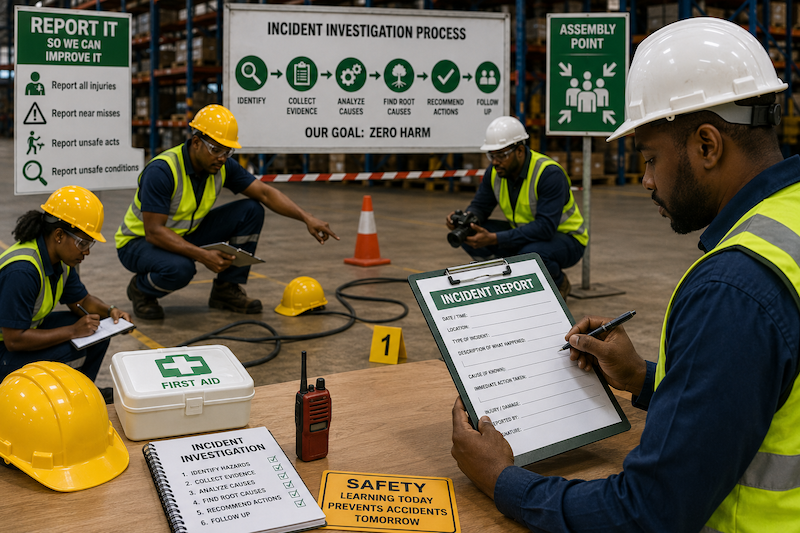
Incident reporting and investigation are important parts of workplace safety. They help organisations learn from accidents, near misses, unsafe conditions, and dangerous events so that similar incidents do not happen again.
An incident is not only an accident that causes injury. It may also be a near miss, equipment damage, fire, spill, unsafe act, unsafe condition, environmental release, security event, or any unplanned event that could affect people, property, operations, or the environment.
Reporting incidents early helps the organisation respond quickly, provide care to injured persons, control hazards, investigate causes, and put corrective actions in place. Investigation helps identify what happened, why it happened, and what must be changed to prevent recurrence.
The purpose of incident reporting and investigation is not to blame people. The main purpose is to learn, improve systems, correct unsafe conditions, and build a stronger safety culture.
Meaning of an Incident
An incident is an unplanned event that results in, or could have resulted in, injury, illness, damage, loss, environmental harm, or disruption to work.
Examples of incidents include:
- A worker slipping on a wet floor.
- A machine guard falling off.
- A chemical spill.
- A fire outbreak.
- A vehicle collision.
- A ladder collapsing.
- A worker receiving an electric shock.
- A gas leak.
- A falling object narrowly missing a worker.
- A worker cutting their hand with a tool.
- A near miss involving a forklift.
- A blocked emergency exit discovered during work.
- A damaged electrical cable found in use.
- A release of oil into a drain.
- A worker fainting during work.
All incidents should be taken seriously because they provide warning signs about workplace hazards.
Meaning of an Accident
An accident is an unplanned event that causes injury, illness, damage, loss, or harm.
Examples include:
- A worker falls from a ladder and breaks a leg.
- A fire damages a storage area.
- A vehicle hits a pedestrian.
- A worker suffers a burn from hot equipment.
- A chemical splash injures a worker’s eye.
- A falling object damages equipment.
- A worker cuts a finger while using a blade.
An accident has already caused harm. It should be reported, investigated, and used as a learning opportunity.
Meaning of a Near Miss
A near miss is an unplanned event that could have caused injury, illness, damage, or environmental harm but did not.
Near misses are also called close calls.
Examples include:
- A tool falls from height but does not hit anyone.
- A worker slips but does not fall.
- A forklift nearly hits a pedestrian.
- A ladder almost tips over.
- A chemical container leaks but is discovered before exposure occurs.
- A worker almost touches a live wire.
- A fire starts but is quickly extinguished before damage occurs.
- A load shifts during lifting but does not fall.
- A vehicle reverses without seeing a worker, but the worker moves away in time.
Near misses are very important because they show that something went wrong. If not corrected, the same situation may later cause serious injury or death.
Difference Between Accident, Incident, and Near Miss
The terms accident, incident, and near miss are closely related but have different meanings.
An accident causes harm or damage.
An incident is a broader term that includes accidents, near misses, unsafe events, damage, environmental releases, and dangerous occurrences.
A near miss does not cause harm, but it had the potential to cause harm.
For example:
- Accident: A worker slips on oil and breaks an arm.
- Near miss: A worker slips on oil but regains balance and is not injured.
- Incident: Both the accident and the near miss should be treated as incidents and reported.
Understanding the difference helps workers know what should be reported.
Meaning of Incident Reporting
Incident reporting is the process of informing the right people about an accident, near miss, unsafe condition, injury, damage, or dangerous event.
Reporting may be done verbally, through a written form, by phone, through a digital system, or by following the workplace reporting procedure.
Incident reporting helps ensure that:
- Injured persons receive help.
- Hazards are controlled.
- Supervisors and safety personnel are informed.
- The incident is recorded.
- Investigation can begin.
- Corrective actions are taken.
- Legal or company reporting requirements are met.
- Lessons are learned.
An incident that is not reported cannot be properly investigated or prevented from happening again.
Why Incident Reporting is Important
Incident reporting is important because it helps prevent future accidents.
Reporting helps to:
- Save lives.
- Provide quick medical support.
- Control hazards before they harm more people.
- Identify unsafe conditions.
- Identify unsafe behaviours.
- Prevent repeat incidents.
- Improve safety procedures.
- Improve training.
- Improve supervision.
- Improve equipment maintenance.
- Support legal compliance.
- Support insurance or compensation processes where applicable.
- Improve emergency response.
- Build trust and transparency.
- Strengthen safety culture.
Every report provides information that can help make the workplace safer.
Why Near-Miss Reporting is Important
Near-miss reporting is one of the strongest ways to prevent serious accidents.
A near miss is a warning. It shows that a hazard exists and that a worker was lucky not to be injured.
Near-miss reporting helps to:
- Identify hazards before injuries occur.
- Prevent serious accidents.
- Improve risk assessment.
- Correct unsafe conditions early.
- Improve procedures.
- Increase worker awareness.
- Encourage proactive safety behaviour.
- Reduce repeated unsafe events.
- Improve communication.
- Build a learning culture.
Ignoring near misses allows hazards to remain in the workplace.
Types of Incidents
Incidents can be grouped into different types depending on what happened and what was affected.
Injury Incidents
Injury incidents involve harm to a person.
Examples include:
- Cuts.
- Burns.
- Fractures.
- Electric shock.
- Sprains.
- Strains.
- Eye injuries.
- Head injuries.
- Crush injuries.
- Chemical burns.
- Heat illness.
- Falling injuries.
- Manual handling injuries.
All injuries should be reported, even if they appear minor.
Illness Incidents
Illness incidents involve health conditions linked to workplace exposure or work activity.
Examples include:
- Breathing difficulty after inhaling fumes.
- Skin irritation from chemicals.
- Heat exhaustion.
- Food poisoning from workplace canteen.
- Noise-related hearing problems.
- Work-related stress illness.
- Infection from biological exposure.
- Dizziness from poor ventilation.
- Allergic reaction to a workplace substance.
Work-related illnesses may develop slowly, so workers should report symptoms early.
Property Damage Incidents
Property damage incidents involve damage to buildings, machines, tools, vehicles, materials, or equipment.
Examples include:
- Forklift hitting a rack.
- Machine part breaking.
- Vehicle collision.
- Damaged ladder.
- Broken window.
- Fire damage.
- Electrical panel damage.
- Damaged scaffold.
- Tool failure.
- Damaged pipe or valve.
Property damage may indicate a safety problem that could later injure someone.
Environmental Incidents
Environmental incidents involve harm or potential harm to land, water, air, animals, plants, or surrounding communities.
Examples include:
- Oil spill.
- Chemical spill.
- Waste dumped incorrectly.
- Smoke release.
- Fuel leak.
- Contaminated water discharge.
- Chemical entering a drain.
- Excessive dust emission.
- Improper disposal of hazardous waste.
- Sewage release.
- Noise pollution.
Environmental incidents should be reported immediately so that harm can be controlled.
Fire and Explosion Incidents
Fire and explosion incidents involve uncontrolled fire, smoke, ignition, blast, or explosion risk.
Examples include:
- Fire in a workshop.
- Electrical fire.
- Gas explosion.
- Fuel ignition.
- Sparks igniting nearby materials.
- Smoke from overheating equipment.
- Small fire extinguished quickly.
- Explosion from a pressure vessel.
- Battery fire.
- Hot work fire.
Even small fires should be reported because they may reveal serious hazards.
Vehicle and Traffic Incidents
Vehicle incidents involve moving vehicles, mobile equipment, or transport activities.
Examples include:
- Forklift collision.
- Reversing accident.
- Vehicle hitting a pedestrian.
- Road traffic accident.
- Load falling from a vehicle.
- Vehicle overturning.
- Mobile crane near miss.
- Collision between site vehicles.
- Unsafe parking incident.
- Pedestrian nearly struck by a vehicle.
Vehicle incidents can be serious because they may involve high force, blind spots, and heavy equipment.
Equipment Failure Incidents
Equipment failure incidents happen when tools, machines, systems, or equipment fail during use.
Examples include:
- Machine guard failure.
- Brake failure.
- Ladder collapse.
- Scaffold part failure.
- Pressure hose burst.
- Lifting sling failure.
- Electrical tool overheating.
- Generator malfunction.
- Fire alarm failure.
- PPE failure.
- Emergency equipment failure.
Equipment failure should be reported because it can expose workers to serious hazards.
Security Incidents
Security incidents involve threats to people, property, or workplace safety.
Examples include:
- Violence.
- Threats.
- Theft.
- Vandalism.
- Unauthorised access.
- Suspicious package.
- Workplace conflict.
- Harassment.
- Assault.
- Civil disturbance affecting work.
- Sabotage.
Security incidents should be reported according to workplace procedures.
Unsafe Acts
An unsafe act is a dangerous behaviour that can cause an incident.
Examples include:
- Not wearing PPE.
- Running in the workplace.
- Ignoring safety signs.
- Taking shortcuts.
- Using damaged tools.
- Operating equipment without training.
- Removing machine guards.
- Working at height without protection.
- Blocking emergency exits.
- Horseplay.
- Using a phone while operating equipment.
- Not following procedures.
Unsafe acts should be corrected and reported where necessary to prevent harm.
Unsafe Conditions
An unsafe condition is a physical workplace condition that can cause an incident.
Examples include:
- Wet floors.
- Exposed wires.
- Poor lighting.
- Broken ladders.
- Damaged tools.
- Blocked walkways.
- Poor ventilation.
- Leaking containers.
- Missing guardrails.
- Faulty machines.
- Unstable stacking.
- Open holes.
- Fire hazards.
- Poor housekeeping.
Unsafe conditions should be reported immediately.
What Should Be Reported
Workers should report anything that causes harm or could cause harm.
Report:
- Injuries.
- Illnesses.
- Near misses.
- Unsafe acts.
- Unsafe conditions.
- Fires.
- Smoke.
- Chemical spills.
- Oil spills.
- Gas leaks.
- Electric shock.
- Equipment damage.
- Property damage.
- Vehicle incidents.
- Falling objects.
- Environmental releases.
- Security threats.
- Damaged PPE.
- Faulty tools.
- Blocked emergency exits.
- Failed emergency equipment.
- Unusual noises, sparks, smells, or overheating.
- Any situation that feels unsafe.
When unsure, report it.
When to Report an Incident
Incidents should be reported as soon as possible.
Immediate reporting is important when:
- Someone is injured.
- There is danger to life.
- A hazard is still present.
- Emergency response is needed.
- There is fire, smoke, gas, or spill.
- Equipment is unsafe.
- The environment may be harmed.
- The incident may affect others.
- The incident may worsen if not controlled.
Delaying a report can allow hazards to continue and may make investigation more difficult.
Who to Report To
The person or department to report to may differ depending on the workplace.
Reports may go to:
- Supervisor.
- Line manager.
- HSE officer.
- Safety representative.
- First aider.
- Emergency response team.
- Security personnel.
- Maintenance team.
- Site manager.
- Human resources, where relevant.
- Environmental officer, where relevant.
Workers should know the reporting chain in their workplace.
How to Report an Incident
Incident reporting should follow workplace procedure.
Common reporting methods include:
- Verbal report.
- Phone call.
- Radio communication.
- Written incident report form.
- Digital reporting system.
- Email.
- Emergency hotline.
- Safety observation card.
- Near-miss card.
For serious incidents, verbal reporting should happen immediately, followed by written documentation.
Information to Include in an Incident Report
An incident report should be clear, accurate, and factual.
Important information may include:
- Date and time of incident.
- Exact location.
- Names of people involved.
- Names of witnesses.
- Type of incident.
- Description of what happened.
- Task being performed.
- Equipment or materials involved.
- Injury or damage caused.
- Immediate actions taken.
- Emergency response provided.
- Hazards observed.
- PPE being used.
- Weather or environmental conditions, where relevant.
- Photos or sketches, where allowed.
- Person reporting.
- Supervisor informed.
- Suggested corrective actions, where appropriate.
Reports should describe facts, not assumptions or blame.
Good Incident Report Writing
A good incident report should be:
- Clear.
- Factual.
- Honest.
- Complete.
- Timely.
- Objective.
- Easy to understand.
- Specific.
- Free from exaggeration.
- Free from blame language.
For example, instead of writing “The worker was careless,” it is better to write “The worker was using the grinder without eye protection at the time of the incident.”
The second statement is factual and useful for investigation.
Poor Incident Report Writing
Poor reporting can make investigation difficult.
Avoid:
- Guessing.
- Blaming people.
- Hiding facts.
- Changing the story.
- Using unclear words.
- Leaving out important details.
- Waiting too long before reporting.
- Copying another person’s statement.
- Reporting only serious injuries and ignoring near misses.
- Making false statements.
- Destroying evidence.
Accurate reporting supports fair and effective investigation.
Immediate Actions After an Incident
After an incident occurs, immediate actions may be needed to protect people and control the situation.
Immediate actions may include:
- Stop work.
- Raise the alarm.
- Call for help.
- Provide first aid.
- Evacuate if needed.
- Isolate the area.
- Control fire, spill, gas, or electrical hazards where safe.
- Prevent others from entering the danger area.
- Preserve the scene where possible.
- Report to supervisor or HSE personnel.
- Secure damaged equipment.
- Arrange medical care.
- Prevent further harm.
Life safety comes first before investigation.
Preserving the Incident Scene
Preserving the incident scene means keeping the area as unchanged as possible after the incident, where it is safe to do so.
This helps investigators understand what happened.
Preserving the scene may include:
- Avoid moving tools or equipment unnecessarily.
- Avoid cleaning up immediately unless needed for safety.
- Barricade the area.
- Keep unauthorised people away.
- Take photos where allowed.
- Record positions of objects.
- Keep damaged parts.
- Protect evidence from being lost.
- Document any changes made for emergency response.
The scene may need to be changed to rescue injured people or remove immediate danger. Safety always comes first.
Incident Investigation
Incident investigation is the process of finding out what happened, why it happened, and what can be done to prevent it from happening again.
Investigation should focus on learning and prevention.
An investigation usually looks at:
- The event.
- The people involved.
- The task being performed.
- Equipment used.
- Work environment.
- Procedures.
- Training.
- Supervision.
- Communication.
- PPE.
- Maintenance.
- Risk assessment.
- Emergency response.
- Management systems.
A good investigation looks beyond the immediate event and identifies deeper causes.
Purpose of Incident Investigation
The purpose of investigation is to:
- Identify what happened.
- Identify why it happened.
- Identify immediate and root causes.
- Prevent recurrence.
- Improve safety controls.
- Improve procedures.
- Improve training.
- Improve supervision.
- Improve maintenance.
- Improve risk assessment.
- Correct unsafe systems.
- Support legal and company requirements.
- Share lessons learned.
- Strengthen safety culture.
Investigation should not be used mainly to punish workers. A blame-focused investigation can discourage reporting.
Incident Investigation Process
A basic incident investigation process includes:
- Respond to the incident.
- Make the area safe.
- Report the incident.
- Preserve evidence.
- Collect information.
- Interview witnesses.
- Review documents and procedures.
- Identify immediate causes.
- Identify root causes.
- Decide corrective and preventive actions.
- Assign responsibilities.
- Set completion dates.
- Communicate lessons learned.
- Follow up to confirm actions are completed.
- Review effectiveness.
The depth of investigation depends on the seriousness and potential seriousness of the incident.
Collecting Evidence
Evidence helps investigators understand the incident accurately.
Evidence may include:
- Photos.
- Videos.
- Witness statements.
- Damaged equipment.
- Tools involved.
- PPE used.
- Work permits.
- Risk assessments.
- Training records.
- Inspection records.
- Maintenance records.
- Weather conditions.
- CCTV footage where available.
- Safety Data Sheets.
- Machine settings.
- Alarm records.
- Emergency response records.
- Housekeeping conditions.
- Layout of the work area.
Evidence should be collected carefully and honestly.
Witness Statements
Witnesses can provide important information about what happened before, during, and after the incident.
A good witness statement should include:
- What the witness saw.
- What the witness heard.
- Where the witness was standing.
- What time the event happened.
- What task was being done.
- What actions were taken after the incident.
- Any hazards observed.
- Any instructions given before the task.
- Any changes in conditions.
Witnesses should give their own account in their own words. They should not be pressured to change their statement.
Interviewing Witnesses
Witness interviews should be respectful, calm, and focused on facts.
Good interview practice includes:
- Speak privately where possible.
- Ask open questions.
- Avoid blaming language.
- Listen carefully.
- Allow the person to explain.
- Clarify unclear points.
- Record information accurately.
- Ask what happened before and after the event.
- Ask about conditions, tools, training, and instructions.
- Thank the witness for providing information.
The purpose is to understand the event, not to intimidate people.
Immediate Causes
Immediate causes are the direct actions or conditions that led to the incident.
They are usually the most visible causes.
Examples include:
- Worker slipped on oil.
- Tool guard was missing.
- Worker used wrong PPE.
- Ladder was damaged.
- Cable was exposed.
- Load was not secured.
- Spill was not cleaned.
- Forklift reversed without warning.
- Worker lifted a load incorrectly.
- Emergency exit was blocked.
Immediate causes explain what directly happened, but they may not explain why the situation existed.
Root Causes
Root causes are the deeper reasons why an incident happened.
They are the underlying weaknesses in systems, planning, supervision, communication, training, maintenance, or management.
Examples include:
- No inspection system.
- Poor maintenance programme.
- Inadequate training.
- Poor supervision.
- Lack of clear procedure.
- Poor housekeeping culture.
- Production pressure.
- Poor communication.
- Inadequate risk assessment.
- Lack of suitable PPE.
- Poor contractor control.
- Weak reporting culture.
- Previous near misses ignored.
- Unsafe design of work area.
- Lack of accountability.
Root causes must be addressed to prevent recurrence.
Difference Between Immediate Cause and Root Cause
Immediate causes are the direct reasons the incident happened.
Root causes are the deeper system failures that allowed the immediate causes to exist.
Example:
A worker falls from a ladder.
Immediate cause:
- The ladder slipped.
- The worker overreached.
Root causes may include:
- No ladder inspection process.
- Worker was not trained on ladder safety.
- The task was not properly planned.
- A safer work platform was not provided.
- Supervisor did not check the work method.
- The risk assessment did not identify the fall hazard.
If only the immediate cause is corrected, the same type of incident may happen again.
Root Cause Analysis
Root Cause Analysis, commonly called RCA, is a method used to identify the underlying causes of an incident.
RCA helps answer:
- What happened?
- Why did it happen?
- What allowed it to happen?
- What system failed?
- What should be changed?
- How can recurrence be prevented?
RCA goes beyond blaming the last person involved. It looks at the full system around the incident.
The Five Whys Method
The Five Whys method is a simple root cause analysis technique. It involves asking “why?” several times until deeper causes are identified.
Example:
Incident: A worker slipped on oil.
Why did the worker slip?
Because there was oil on the floor.
Why was there oil on the floor?
Because a machine was leaking.
Why was the machine leaking?
Because a seal was damaged.
Why was the seal damaged and not replaced?
Because the machine inspection was not done.
Why was the inspection not done?
Because there was no clear maintenance schedule.
Possible root cause: Lack of preventive maintenance schedule.
This method helps move from the visible problem to the underlying system issue.
Fishbone Analysis Awareness
Fishbone analysis, also called cause-and-effect analysis, is a method used to group possible causes of an incident into categories.
Common categories may include:
- People.
- Equipment.
- Materials.
- Methods.
- Environment.
- Management.
For example, a hand injury may involve:
- People: worker not trained.
- Equipment: machine guard missing.
- Materials: sharp metal edges.
- Methods: unsafe procedure.
- Environment: poor lighting.
- Management: weak supervision.
Fishbone analysis helps investigators look at multiple possible causes instead of focusing on only one.
Corrective Actions
Corrective actions are actions taken to fix the causes of an incident and prevent it from happening again.
Examples include:
- Repair damaged equipment.
- Replace faulty tools.
- Clean spills.
- Install machine guards.
- Provide missing PPE.
- Train workers.
- Update procedures.
- Improve signage.
- Improve lighting.
- Improve housekeeping.
- Repair damaged flooring.
- Discipline unsafe behaviour where appropriate.
- Improve supervision.
- Review risk assessment.
- Improve emergency response.
Corrective actions should address the real causes identified during investigation.
Preventive Actions
Preventive actions are actions taken to stop similar incidents from happening in the future, even where they have not yet occurred.
Examples include:
- Regular inspections.
- Preventive maintenance.
- Safety training.
- Near-miss reporting campaigns.
- Better work planning.
- Improved storage systems.
- Stronger contractor control.
- Improved design of work areas.
- Periodic review of procedures.
- Safety audits.
- Behavioural safety observations.
- Emergency drills.
- Improved procurement standards.
- Better supervision.
Preventive actions focus on reducing future risk.
Difference Between Corrective and Preventive Actions
Corrective action fixes a problem that has already happened.
Preventive action reduces the chance of the problem happening in the future.
For example:
Incident: A worker trips over a loose cable.
Corrective action:
- Remove or secure the cable immediately.
Preventive action:
- Install cable management systems and include cable checks in routine inspections.
Both are important.
Effective Corrective and Preventive Actions
Corrective and preventive actions should be practical and effective.
Good actions are:
- Specific.
- Realistic.
- Assigned to a responsible person.
- Given a completion date.
- Based on investigation findings.
- Focused on preventing recurrence.
- Checked after completion.
- Communicated to affected workers.
- Documented properly.
Weak actions are often too general.
For example, “be careful” is a weak action. A stronger action would be “install non-slip flooring in the wash area and inspect it daily.”
Hierarchy of Controls in Corrective Actions
Corrective actions should consider the hierarchy of controls.
The hierarchy is:
- Elimination.
- Substitution.
- Engineering controls.
- Administrative controls.
- PPE.
When correcting an incident cause, higher-level controls are usually more effective.
For example, if workers are exposed to flying particles during cutting, stronger controls may include installing guards, changing the cutting method, or using enclosed equipment. PPE such as goggles is still important, but it should not be the only control if better controls are possible.
Incident Classification
Some workplaces classify incidents based on severity or potential severity.
Common categories may include:
- First aid case.
- Medical treatment case.
- Lost time injury.
- Restricted work case.
- Fatality.
- Near miss.
- Property damage.
- Environmental incident.
- Fire incident.
- Security incident.
- Dangerous occurrence.
Classification helps organisations decide the level of response, investigation, reporting, and management review needed.
First Aid Case
A first aid case is an injury that requires basic first aid treatment only.
Examples include:
- Small cut cleaned and covered.
- Minor scrape.
- Small bruise.
- Minor burn treated with first aid.
- Small splinter removed.
Even first aid cases should be recorded because repeated minor injuries may show a bigger safety problem.
Medical Treatment Case
A medical treatment case is an injury or illness that requires care from a medical professional beyond basic first aid.
Examples include:
- Stitches.
- Prescription medication.
- Treatment for burns.
- X-ray.
- Treatment for chemical exposure.
- Medical assessment after electric shock.
- Treatment for serious sprain.
Medical treatment cases usually require more detailed reporting and investigation.
Lost Time Injury
A lost time injury is a work-related injury that causes a worker to be unable to return to work for a period of time.
Lost time injuries are serious because they affect the worker’s health, income, productivity, and workplace performance.
Examples include:
- Fracture.
- Severe back injury.
- Serious burn.
- Major cut.
- Head injury.
- Injury requiring days away from work.
Lost time injuries usually require formal investigation and management review.
Dangerous Occurrence
A dangerous occurrence is a serious event that may not cause injury but has high potential for harm.
Examples include:
- Scaffold collapse.
- Crane failure.
- Explosion.
- Major gas leak.
- Serious electrical fault.
- Pressure vessel failure.
- Collapse of excavation.
- Major fire.
- Chemical release.
- Lifting equipment failure.
Dangerous occurrences should be reported and investigated urgently.
Incident Recording
Incident recording means documenting the details of incidents in a formal system or register.
Records may include:
- Incident report forms.
- Near-miss reports.
- First aid records.
- Investigation reports.
- Photos.
- Witness statements.
- Corrective action logs.
- Medical reports where appropriate.
- Environmental reports.
- Maintenance records.
- Training records.
Good records help track patterns and prove that actions were taken.
Incident Trends
Incident trends show repeated patterns in workplace incidents.
Examples of trends include:
- Many slips in the same area.
- Repeated hand injuries.
- Frequent tool damage.
- Multiple near misses involving forklifts.
- Repeated chemical spills.
- Several incidents during night shift.
- High number of injuries among new workers.
- Frequent electrical faults.
- Repeated manual handling injuries.
Tracking trends helps organisations focus on areas that need improvement.
Learning from Incidents
Every incident should provide lessons.
Learning may include:
- Updating procedures.
- Improving training.
- Fixing equipment.
- Improving housekeeping.
- Increasing supervision.
- Changing work methods.
- Improving PPE.
- Improving communication.
- Reviewing risk assessments.
- Improving emergency response.
- Sharing safety alerts.
- Improving maintenance systems.
A workplace that learns from incidents becomes safer over time.
Sharing Lessons Learned
Lessons learned should be communicated to workers who may face similar risks.
This may be done through:
- Toolbox talks.
- Safety meetings.
- Notice boards.
- Safety alerts.
- Training sessions.
- Emails.
- Shift briefings.
- Posters.
- Procedure updates.
- Contractor briefings.
Sharing lessons helps prevent similar incidents in other departments or locations.
No-Blame Reporting Culture
A no-blame reporting culture encourages workers to report incidents and near misses without fear of unfair punishment.
This does not mean people are free to act recklessly. It means honest reporting is encouraged so that the organisation can learn and improve.
A strong reporting culture includes:
- Workers reporting hazards early.
- Management listening to reports.
- No punishment for honest mistakes.
- Fair investigation.
- Action taken on reports.
- Feedback given to workers.
- Serious violations addressed appropriately.
- Near misses treated as learning opportunities.
When workers fear punishment, they may hide incidents, and hazards remain uncontrolled.
Barriers to Incident Reporting
Workers may fail to report incidents for many reasons.
Common barriers include:
- Fear of blame.
- Fear of punishment.
- Fear of losing job.
- Belief that the incident is too minor.
- Lack of time.
- Complicated reporting process.
- Poor supervisor response.
- Lack of feedback.
- Not knowing what to report.
- Thinking reporting will not change anything.
- Peer pressure.
- Embarrassment.
- Desire to avoid paperwork.
Organisations should remove these barriers and make reporting simple, fair, and useful.
Worker Responsibilities in Incident Reporting
Workers have important responsibilities in incident reporting.
Workers should:
- Report injuries immediately.
- Report near misses.
- Report unsafe conditions.
- Report unsafe acts.
- Report damaged equipment.
- Report environmental spills.
- Report fires, gas leaks, and electrical hazards.
- Provide accurate information.
- Cooperate with investigations.
- Preserve evidence where safe.
- Follow emergency procedures.
- Avoid blaming or hiding facts.
- Participate in corrective actions where required.
Reporting is part of every worker’s safety responsibility.
Supervisor Responsibilities in Incident Reporting
Supervisors play a key role in incident response and reporting.
Supervisors should:
- Ensure injured persons receive help.
- Stop unsafe work.
- Make the area safe.
- Receive and escalate incident reports.
- Ensure reports are completed.
- Support investigation.
- Encourage honest reporting.
- Prevent scene disturbance where safe.
- Communicate with HSE personnel.
- Follow up corrective actions.
- Give feedback to workers.
- Reinforce safe behaviour.
A supervisor’s response can either strengthen or weaken reporting culture.
Management Responsibilities in Incident Reporting
Management is responsible for creating an effective reporting and investigation system.
Management should:
- Provide clear reporting procedures.
- Provide reporting tools and forms.
- Encourage near-miss reporting.
- Provide investigation resources.
- Ensure corrective actions are completed.
- Review serious incidents.
- Track incident trends.
- Communicate lessons learned.
- Avoid unfair blame.
- Ensure legal reporting where required.
- Provide training.
- Support safety improvements.
Management commitment is essential for effective incident learning.
HSE Team Responsibilities
The HSE team may support incident reporting and investigation by:
- Receiving incident reports.
- Advising on immediate controls.
- Leading or supporting investigations.
- Analysing root causes.
- Reviewing evidence.
- Preparing investigation reports.
- Tracking corrective actions.
- Analysing incident trends.
- Communicating lessons learned.
- Supporting legal and company compliance.
- Reviewing risk assessments.
- Improving HSE procedures.
The HSE team helps turn incident information into safety improvement.
Confidentiality and Sensitivity
Some incident information may be sensitive.
Workers should avoid:
- Sharing photos of injured persons without permission.
- Posting incident details on social media.
- Spreading rumours.
- Blaming people publicly.
- Sharing medical details unnecessarily.
- Mocking or embarrassing injured persons.
- Discussing investigation details with unauthorised persons.
Respect and confidentiality are important after incidents.
Incident Reporting and Legal Compliance
Some incidents may need to be reported to regulatory authorities, depending on local law and company procedure.
These may include:
- Fatalities.
- Serious injuries.
- Dangerous occurrences.
- Major fires.
- Major environmental spills.
- Occupational diseases.
- Serious equipment failures.
- Explosions.
- Significant chemical releases.
Workers are not usually responsible for external legal reporting, but they are responsible for reporting internally so that the organisation can meet its obligations.
Environmental Incident Reporting
Environmental incidents should be reported quickly because pollution can spread.
Environmental incidents include:
- Oil spills.
- Chemical spills.
- Fuel leaks.
- Waste dumped incorrectly.
- Smoke release.
- Dust release.
- Contaminated water discharge.
- Hazardous waste spill.
- Sewage release.
- Spill entering a drain.
- Damage to vegetation or water bodies.
Immediate reporting helps the organisation contain the spill, protect drains, prevent spread, and notify relevant persons where required.
Reporting Unsafe Conditions Before Incidents Occur
Workers should not wait for an accident before reporting hazards.
Examples of unsafe conditions to report include:
- Broken ladder.
- Loose handrail.
- Damaged socket.
- Leaking chemical container.
- Missing fire extinguisher.
- Blocked emergency exit.
- Wet floor.
- Poor lighting.
- Unsafe scaffold.
- Damaged PPE.
- Missing machine guard.
- Unstable stack of materials.
- Poor ventilation.
- Exposed cable.
- Faulty alarm.
Early reporting prevents incidents.
Reporting Unsafe Behaviour
Unsafe behaviour should be addressed before it causes harm.
Examples include:
- Worker not wearing PPE.
- Worker operating equipment without authorisation.
- Worker bypassing machine guard.
- Worker using phone while operating equipment.
- Worker smoking near flammable materials.
- Worker standing under suspended load.
- Worker misusing ladder.
- Worker taking unsafe shortcut.
Unsafe behaviour should be corrected respectfully and reported where necessary.
Feedback After Reporting
Feedback is important after a worker reports an incident or hazard.
Feedback may include:
- Confirmation that the report was received.
- Explanation of immediate actions taken.
- Update on investigation progress.
- Corrective actions planned.
- Corrective actions completed.
- Lessons learned.
- Appreciation for reporting.
When workers receive feedback, they are more likely to continue reporting.
Corrective Action Follow-Up
Corrective actions must be followed up to ensure they are completed and effective.
Follow-up may include checking:
- Was the action completed?
- Was it completed on time?
- Did it address the real cause?
- Is the hazard controlled?
- Do workers understand the new control?
- Is additional training needed?
- Has the risk assessment been updated?
- Has the procedure been revised?
- Is the incident likely to happen again?
An action that is written but not completed does not improve safety.
Common Mistakes in Incident Investigation
Common mistakes include:
- Blaming the worker immediately.
- Failing to investigate near misses.
- Not collecting evidence early.
- Ignoring witness statements.
- Focusing only on immediate causes.
- Failing to identify root causes.
- Choosing weak corrective actions.
- Not assigning responsible persons.
- Not setting completion dates.
- Not following up actions.
- Not sharing lessons learned.
- Hiding serious incidents.
- Poor documentation.
- Rushing the investigation.
A poor investigation allows hazards to remain.
Practical Example of Incident Investigation
Scenario:
A worker trips over a cable in a workshop and falls. The worker suffers a minor wrist injury.
Immediate causes may include:
- Cable across walkway.
- Worker did not see the cable.
- Poor housekeeping.
Root causes may include:
- No cable management system.
- Poor supervision.
- No routine housekeeping inspection.
- Work area layout not properly planned.
- Workers not trained to keep walkways clear.
- Previous trip hazards were ignored.
Corrective actions may include:
- Remove cable from walkway.
- Install cable covers or overhead cable routing.
- Mark pedestrian walkways.
- Conduct housekeeping inspection.
- Train workers on trip hazard prevention.
- Supervisor to check walkways daily.
This example shows why investigation should go beyond saying the worker “was not careful.”
Incident Investigation and Risk Assessment Review
After an incident, the risk assessment should be reviewed.
The review should ask:
- Was the hazard identified before?
- Was the risk level correct?
- Were controls listed?
- Were controls actually implemented?
- Did workers understand the controls?
- Did the work conditions change?
- Were new hazards introduced?
- Are additional controls needed?
If the risk assessment failed to prevent the incident, it should be updated.
Incident Investigation and Training
Investigation may reveal training needs.
Training may be needed when:
- Workers do not understand hazards.
- Workers do not know the procedure.
- PPE is used incorrectly.
- Equipment is operated incorrectly.
- Emergency response is poor.
- Near misses are not reported.
- New controls are introduced.
- Workers are new to the task.
- Contractors do not understand site rules.
Training should be practical and linked to the real hazards of the work.
Incident Investigation and Supervision
Investigation may reveal supervision issues.
Supervision may need improvement when:
- Unsafe acts are common.
- Procedures are ignored.
- Workers are not corrected.
- High-risk work is not monitored.
- New workers are left unsupported.
- Contractors are not controlled.
- PPE rules are not enforced.
- Housekeeping is poor.
- Work is rushed without safety checks.
Good supervision helps ensure that safety controls are followed.
Incident Investigation and Maintenance
Investigation may reveal maintenance problems.
Maintenance issues may include:
- Equipment not inspected.
- Repairs delayed.
- Faulty tools still in use.
- Machine guards missing.
- Electrical faults ignored.
- Leaks not repaired.
- Vehicles poorly maintained.
- Fire equipment not serviced.
- PPE not replaced.
Preventive maintenance can stop many incidents before they happen.
Incident Investigation and Communication
Communication problems often contribute to incidents.
Examples include:
- Workers not informed of hazards.
- Poor shift handover.
- Instructions not clear.
- Language barriers.
- Warning signs missing.
- Emergency information not communicated.
- Contractors not briefed.
- Changes in work conditions not shared.
- Workers afraid to speak up.
Good communication helps prevent confusion and unsafe decisions.
Behaviour After an Incident
After an incident, workers should behave responsibly.
Workers should:
- Help if safe.
- Raise the alarm.
- Report immediately.
- Avoid disturbing the scene unnecessarily.
- Provide truthful information.
- Cooperate with investigation.
- Avoid rumours.
- Avoid blaming others.
- Respect injured persons.
- Follow instructions.
- Learn from the incident.
- Apply corrective actions.
The way workers respond after an incident affects recovery and prevention.
Building a Strong Reporting Culture
A strong reporting culture exists when workers feel responsible and safe to report hazards, near misses, and incidents.
A strong reporting culture includes:
- Reporting without fear.
- Supervisors listening to workers.
- Quick response to hazards.
- Feedback after reporting.
- Near misses treated seriously.
- Lessons shared openly.
- Corrective actions completed.
- Management leading by example.
- Workers encouraged to speak up.
- Unsafe behaviour corrected fairly.
A workplace that reports well learns faster and prevents more accidents.
Key HSE Terms
Incident
An unplanned event that results in, or could have resulted in, injury, illness, damage, loss, environmental harm, or disruption.
Accident
An unplanned event that causes injury, illness, damage, loss, or harm.
Near Miss
An unplanned event that could have caused harm but did not.
Unsafe Act
A dangerous behaviour that can lead to an incident.
Unsafe Condition
A dangerous workplace condition that can cause harm.
Incident Reporting
The process of informing the right people about an incident, accident, near miss, injury, damage, or unsafe condition.
Incident Investigation
The process of finding out what happened, why it happened, and how to prevent recurrence.
Immediate Cause
The direct action or condition that led to an incident.
Root Cause
The deeper underlying reason why an incident happened.
Root Cause Analysis
A method used to identify the underlying causes of an incident.
Corrective Action
An action taken to fix the cause of an incident that has already happened.
Preventive Action
An action taken to prevent a similar incident from happening in the future.
Dangerous Occurrence
A serious event that may not cause injury but has high potential for harm.
Lost Time Injury
A work-related injury that causes a worker to be unable to return to work for a period of time.
Evidence
Information, objects, records, photos, statements, or conditions used to understand an incident.
Witness Statement
A factual account given by a person who saw, heard, or knows something about an incident.
Summary
Incident reporting and investigation are essential parts of workplace safety. They help organisations identify hazards, learn from mistakes, correct unsafe conditions, and prevent similar incidents from happening again.
An incident is any unplanned event that causes or could cause injury, illness, damage, environmental harm, or work disruption. An accident causes harm, while a near miss could have caused harm but did not. Near misses are important warning signs and should always be reported.
Workers should report injuries, near misses, unsafe acts, unsafe conditions, fires, spills, property damage, equipment failure, electrical hazards, environmental incidents, and any situation that may cause harm. Reports should be made as soon as possible and should include clear, factual information.
Incident investigation helps identify what happened, why it happened, and what must be done to prevent recurrence. A good investigation looks beyond immediate causes and identifies root causes such as poor training, weak supervision, poor maintenance, unclear procedures, poor communication, or inadequate risk assessment.
Corrective actions fix the causes of incidents that have already happened, while preventive actions reduce the chance of similar incidents happening in the future. Effective actions should be specific, practical, assigned to responsible persons, completed on time, and reviewed for effectiveness.
A strong reporting culture is built when workers are encouraged to report honestly, supervisors respond positively, management takes action, and lessons are shared. The goal of incident reporting and investigation is not blame; it is learning, prevention, and continuous improvement.