
Choking Emergencies
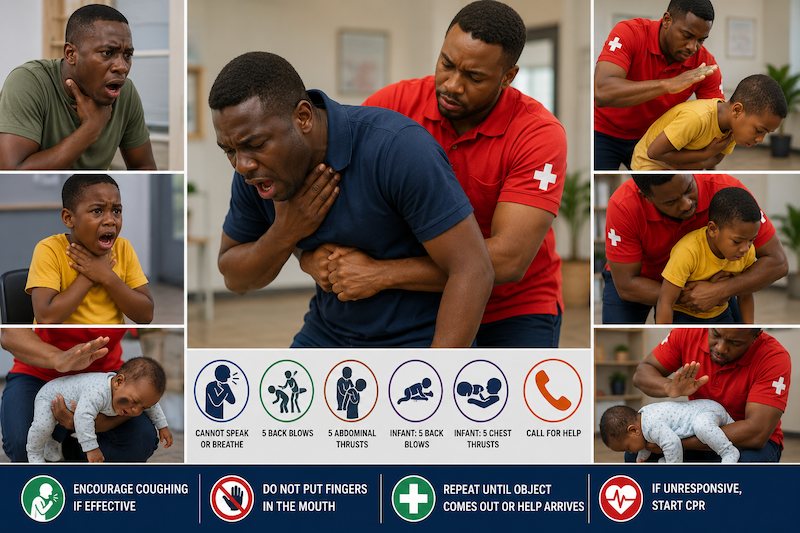
Introduction to Choking Emergencies
Choking happens when food, liquid, vomit, or an object blocks the airway and prevents normal breathing. It can happen suddenly and can become life-threatening within minutes if the blockage is not cleared.
Choking can affect adults, children, and infants. It often occurs while eating, laughing, talking with food in the mouth, drinking, playing with small objects, or in children who put objects into their mouths.
A first aider must recognise choking quickly and respond immediately. The aim is to help clear the airway, restore normal breathing, call for emergency help when needed, and start CPR if the casualty becomes unresponsive.
Why Choking Is Dangerous
The airway carries air into the lungs. If the airway is blocked, oxygen cannot reach the body. Without oxygen, the brain and vital organs can be damaged quickly.
Choking may lead to:
- Panic and distress.
- Breathing difficulty.
- Collapse.
- Unconsciousness.
- Cardiac arrest.
- Death if the blockage is not relieved.
Fast action can save a life.
Common Causes of Choking
Common causes include:
- Large pieces of food.
- Meat, fish, bones, or hard food.
- Nuts.
- Sweets or hard candy.
- Grapes or round fruits.
- Popcorn.
- Small toys.
- Coins.
- Buttons.
- Pen caps.
- Beads.
- Balloons.
- Vomit.
- Dentures or broken teeth.
Children under 5 years are at higher risk because they explore by putting things in their mouths and may not chew properly. The American Red Cross notes that infants and toddlers are at particular risk because they often put objects in their mouths and can choke on common foods.
Types of Airway Obstruction
Choking may be mild or severe.
| Type | Meaning |
|---|---|
| Mild airway obstruction | The casualty can cough, breathe, cry, or speak |
| Severe airway obstruction | The casualty cannot breathe, speak, cry, or cough effectively |
The first aid action depends on whether the obstruction is mild or severe.
Signs of Mild Choking
A casualty with mild choking may:
- Cough forcefully.
- Speak or make sounds.
- Breathe, although with difficulty.
- Look frightened.
- Hold the throat.
- Have watery eyes.
- Gag or retch.
If the casualty can cough strongly, encourage coughing and monitor closely. Do not give back blows or abdominal thrusts if the casualty is coughing effectively.
First Aid for Mild Choking
For mild choking:
- Stay calm.
- Encourage the casualty to keep coughing.
- Do not put your fingers in the mouth.
- Do not slap the back if they are coughing effectively.
- Stay with them and monitor breathing.
- Be ready to act if coughing becomes weak or stops.
- Seek medical help if coughing continues, breathing worsens, or the casualty feels something remains stuck.
A strong cough is the body’s natural way of clearing the airway.
Signs of Severe Choking
A casualty with severe choking may:
- Be unable to speak.
- Be unable to breathe.
- Be unable to cough effectively.
- Make high-pitched or weak sounds.
- Hold the throat with one or both hands.
- Look panicked.
- Turn pale, blue, or grey.
- Become weak.
- Collapse or become unresponsive.
If the casualty cannot breathe, speak, cry, or cough forcefully, treat it as severe choking. Mayo Clinic advises giving five back blows followed by five abdominal thrusts when a choking person cannot talk, cry, or laugh forcefully.
First Aid Priorities for Severe Choking
For severe choking:
- Ask, “Are you choking?”
- Call for help.
- Give up to 5 back blows.
- If not relieved, give up to 5 abdominal thrusts for adults and children over 1 year.
- Repeat cycles of 5 back blows and 5 thrusts.
- Call emergency services if the blockage does not clear quickly.
- If the casualty becomes unresponsive, start CPR.
St John Ambulance advises repeating five back blows and five abdominal thrusts until help arrives, the blockage clears, or the person becomes unresponsive.
Adult Choking Management
Adult choking management applies to a person who is adult-sized or has reached puberty.
A choking adult may be eating, drinking, talking, laughing, or suddenly become distressed. The first aider should act quickly but safely.
Step 1: Ask and Encourage Coughing
Ask loudly:
“Are you choking?”
If the adult can cough strongly, speak, or breathe:
- Encourage them to cough.
- Keep watching them.
- Do not perform abdominal thrusts yet.
- Be ready if the obstruction becomes severe.
If the adult cannot speak, breathe, or cough effectively, begin active choking first aid.
Step 2: Give Back Blows to an Adult
To give back blows:
- Stand to the side and slightly behind the casualty.
- Support their chest with one hand.
- Lean them forward so the object can come out of the mouth.
- Use the heel of your other hand.
- Give up to 5 sharp blows between the shoulder blades.
- Check after each blow to see if the blockage has cleared.
Do not give all 5 back blows automatically if the object comes out before then.
Step 3: Give Abdominal Thrusts to an Adult
If back blows do not clear the blockage, give abdominal thrusts.
Steps:
- Stand behind the casualty.
- Put your arms around their waist.
- Make a fist with one hand.
- Place the thumb side of your fist just above the navel and below the breastbone.
- Hold your fist with the other hand.
- Pull sharply inward and upward.
- Give up to 5 abdominal thrusts.
- Check after each thrust if the object has cleared.
The British Red Cross advises standing behind the choking person, joining your hands around their tummy, forming a fist, and pulling sharply inwards and upwards up to five times if back blows do not work.
Step 4: Repeat and Call for Help
If the blockage does not clear:
- Continue cycles of 5 back blows and 5 abdominal thrusts.
- Call emergency services if not already done.
- Keep checking if the object has come out.
- Stop if the casualty can breathe, cough, or speak.
- Start CPR if the casualty becomes unresponsive.
Anyone who receives abdominal thrusts should be medically assessed, especially if they have pain, difficulty breathing, vomiting, abdominal discomfort, or persistent symptoms.
Adult Choking: Pregnant or Larger-Bodied Casualty
For a pregnant casualty or a casualty where you cannot reach around the abdomen, use chest thrusts instead of abdominal thrusts.
Steps:
- Stand behind the casualty.
- Place your arms under the armpits and around the chest.
- Place your fist on the centre of the chest, on the breastbone.
- Hold your fist with the other hand.
- Pull sharply straight back.
- Give up to 5 chest thrusts.
- Continue cycles of back blows and chest thrusts if needed.
Do not press on the lower ribs or abdomen of a pregnant casualty.
Child Choking Management
Child choking management applies to a child from over 1 year old to puberty.
The steps are similar to adult choking care, but the force should be adjusted to the child’s size.
Children can choke on food, toys, coins, sweets, bones, small household objects, or pieces of plastic. A child may suddenly stop talking, hold the throat, cough weakly, struggle to breathe, or become silent.
First Aid for a Choking Child
For a choking child:
- Encourage coughing if the child can cough effectively.
- If the child cannot breathe, speak, cry, or cough effectively, give back blows.
- Give up to 5 back blows.
- If the blockage does not clear, give up to 5 abdominal thrusts.
- Continue cycles of 5 back blows and 5 abdominal thrusts.
- Call emergency services if the blockage does not clear quickly.
- If the child becomes unresponsive, start CPR.
The British Red Cross advises calling emergency help if the blockage does not dislodge and continuing cycles of back blows and abdominal thrusts until the blockage clears, help arrives, or the child becomes unresponsive.
Back Blows for a Child
To give back blows to a child:
- Support the child in a forward-leaning position.
- For a small child, you may place them across your lap.
- Use the heel of your hand.
- Give up to 5 sharp blows between the shoulder blades.
- Check after each blow.
Leaning the child forward helps the object come out rather than moving deeper into the airway.
Abdominal Thrusts for a Child
If back blows do not clear the obstruction:
- Stand or kneel behind the child.
- Place your arms around the child’s waist.
- Make a fist with one hand.
- Place it above the navel and below the breastbone.
- Hold the fist with the other hand.
- Pull sharply inward and upward.
- Give up to 5 abdominal thrusts.
- Check after each thrust.
Use less force than you would for an adult.
Infant Choking Management
Infant choking management applies to a baby under 1 year old.
Infants are at high risk because their airways are small, they put objects in their mouths, and they cannot explain what is wrong.
Never perform abdominal thrusts on an infant under 1 year old. Use back blows and chest thrusts.
NHS guidance states that if back blows do not relieve choking in a baby under 1 year, give chest thrusts; for children over 1 year, use abdominal thrusts.
Signs of Choking in an Infant
An infant who is choking may:
- Be unable to cry or cough normally.
- Have weak, ineffective coughing.
- Have difficulty breathing.
- Make high-pitched sounds.
- Become silent.
- Turn blue or pale.
- Look distressed.
- Become limp or unresponsive.
A baby who is coughing strongly should be allowed to cough while you monitor closely.
Back Blows for an Infant
To give back blows to an infant:
- Sit or kneel safely.
- Lay the baby face down along your forearm or thigh.
- Support the baby’s head and jaw with your hand.
- Keep the baby’s head lower than the chest.
- Use the heel of your hand.
- Give up to 5 sharp back blows between the shoulder blades.
- Check after each blow to see if the object has come out.
Do not shake the baby. Do not press on the soft part under the chin.
Chest Thrusts for an Infant
If back blows do not clear the blockage:
- Turn the baby face up while supporting the head and neck.
- Keep the head lower than the chest.
- Place two fingers on the centre of the chest, just below the nipple line.
- Give up to 5 chest thrusts.
- Press downward about one-third of the chest depth.
- Check after each thrust.
Chest thrusts should be firm but controlled. They are similar in position to infant CPR compressions, but slower and sharper.
Repeat Infant Choking Cycles
If the infant is still choking:
- Repeat 5 back blows and 5 chest thrusts.
- Call emergency services if the blockage does not clear quickly.
- Continue until the object comes out, help arrives, or the infant becomes unresponsive.
- If the infant becomes unresponsive, start CPR.
Do not put your finger into the baby’s mouth unless you can clearly see the object and remove it easily.
If a Choking Casualty Becomes Unresponsive
If an adult, child, or infant becomes unresponsive:
- Carefully lower them to the ground.
- Shout for help.
- Call emergency services.
- Start CPR.
- Open the airway before giving breaths if trained.
- Look in the mouth only when opening the airway.
- Remove a visible object only if easy to do.
- Do not perform blind finger sweeps.
- Continue CPR until help arrives or the casualty breathes normally.
For choking-related collapse, chest compressions may help move the blockage. Rescue breaths should be attempted if trained, but if breaths do not go in, reposition the airway and continue CPR.
Airway Obstruction Relief Techniques
The main airway obstruction relief techniques are:
| Technique | Used For |
|---|---|
| Encouraging cough | Mild choking when casualty can cough effectively |
| Back blows | Severe choking in adults, children, and infants |
| Abdominal thrusts | Adults and children over 1 year |
| Chest thrusts | Infants under 1 year, pregnant casualties, or larger-bodied casualties |
| CPR | Casualty becomes unresponsive |
The correct technique depends on the casualty’s age, size, condition, and response.
Back Blows: Key Points
Back blows help create pressure and vibration to dislodge the object.
Key points:
- Lean the casualty forward.
- Use the heel of the hand.
- Strike between the shoulder blades.
- Give up to 5 blows.
- Check after each blow.
- Do not continue if the object comes out.
Back blows are useful for adults, children, and infants when performed correctly.
Abdominal Thrusts: Key Points
Abdominal thrusts help force air from the lungs to push the object out.
Key points:
- Use for adults and children over 1 year.
- Stand or kneel behind the casualty.
- Place fist above the navel and below the breastbone.
- Pull inward and upward.
- Give up to 5 thrusts.
- Do not use abdominal thrusts on infants.
- Use chest thrusts instead for pregnancy or when abdominal thrusts are not suitable.
Abdominal thrusts can cause injury, so medical assessment is advised after they are used.
Chest Thrusts: Key Points
Chest thrusts are used for:
- Infants under 1 year.
- Pregnant casualties.
- Larger-bodied casualties when abdominal thrusts are not possible.
For infants, chest thrusts are given with two fingers on the centre of the chest.
For pregnant or larger-bodied adults, chest thrusts are given from behind with pressure on the breastbone.
Do Not Use Blind Finger Sweeps
A blind finger sweep means putting your finger into the mouth when you cannot see the object.
Do not do this.
Blind finger sweeps can:
- Push the object deeper.
- Injure the mouth or throat.
- Cause bleeding.
- Make the airway blockage worse.
Only remove an object if you can clearly see it and can remove it easily.
Choking Prevention for Adults
Adults can reduce choking risk by:
- Eating slowly.
- Chewing food properly.
- Avoiding talking or laughing with food in the mouth.
- Cutting food into manageable pieces.
- Avoiding excessive alcohol while eating.
- Taking care with meat, fish bones, and hard foods.
- Ensuring dentures fit properly.
- Sitting upright while eating.
- Avoiding rushing meals.
Older adults, people with swallowing difficulty, stroke history, neurological conditions, poor dentition, or alcohol intoxication may be at higher risk.
Choking Prevention for Children and Infants
To reduce choking risk in children:
- Keep small objects away from babies and toddlers.
- Cut food into small safe pieces.
- Avoid whole grapes, hard sweets, nuts, popcorn, and similar foods for very young children.
- Supervise children while eating.
- Encourage children to sit while eating.
- Do not let children run, play, or laugh with food in the mouth.
- Keep coins, beads, buttons, pen caps, balloons, and small toy parts away.
- Choose age-appropriate toys.
- Check floors and low surfaces for small objects.
Prevention is especially important because choking can happen silently and quickly.
Choking and Food Allergy
Sometimes choking may be confused with an allergic reaction. They are different emergencies.
| Choking | Severe Allergy / Anaphylaxis |
|---|---|
| Sudden airway blockage by food or object | Body-wide allergic reaction |
| Cannot breathe, speak, or cough effectively | Swelling, rash, wheeze, breathing difficulty, collapse |
| Back blows and thrusts may be needed | Adrenaline auto-injector may be needed if prescribed |
| Object may come out | No object blocking airway |
If the casualty has swelling of the face, lips, tongue, or throat after eating and is struggling to breathe, suspect severe allergy and seek emergency help immediately.
Choking and Asthma
Asthma can also cause breathing difficulty, but choking usually starts suddenly during eating or object handling.
| Choking | Asthma Attack |
|---|---|
| Sudden blockage | Airway narrowing |
| Often during eating or playing with object | May occur after trigger exposure |
| Unable to speak or cough effectively in severe cases | Wheezing, coughing, breathlessness |
| Back blows and thrusts | Reliever inhaler and medical help |
Ask what happened if the casualty can respond.
When to Seek Medical Help After Choking
Seek medical help if:
- The casualty received abdominal thrusts.
- The casualty has difficulty breathing.
- The casualty has persistent coughing.
- The casualty has chest, throat, or abdominal pain.
- The casualty vomits blood.
- The casualty swallowed or inhaled a sharp object.
- The casualty is a child or infant and you are concerned.
- The casualty became unconscious.
- The object may still be stuck.
- The casualty’s voice, breathing, or swallowing remains abnormal.
Even after the object comes out, airway irritation or injury may remain.
Handover to Emergency Responders
When help arrives, explain:
- What the casualty was doing when choking started.
- What the casualty may have choked on.
- Whether they could cough or speak.
- How many back blows were given.
- Whether abdominal or chest thrusts were given.
- Whether the casualty became unresponsive.
- Whether CPR was started.
- Whether the object came out.
- Any medical history if known.
Clear handover helps responders continue care safely.
Common Choking Management Mistakes
Avoid these mistakes:
- Ignoring mild choking that worsens.
- Giving water to someone who cannot breathe.
- Putting fingers blindly into the mouth.
- Slapping the back while the casualty is upright instead of leaning forward.
- Using abdominal thrusts on an infant.
- Using too much force on a child or infant.
- Delaying emergency help.
- Stopping too early when the casualty is still unable to breathe.
- Failing to start CPR when the casualty becomes unresponsive.
- Not seeking medical care after abdominal thrusts.
- Allowing children to eat while running or playing.
What a First Aider Should Never Do
A first aider should never:
- Put themselves in danger.
- Panic and delay action.
- Give food or drink to a choking casualty.
- Perform blind finger sweeps.
- Use abdominal thrusts on a baby under 1 year.
- Shake an infant.
- Hold an infant upside down by the feet.
- Continue thrusts after the object is cleared and the casualty can breathe.
- Leave the casualty alone immediately after a choking incident.
- Ignore breathing difficulty after the object comes out.
- Hide information from emergency responders.
Real-Life Scenario
During lunch at a workplace, a staff member suddenly stops talking while eating and grabs his throat. He cannot speak or cough effectively. A first aider asks, “Are you choking?” The man nods but cannot make a sound.
The first aider stands to the side, supports his chest, leans him forward, and gives up to 5 sharp back blows between the shoulder blades. The object does not come out. The first aider then stands behind him and gives up to 5 abdominal thrusts. After the third thrust, a piece of food comes out and the man begins coughing and breathing again.
The first aider stops the thrusts, reassures him, monitors his breathing, and advises medical assessment because abdominal thrusts were used.
The key lesson is simple: recognise severe choking quickly, give back blows, follow with abdominal thrusts for adults and children over 1 year, and start CPR if the casualty becomes unresponsive.
Practical Skills to Demonstrate
Learners should practise:
- Recognising mild and severe choking.
- Encouraging effective coughing.
- Adult back blows.
- Adult abdominal thrusts.
- Child back blows.
- Child abdominal thrusts.
- Infant back blows.
- Infant chest thrusts.
- Chest thrusts for pregnancy or larger-bodied casualty.
- Safe lowering of an unresponsive choking casualty.
- Starting CPR after choking collapse.
- Clear emergency handover.
Practice should be done only on approved manikins or training equipment, not forcefully on real people.
Practical Skill Checklist
| Skill | Competent |
|---|---|
| Identifies mild choking | |
| Identifies severe choking | |
| Encourages coughing when appropriate | |
| Calls for help when needed | |
| Positions adult/child forward correctly | |
| Gives effective back blows | |
| Performs adult abdominal thrust technique correctly | |
| Performs child abdominal thrust technique with correct force | |
| Performs infant back blows correctly | |
| Performs infant chest thrusts correctly | |
| Does not use abdominal thrusts on an infant | |
| Avoids blind finger sweeps | |
| Starts CPR if casualty becomes unresponsive | |
| Gives clear handover |
Quick Recap
Choking happens when the airway is blocked by food, liquid, vomit, or an object. If the casualty can cough strongly, encourage coughing and monitor. If the casualty cannot breathe, speak, cry, or cough effectively, treat it as severe choking. For adults and children over 1 year, give up to 5 back blows followed by up to 5 abdominal thrusts, repeating as needed. For infants under 1 year, give up to 5 back blows followed by up to 5 chest thrusts. Do not use abdominal thrusts on infants. If any choking casualty becomes unresponsive, lower them to the ground, call emergency services, and start CPR. Never perform blind finger sweeps, never give food or drink to a choking casualty, and always seek medical help if symptoms continue or abdominal thrusts were used.