
Electrical Maintenance
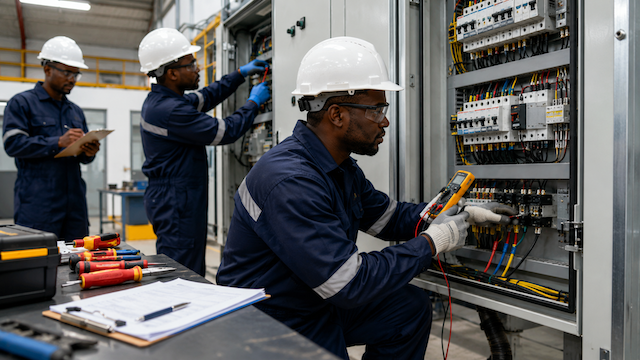
Introduction to Electrical Maintenance
Electrical maintenance is the process of inspecting, testing, servicing, repairing, and replacing electrical systems or equipment to keep them safe, reliable, and efficient.
Maintenance helps prevent electrical shock, fire, equipment failure, production downtime, and costly breakdowns. It applies to domestic, commercial, and industrial systems such as lighting circuits, socket circuits, distribution boards, motors, control panels, generators, transformers, cables, switches, protective devices, and earthing systems.
Electrical maintenance must be carried out safely. HSE guidance explains that electrical equipment should be maintained so far as reasonably practicable to prevent danger, and the level of maintenance should depend on the risk, type of equipment, use, and environment.
Preventive Maintenance
Preventive maintenance is planned maintenance carried out before a fault occurs. Its purpose is to reduce breakdowns, improve safety, extend equipment life, and keep systems working efficiently.
Preventive maintenance may include:
- Visual inspection of electrical panels and wiring.
- Cleaning dust from panels, vents, and equipment.
- Tightening loose terminals where safe and authorised.
- Checking for overheating or burnt marks.
- Testing protective devices.
- Checking earthing and bonding.
- Inspecting cables, plugs, sockets, switches, and isolators.
- Testing insulation resistance.
- Checking motors, fans, bearings, and ventilation.
- Replacing worn or damaged parts before failure.
- Reviewing maintenance records.
Preventive maintenance is important because many electrical failures give warning signs before they become serious. Heat, smell, discoloration, noise, vibration, repeated tripping, and loose connections should never be ignored.
Benefits of Preventive Maintenance
| Benefit | Explanation |
|---|---|
| Improved safety | Reduces risk of shock, fire, and equipment failure |
| Less downtime | Faults are detected before major breakdowns |
| Longer equipment life | Components are kept in better condition |
| Lower repair cost | Minor issues are corrected early |
| Better performance | Equipment operates more reliably |
| Compliance support | Records show that maintenance is being carried out |
Preventive maintenance should follow manufacturer instructions, site procedures, electrical standards, and risk assessment.
Corrective Maintenance
Corrective maintenance is carried out after a fault has occurred. The purpose is to identify the problem, repair or replace the faulty part, test the system, and return it safely to service.
Corrective maintenance may be needed when:
- A breaker trips repeatedly.
- A socket stops working.
- A motor fails to start.
- A light circuit fails.
- A control panel develops a fault.
- A cable is damaged.
- A switch or contactor burns out.
- Equipment overheats.
- A protective device fails.
- A circuit shows poor insulation resistance.
Corrective maintenance should not be rushed. The fault must be properly diagnosed and corrected. Simply resetting breakers or replacing fuses without finding the cause can create a serious safety risk.
Corrective Maintenance Process
A safe corrective maintenance process should include:
- Receive and understand the fault report.
- Identify the affected circuit or equipment.
- Review drawings, manuals, and previous maintenance records.
- Isolate the power supply.
- Apply lockout/tagout where required.
- Confirm the circuit is dead before touching.
- Inspect the equipment.
- Test safely using suitable instruments.
- Identify the root cause.
- Repair or replace the faulty component.
- Retest the circuit.
- Restore power safely.
- Confirm normal operation.
- Record the work done.
OSHA’s lockout/tagout standard applies to servicing and maintenance where unexpected energisation, startup, or release of stored energy could cause injury. It establishes minimum requirements for controlling hazardous energy during such work.
Routine Inspection
Routine inspection is the regular checking of electrical systems to identify early signs of damage, deterioration, overheating, loose connections, poor workmanship, or unsafe conditions.
Routine inspection may be daily, weekly, monthly, quarterly, or annual, depending on the equipment, environment, and risk level.
What to Check During Routine Inspection
| Area | What to Look For |
|---|---|
| Distribution boards | Heat marks, loose covers, missing labels, tripped breakers |
| Cables | Cuts, cracks, exposed conductors, overheating, poor support |
| Sockets | Cracks, burn marks, looseness, overheating |
| Switches | Sticking, sparking, cracks, poor operation |
| Plugs | Damaged pins, loose body, burnt marks |
| Motors | Noise, vibration, overheating, poor ventilation |
| Control panels | Dust, loose wires, burnt smell, faulty indicators |
| Earthing | Loose connections, corrosion, missing bonding |
| Lighting | Flickering, failed lamps, damaged fittings |
| Protective devices | Frequent tripping, wrong rating, damage |
| Tools and equipment | Damaged cables, plugs, guards, or insulation |
Routine inspection should be documented. If defects are found, they should be reported, isolated where necessary, and corrected by a competent person.
Troubleshooting
Troubleshooting is the process of finding the cause of an electrical fault. It requires safe working, logical thinking, testing, and understanding of how the circuit should operate.
Good troubleshooting does not rely on guessing. It follows evidence.
Common Electrical Faults
| Fault | Possible Cause |
|---|---|
| No power | Tripped breaker, blown fuse, loose connection, open circuit |
| Breaker trips | Overload, short circuit, earth fault, faulty appliance |
| RCD trips | Leakage current, moisture, insulation failure |
| Light flickers | Loose connection, faulty lamp, voltage drop |
| Socket overheats | Overload, loose terminal, damaged contacts |
| Motor does not start | No supply, overload trip, starter fault, winding fault |
| Motor overheats | Overload, poor ventilation, bearing problem, phase loss |
| Control panel fault | Relay, contactor, timer, fuse, PLC, or wiring issue |
| Burning smell | Overheating, loose connection, insulation damage |
| Electric shock report | Earthing fault, leakage current, exposed live part |
Troubleshooting Method
A basic troubleshooting method includes:
- Understand the fault symptom.
- Ask when and how the fault started.
- Check whether the fault is constant or intermittent.
- Review drawings and circuit labels.
- Inspect visually for damage, heat, smell, loose parts, moisture, or dust.
- Isolate before opening or touching equipment.
- Test voltage, continuity, insulation, earth path, and polarity where required.
- Identify whether the fault is supply-related, load-related, control-related, or protection-related.
- Correct the fault.
- Retest and confirm safe operation.
Repeated tripping, overheating, burning smell, or shock reports should be treated as serious warning signs.
Replacement of Faulty Components
Faulty electrical components must be replaced correctly. Using the wrong replacement can create new hazards.
Components that may require replacement include:
- Switches
- Socket outlets
- Circuit breakers
- Fuses
- RCDs / RCCBs
- RCBOs
- Contactors
- Overload relays
- Timers
- Lamps and fittings
- Cable glands
- Terminal blocks
- Damaged cables
- Motor starters
- Control relays
- Indicator lamps
- Push buttons
- Capacitors
- Earthing clamps
Safe Replacement Procedure
Before replacing any component:
- Isolate the supply.
- Lock and tag where required.
- Confirm absence of voltage.
- Check the component rating.
- Use the correct replacement type.
- Follow the wiring diagram.
- Label wires before disconnecting if necessary.
- Avoid damaging terminals or conductors.
- Tighten connections properly.
- Inspect surrounding components for heat or damage.
- Test before restoring supply.
- Confirm correct operation.
A replacement component should match the required voltage, current rating, breaking capacity, duty, size, function, and environmental rating.
Choosing the Correct Replacement
| Component | What to Confirm |
|---|---|
| Circuit breaker | Current rating, curve type, breaking capacity, pole number |
| Fuse | Correct current rating, voltage rating, type, breaking capacity |
| Contactor | Coil voltage, current rating, number of poles, load type |
| Overload relay | Motor current range and trip class |
| Socket | Current rating, earth connection, environment suitability |
| Cable | Size, insulation type, voltage rating, installation condition |
| RCD / RCBO | Sensitivity, current rating, type, pole number |
| Motor capacitor | Capacitance, voltage rating, duty type |
| Terminal block | Current rating, cable size, insulation rating |
Do not increase fuse or breaker size simply to stop tripping. The cause of tripping must be investigated.
Maintenance Records
Maintenance records are written or digital documents showing what inspection, testing, repair, or replacement work has been carried out.
Good records help with safety, planning, troubleshooting, compliance, budgeting, and future maintenance.
What Maintenance Records Should Include
| Record Item | Purpose |
|---|---|
| Date of maintenance | Shows when the work was done |
| Equipment name or circuit | Identifies what was maintained |
| Location | Shows where the equipment is installed |
| Fault reported | Explains the original problem |
| Inspection findings | Records what was observed |
| Test results | Shows measured values |
| Work carried out | Describes repair or service action |
| Parts replaced | Lists replacement components |
| Person responsible | Identifies who performed the work |
| Safety actions | Records isolation, LOTO, or permits used |
| Final status | Confirms whether equipment is safe and operational |
| Next maintenance date | Helps with planning |
Maintenance records should be clear, accurate, and easy to retrieve. Poor records can make future faults harder to diagnose.
Safe Isolation During Maintenance
Electrical maintenance should normally be carried out with the circuit dead. Safe isolation protects workers from electric shock, arc flash, and unexpected startup.
A basic safe isolation process includes:
- Identify the correct circuit or equipment.
- Inform affected persons.
- Switch off the supply.
- Isolate from all energy sources.
- Apply lockout/tagout where required.
- Prove the tester on a known source.
- Test the circuit to confirm it is dead.
- Prove the tester again after testing.
- Discharge stored energy where required.
- Begin work only when safe.
NIOSH warns that workers can be severely injured or killed during machine maintenance if proper lockout and tagout procedures are not followed, and recommends hazardous energy control programmes, procedures, and worker training.
Maintenance of Motors and Control Panels
Motors and control panels are common in industrial and commercial maintenance.
For motors, check:
- Noise
- Vibration
- Temperature
- Ventilation
- Bearings
- Terminal tightness
- Cable glands
- Earthing
- Overload settings
- Current draw
- Insulation resistance
- Direction of rotation
For control panels, check:
- Dust and moisture
- Loose terminals
- Burnt marks
- Faulty indicators
- Damaged contactors
- Incorrect labels
- Overheating
- Wire condition
- Cooling fans and filters
- Door seals and locks
- Updated drawings
A motor or panel should not be repeatedly reset after tripping. Repeated tripping indicates a fault that must be investigated.
Real-Life Scenario
A facility worker reports that a socket in an office is hot and has a burning smell. The equipment plugged into the socket still works, so someone suggests continuing to use it until it fails completely.
This is unsafe.
A hot socket and burning smell may indicate overload, loose terminals, damaged contacts, or cable overheating. The correct action is to stop using the socket, isolate the circuit, inspect the socket and wiring, replace damaged parts, test the circuit, and restore power only when it is safe.
Common Mistakes in Electrical Maintenance
Avoid these unsafe practices:
- Working without isolation.
- Ignoring lockout/tagout procedures.
- Resetting breakers repeatedly without finding the fault.
- Replacing fuses with oversized ratings.
- Using wrong replacement parts.
- Ignoring overheating, smell, smoke, or sparks.
- Leaving panels open after maintenance.
- Failing to tighten terminals properly.
- Not testing after repairs.
- Not recording maintenance work.
- Allowing unqualified persons to repair electrical systems.
- Ignoring manufacturer maintenance instructions.
- Treating preventive maintenance as unnecessary.
What an Electrical Worker Should Never Do
An electrical worker should never:
- Touch live parts without authorisation, competence, and proper controls.
- Assume a circuit is dead without testing.
- Bypass fuses, breakers, RCDs, interlocks, or emergency stops.
- Replace components with incorrect ratings.
- Ignore repeated tripping.
- Leave exposed conductors after repair.
- Use damaged tools or test leads.
- Work on a machine that can restart unexpectedly.
- Remove earthing or bonding conductors.
- Leave maintenance work undocumented.
- Return unsafe equipment to service.
Quick Recap
Electrical maintenance keeps installations and equipment safe, reliable, and efficient. Preventive maintenance reduces breakdowns before they happen, while corrective maintenance repairs faults after they occur. Routine inspection helps identify early warning signs such as heat, smell, damage, loose connections, and repeated tripping. Troubleshooting should follow a safe and logical process. Faulty components must be replaced with the correct ratings, and all maintenance work should be properly recorded. Safe isolation and lockout/tagout are essential before maintenance begins.