
Renewable Energy Systems
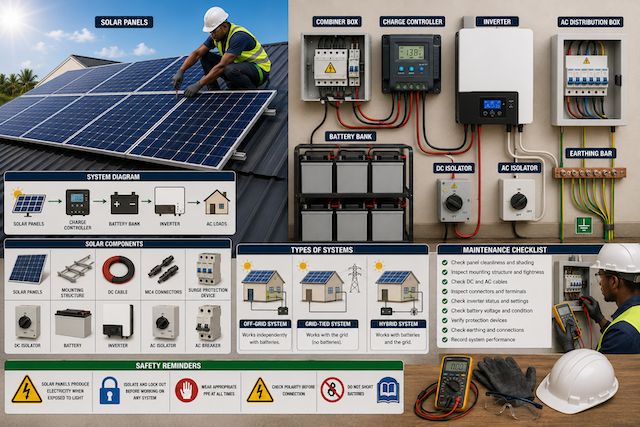
Introduction to Renewable Energy Systems
Renewable energy systems produce electricity from natural energy sources that can be replenished. Common renewable energy sources include sunlight, wind, water, biomass, and geothermal heat.
In electrical installation and maintenance, solar energy is one of the most common renewable energy systems. It is widely used in homes, offices, schools, hospitals, farms, shops, telecom sites, and industries to reduce dependence on public electricity supply and fuel-powered generators.
A solar photovoltaic system converts sunlight into DC electricity. The DC electricity may be used to charge batteries, converted to AC by an inverter, used directly by electrical loads, or exported to the grid where permitted. Solar PV installation standards require systems to be designed, installed, commissioned, and handed over by competent persons using suitable equipment and safe procedures.
Introduction to Solar Energy
Solar energy is energy from the sun. In electrical systems, solar panels convert sunlight into electricity through the photovoltaic effect.
Solar energy systems can be used for:
- Lighting
- Phone and laptop charging
- Home appliances
- Water pumps
- CCTV and security systems
- Telecom equipment
- Office power backup
- Farm and rural electrification
- Industrial support systems
- Battery charging
Solar systems are useful where electricity supply is unreliable, expensive, unavailable, or where clean energy is desired.
Types of Solar Power Systems
| System Type | Description |
|---|---|
| Off-grid solar system | Works independently from public supply, usually with batteries |
| Grid-tied solar system | Works with public electricity supply and may export power where allowed |
| Hybrid solar system | Combines solar panels, batteries, inverter, and public supply or generator |
| Solar water pumping system | Uses solar power to run water pumps |
| Solar street lighting system | Uses solar panels and batteries for outdoor lighting |
Off-grid and hybrid systems are common in areas with unstable electricity supply because they can store energy in batteries for use when sunlight is not available.
Solar Components
A complete solar power system is made up of several components. Each part must be correctly selected, connected, protected, and maintained.
Common solar components include:
| Component | Function |
|---|---|
| Solar panels | Convert sunlight into DC electricity |
| Charge controller | Regulates battery charging |
| Battery bank | Stores energy for later use |
| Inverter | Converts DC electricity to AC electricity |
| Mounting structure | Holds panels securely |
| DC cables | Carry power from panels and batteries |
| AC cables | Carry AC power from inverter to loads |
| Combiner box | Combines multiple solar panel strings |
| DC isolator | Allows safe disconnection of DC side |
| AC isolator | Allows safe disconnection of AC side |
| Fuses and breakers | Protect cables and equipment |
| Surge protection device | Protects against voltage surges |
| Earthing system | Provides fault and lightning protection path |
| Monitoring system | Shows system performance and faults |
Solar Panels
Solar panels, also called PV modules, are the main power-producing part of the system. They generate DC electricity when exposed to sunlight.
Panel output depends on:
- Sunlight intensity
- Panel rating
- Panel direction
- Tilt angle
- Shading
- Temperature
- Dirt or dust
- Cable losses
- Panel condition
Solar panels should be installed where they receive maximum sunlight and minimum shading. Even partial shading from trees, buildings, poles, tanks, or antennas can reduce system performance.
Charge Controllers
A charge controller regulates the charging of batteries from solar panels. It helps prevent overcharging, excessive discharge, and battery damage.
Common charge controller types include:
| Type | Description |
|---|---|
| PWM charge controller | Simpler and cheaper, suitable for smaller systems |
| MPPT charge controller | More efficient, tracks maximum panel power, better for larger systems |
MPPT controllers are usually preferred for better energy harvest, especially where panel voltage is higher than battery voltage.
Battery Systems
Batteries store solar energy for use at night, during cloudy weather, or when the solar panels are not producing enough power.
Common battery types include:
| Battery Type | Features |
|---|---|
| Lead-acid battery | Affordable, widely available, requires careful charging and ventilation |
| AGM battery | Sealed lead-acid type, lower maintenance |
| Gel battery | Sealed, deep-cycle use, sensitive to incorrect charging |
| Lithium battery | Longer life, lighter, better depth of discharge, usually more expensive |
Battery systems must be correctly sized, protected, ventilated where required, and installed according to manufacturer instructions. Battery energy storage can present risks such as electric shock, short circuit, overheating, fire, chemical exposure, and stored energy release.
Battery Safety
Battery safety is very important because batteries can store large amounts of energy.
Good battery safety practices include:
- Use the correct battery type for the system.
- Do not mix old and new batteries.
- Do not mix different battery capacities or chemistries.
- Use correct cable size and protection.
- Keep terminals tight and protected.
- Avoid short circuits across battery terminals.
- Install batteries in a clean, dry, ventilated area.
- Keep batteries away from heat, sparks, and flame.
- Use correct charging settings.
- Follow manufacturer instructions.
- Wear suitable PPE when handling batteries.
- Keep unauthorised persons away.
Deep discharge and overcharging can shorten battery life. Battery systems should be monitored and maintained properly.
Inverters
An inverter converts DC electricity from solar panels or batteries into AC electricity for normal appliances and electrical loads.
Most homes and businesses use AC appliances, so the inverter is a key part of the system.
Common inverter types include:
| Inverter Type | Description |
|---|---|
| Off-grid inverter | Works with batteries and supplies standalone loads |
| Grid-tied inverter | Connects solar panels to the public grid |
| Hybrid inverter | Works with solar panels, batteries, grid, and sometimes generator |
| Microinverter | Small inverter installed at individual solar panels |
| String inverter | Connects a group of solar panels in series |
| Pure sine wave inverter | Produces high-quality AC output suitable for most appliances |
| Modified sine wave inverter | Cheaper but not suitable for many sensitive appliances |
Hybrid inverters are common in backup systems because they can manage solar input, battery charging, grid supply, and load output. A practical PV O&M manual notes that hybrid inverters combine the functions of solar inverters and battery inverters to manage solar panels, grid supply, and battery storage.
Inverter Selection
When selecting an inverter, consider:
- Load power requirement
- Surge power requirement
- Battery voltage
- Solar panel input voltage range
- MPPT rating
- AC output voltage
- System type: off-grid, grid-tied, or hybrid
- Efficiency
- Protection features
- Cooling method
- Manufacturer support
- Installation environment
The inverter should not be overloaded. Loads such as refrigerators, pumps, compressors, and motors may require higher starting current than their normal running current.
Solar Installation
Solar installation involves mounting solar panels, connecting DC cables, installing protection devices, connecting charge controllers or inverters, installing batteries where required, and testing the full system before use.
A proper installation should follow approved design, manufacturer instructions, electrical standards, and safety procedures. MCS solar PV requirements state that buildings should be assessed by competent professionals to confirm suitability before PV installation work is carried out.
Basic Solar Installation Steps
A typical solar installation may include:
- Assess the site and available sunlight.
- Check roof or mounting structure strength.
- Identify shading risks.
- Calculate load demand.
- Size the solar panels, inverter, batteries, and cables.
- Plan cable routes.
- Install mounting structure.
- Mount solar panels securely.
- Install DC protection and isolators.
- Install charge controller or inverter.
- Install battery system where required.
- Connect earthing and bonding.
- Label DC and AC circuits.
- Test polarity, voltage, continuity, insulation, and operation.
- Commission the system.
- Provide user guidance and maintenance records.
PV systems require special care because solar panels can produce voltage whenever they are exposed to light. A PV installation guide notes that PV module output cannot simply be switched off, so live parts must be protected from contact during installation, use, and maintenance.
DC and AC Sides of a Solar System
A solar system usually has a DC side and an AC side.
| Side | Description |
|---|---|
| DC side | Solar panels, DC cables, combiner box, charge controller, battery, DC isolator |
| AC side | Inverter output, AC isolator, distribution board, AC loads |
DC solar circuits can be dangerous. DC arcs can be difficult to extinguish, and incorrect polarity can damage equipment. Only suitable DC-rated isolators, fuses, breakers, cables, and connectors should be used.
Solar Cable and Connector Safety
Solar cables and connectors must be suitable for outdoor exposure, UV radiation, temperature changes, and DC operation.
Good practices include:
- Use proper solar PV cable.
- Use compatible connectors.
- Do not mix connector brands unless approved.
- Avoid loose connections.
- Support cables properly.
- Keep cables away from sharp edges.
- Protect cables from water entry.
- Avoid cables touching hot roof surfaces.
- Use correct polarity.
- Label DC cables clearly.
- Use DC-rated protection devices.
Poor solar connections can cause overheating, arcing, energy loss, inverter faults, or fire risk.
Earthing and Surge Protection
Solar systems should have proper earthing and surge protection according to the design and applicable standards.
Earthing may be required for:
- Panel frames
- Mounting structures
- Inverter body
- Distribution boards
- Battery racks
- Surge protection devices
Surge protection helps reduce damage from lightning-related surges and switching surges. This is especially important in areas with frequent thunderstorms or exposed installations.
Solar Maintenance
Solar maintenance keeps the system safe, efficient, and reliable. Maintenance should include visual inspection, performance checks, cleaning where needed, electrical checks, battery checks, and inverter monitoring.
Solar Energy UK’s rooftop PV operation and maintenance guidance focuses on maintaining system condition and efficiency, with attention to performance, safety, documentation, and asset management.
Routine Solar Maintenance Checks
| Area | What to Check |
|---|---|
| Solar panels | Dirt, cracks, shading, broken glass, loose mounting |
| Mounting structure | Rust, loose bolts, movement, roof condition |
| DC cables | Damage, loose support, UV damage, exposed conductors |
| Connectors | Tightness, overheating, corrosion, water entry |
| Inverter | Error codes, warning lights, cooling, noise, output |
| Batteries | Swelling, leakage, terminal tightness, state of charge |
| Protection devices | Fuses, breakers, isolators, SPD condition |
| Earthing | Loose or corroded earth connections |
| Performance | Low output, unusual drop in generation |
| Ventilation | Blocked inverter or battery cooling path |
Panel Cleaning
Solar panels may need cleaning when dust, bird droppings, leaves, or dirt reduce performance.
Safe cleaning practices include:
- Clean only when it is safe to access the panels.
- Avoid standing directly on panels.
- Use soft brushes or appropriate cleaning tools.
- Do not use abrasive materials.
- Avoid harsh chemicals.
- Do not clean hot panels with very cold water.
- Follow manufacturer instructions.
- Use fall protection where working at height is involved.
In some locations, rainfall may remove light dust, but heavy dirt, harmattan dust, bird droppings, or nearby construction dust may require cleaning.
Inverter and Battery Maintenance
Inverters and batteries need regular attention because they are critical to system performance.
For inverters, check:
- Display status
- Error codes
- Cooling fan
- Dust buildup
- Loose terminals
- Overheating
- Output voltage
- Warning alarms
- Communication or monitoring system
For batteries, check:
- Terminal tightness
- Corrosion
- Swelling
- Leakage
- Battery temperature
- State of charge
- Charging settings
- Ventilation
- Cable condition
- Battery management system alarms
Do not open sealed batteries or inverters unless trained and authorised.
Real-Life Scenario
A home solar system works well during the day but shuts down quickly at night. The user believes the solar panels are faulty.
A proper check shows that the panels are producing power during the day, but the batteries are weak and no longer holding charge properly. The issue is not the panels; it is the battery system.
The correct action is to inspect the battery terminals, check charging voltage, review battery age, test battery condition, confirm inverter settings, and replace the battery if it has failed.
Common Mistakes in Solar Installation and Maintenance
Avoid these unsafe practices:
- Installing panels where there is heavy shading.
- Using undersized cables.
- Reversing DC polarity.
- Using AC breakers on DC circuits where not rated.
- Mixing incompatible solar connectors.
- Overloading the inverter.
- Connecting too many panels beyond inverter input limits.
- Installing batteries in hot or poorly ventilated areas.
- Mixing old and new batteries.
- Ignoring inverter error codes.
- Failing to earth panel frames or metal structures where required.
- Leaving DC cables unsupported.
- Walking on solar panels.
- Cleaning panels unsafely at height.
- Not recording maintenance checks.
What an Electrical Worker Should Never Do
An electrical worker should never:
- Work on solar DC circuits without understanding the hazard.
- Assume solar panels are off because the inverter is off.
- Touch exposed DC conductors from solar panels.
- Disconnect DC connectors under load unless designed for it.
- Use damaged solar cables or connectors.
- Short-circuit battery terminals.
- Install batteries without proper protection.
- Bypass fuses, breakers, isolators, or charge controllers.
- Ignore overheating, burning smell, sparks, or swelling batteries.
- Connect a solar system to building wiring without proper design and protection.
- Work at height without fall protection.
- Hand over a solar system without testing and user guidance.
Quick Recap
Renewable energy systems use natural energy sources to produce electricity, and solar PV is one of the most common systems used in homes and businesses. A solar system may include panels, charge controllers, batteries, inverters, cables, protection devices, mounting structures, and earthing. Solar panels produce DC electricity, batteries store energy, and inverters convert DC to AC for normal appliances. Safe solar installation requires proper design, correct cable sizing, suitable protection, correct polarity, safe mounting, and testing. Regular solar maintenance helps prevent faults, improve performance, extend equipment life, and keep the system safe.