
Patient Assessment
Why Patient Assessment Matters
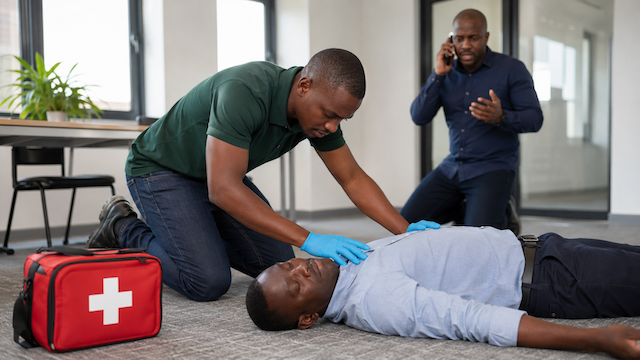
Patient assessment helps a first aider quickly identify life-threatening problems and decide what to do first. In an emergency, the most serious problems must be managed before less urgent injuries.
A good assessment helps the first aider answer three important questions:
- Is the person in immediate danger?
- Are they responsive and breathing normally?
- Do they need urgent medical help?
The primary survey is used to quickly identify life-threatening conditions in order of priority. St John Ambulance describes it as a quick way to assess danger, response, airway, breathing and circulation.
Primary Survey: DRABC / DRSABCD
The primary survey is the first assessment done during an emergency. It helps the first aider check the most important things first.
Different first aid systems use slightly different acronyms. Two common versions are:
DRABC
- D — Danger
- R — Response
- A — Airway
- B — Breathing
- C — Circulation
DRSABCD
- D — Danger
- R — Response
- S — Send for help
- A — Airway
- B — Breathing
- C — CPR
- D — Defibrillation
DRSABCD is commonly taught as an emergency action plan: check for danger, check response, send for help, open airway, check breathing, start CPR if needed, and use a defibrillator/AED where available.
D – Danger
Before touching the casualty, check that the scene is safe.
Look for:
- Traffic
- Fire or smoke
- Electricity
- Violence
- Chemicals
- Broken glass
- Falling objects
- Blood or body fluids
- Unsafe water or slippery floors
If the scene is not safe, do not enter. Call emergency services and wait at a safe distance.
First aid rule:
Your safety comes first. A first aider who becomes injured may not be able to help anyone.
R – Response
Check whether the person responds.
How to Check Responsiveness
Approach from the front if possible and speak clearly.
Say:
“Hello, can you hear me?”
“Are you okay?”
“Can you open your eyes?”
If there is no response, gently tap or squeeze their shoulders.
Do not shake the person forcefully, especially if you suspect a head, neck, or spinal injury.
If the Person Responds
If the person can speak, move, cry, or open their eyes:
- Keep them calm.
- Ask what happened.
- Check for serious bleeding or pain.
- Keep them still if injury is suspected.
- Call for help if needed.
- Continue monitoring them.
If the Person Does Not Respond
If the person does not respond:
- Shout for help.
- Ask someone to call emergency services.
- Open the airway.
- Check breathing immediately.
The British Red Cross explains that someone who is unresponsive will not answer or move when their name is called or their shoulders are tapped.
S – Send for Help
If the person is unresponsive, seriously injured, not breathing normally, bleeding heavily, or you are unsure what to do, call emergency services immediately.
In Nigeria, call 112 for emergency assistance where available.
If other people are nearby, give a direct instruction:
“You in the blue shirt, call 112 now and come back to tell me what they said.”
Also ask someone to bring:
- First aid kit
- AED/defibrillator, if available
- Extra help
- Clean cloth or dressing for bleeding
A – Airway Assessment
The airway is the passage that allows air to move into the lungs. If the airway is blocked, the person may not breathe properly.
How to Open the Airway
If the person is unresponsive:
- Place one hand on their forehead.
- Gently tilt the head back.
- Place two fingers under the chin.
- Lift the chin upward.
This is called the head tilt and chin lift.
Check the Mouth
- Look inside the mouth only if you can do so safely.
- Remove only visible loose objects, such as food, vomit, or debris.
- Do not blindly sweep your finger inside the mouth. This can push objects deeper into the airway or injure the person.
If Spinal Injury Is Suspected
If the person may have a head, neck, or spinal injury, avoid unnecessary movement. Open the airway as gently as possible and call emergency services immediately.
B – Breathing Assessment
After opening the airway, check whether the person is breathing normally.
How to Check Breathing
Use Look, Listen, and Feel for up to 10 seconds.
- Look for chest movement.
- Listen for breathing sounds.
- Feel for air on your cheek.
Normal breathing should be regular and effective.
Not Normal Breathing
The following are not normal breathing:
- No breathing
- Gasping
- Occasional weak breaths
- Noisy, irregular breathing
- Very slow or very difficult breathing
If the person is unresponsive and not breathing normally, start CPR immediately and use an AED if available. The DRSABCD action plan includes CPR and defibrillation when breathing is absent or abnormal.
C – Circulation Assessment
In first aid, circulation assessment focuses mainly on signs of life and severe bleeding.
Check for Severe Bleeding
Look quickly for:
- Heavy bleeding
- Blood soaking clothing
- Blood pooling on the ground
- Amputated or badly injured limb
- Signs of shock
Signs of Poor Circulation or Shock
The person may have:
- Pale, cold, or sweaty skin
- Weakness
- Dizziness
- Confusion
- Fast or weak pulse
- Rapid breathing
- Extreme thirst
- Collapse
What to Do
If there is severe bleeding:
- Put on gloves if available.
- Apply firm direct pressure with a clean dressing or cloth.
- Call emergency services.
- Keep pressure on the wound.
- Monitor breathing and responsiveness.
Do not delay emergency help when bleeding is heavy.
Secondary Survey
The secondary survey is a more detailed assessment done after life-threatening problems have been checked and managed.
Do a secondary survey only when:
- The scene is safe.
- The person is breathing.
- Severe bleeding has been controlled.
- Emergency help has been called if needed.
What to Check During a Secondary Survey
Use a calm, respectful approach.
Ask:
- What happened?
- Where do you feel pain?
- Do you have any medical conditions?
- Are you taking any medication?
- Do you have allergies?
- When did you last eat or drink?
- Has this happened before?
You can remember this using SAMPLE:
| Letter | Meaning | Question |
|---|---|---|
| S | Signs and symptoms | What do you feel? What can I see? |
| A | Allergies | Are you allergic to anything? |
| M | Medication | Are you taking any medicine? |
| P | Past medical history | Do you have any known condition? |
| L | Last food or drink | When did you last eat or drink? |
| E | Events | What happened before this started? |
Head-to-Toe Check
If appropriate and with consent, check from head to toe for:
- Bleeding
- Swelling
- Bruising
- Pain
- Deformity
- Burns
- Medical ID bracelet or card
- Difficulty moving
- Changes in skin colour or temperature
Do not expose the person unnecessarily. Protect their privacy and dignity.
Recovery Position
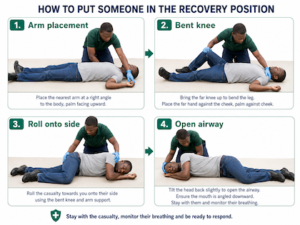
The recovery position helps keep the airway open in an unresponsive person who is breathing normally. It also helps fluids drain from the mouth and reduces the risk of choking.
Use the recovery position when the person is:
- Unresponsive
- Breathing normally
- Not suspected to have a serious spinal injury
- Not needing CPR
The NHS advises placing an unconscious but breathing casualty into the recovery position while continuing to monitor their breathing.
How to Put Someone in the Recovery Position
- Kneel beside the person.
- Make sure both legs are straight.
- Place the arm nearest to you at a right angle to their body, with the palm facing upward.
- Bring the far arm across the chest and place the back of their hand against the cheek nearest to you.
- Bend the far knee.
- Hold the far knee and shoulder.
- Carefully roll the person toward you onto their side.
- Tilt the head back slightly to keep the airway open.
- Make sure the mouth is facing downward so fluid can drain.
- Monitor breathing continuously until help arrives.
Important Safety Notes
- Do not use the recovery position if the person is not breathing normally; start CPR instead.
- Avoid unnecessary movement if you suspect head, neck, or spinal injury.
- Keep checking breathing.
- Be ready to roll the person onto their back and start CPR if breathing stops.
Real-Life Scenario
During a community training session, a participant suddenly collapses. You check the room and confirm there is no danger. You approach, speak loudly, and tap their shoulders. They do not respond.
You ask someone to call 112 and another person to bring the first aid kit. You open the airway using head tilt and chin lift, then check breathing for up to 10 seconds. The person is breathing normally, so you place them in the recovery position and continue monitoring them until help arrives.
This is a correct use of patient assessment.
What NOT to Do
A first aider should not:
- Rush in without checking for danger.
- Shake the person violently.
- Put fingers blindly into the mouth.
- Give food, drink, or medication to an unconscious person.
- Move the person unnecessarily if spinal injury is suspected.
- Put a non-breathing person in the recovery position instead of starting CPR.
- Leave an unresponsive person alone.
- Assume the person is fine because they are breathing.
- Stop monitoring after placing them in the recovery position.
When to Seek Emergency Help Immediately
Call emergency services immediately if the person:
- Is unresponsive.
- Is not breathing normally.
- Has severe bleeding.
- Has chest pain or difficulty breathing.
- Has signs of stroke.
- Has a seizure lasting more than a few minutes.
- Has suspected head, neck, or spinal injury.
- Has signs of shock.
- Has been involved in a serious accident.
- Becomes worse during assessment.
Quick Recap
Patient assessment helps a first aider identify life-threatening problems quickly. Use DRABC/DRSABCD: check danger, response, send for help, airway, breathing, circulation, CPR and defibrillation where needed. If a person is unresponsive but breathing normally, place them in the recovery position and keep monitoring until help arrives.