Health, Safety and Emergency Scene Management
Why Scene Management Matters
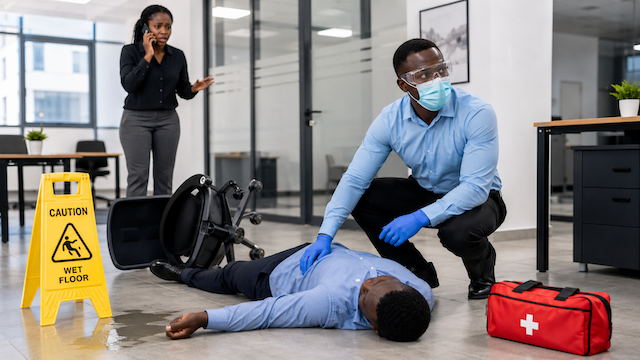
Before giving first aid, the first aider must make sure the emergency scene is safe. A first aider who becomes injured or infected may become another casualty and may no longer be able to help.
A safe first aid response follows this simple order:
Check the scene. Call for help. Care for the casualty.
The Red Cross teaches this as a core emergency response approach: check the scene for safety first, call emergency services when needed, then give care based on the person’s condition and your level of training.
Personal Safety and Scene Assessment
The first rule of first aid is:
Do not put yourself in danger.
Before approaching the casualty, pause and look around carefully.
Ask Yourself These Questions
- Is the area safe for me to enter?
- What happened?
- How many people are injured or sick?
- Is there fire, smoke, traffic, electricity, violence, chemicals, water, or falling objects?
- Do I need help from emergency services?
- Do I have gloves or other protective equipment?
- Can I safely reach the person?
- Is the danger still present?
If the scene is unsafe, do not rush in. Call emergency services and wait at a safe distance.
The First Aider’s Scene Safety Rule
A first aider should follow this simple rule:
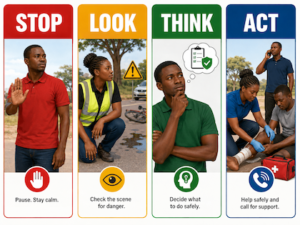
Stop. Look. Think. Act.
Stop
Pause before rushing into the scene.
Look
Observe the environment, the casualty, and possible dangers.
Think
Decide whether it is safe to approach and what help is needed.
Act
Call for help, put on PPE if available, and provide safe first aid within your level of training.
Hazard Identification
A hazard is anything that can cause harm. In first aid, hazards may come from the environment, people, equipment, animals, substances, or the casualty’s condition.
Common Hazards at an Emergency Scene
| Hazard | Example | What to Do |
|---|---|---|
| Traffic | Road accident, motorcycle crash | Keep a safe distance, warn others, call emergency services |
| Fire or smoke | Burning building, generator fire | Do not enter; call fire service |
| Electricity | Fallen power cable, exposed wire | Stay away; do not touch the person until power is off |
| Chemicals | Fuel spill, cleaning chemicals, pesticide | Avoid contact; move away from fumes if safe |
| Violence | Fighting, angry crowd, weapon | Do not intervene directly; call security or police |
| Blood and body fluids | Bleeding wound, vomit, saliva | Wear gloves and avoid direct contact |
| Water | Drowning, flood, wet floor | Avoid entering water unless trained and safe |
| Unstable structures | Collapsed building, falling objects | Stay clear and call emergency responders |
| Animals | Dog bite, snake, aggressive animal | Keep distance and do not provoke the animal |
Real-Life Scenario
You arrive at the scene of a motorcycle accident. A rider is lying on the road and people are shouting. Before touching the casualty, you notice fuel leaking from the motorcycle and cars still passing close to the scene.
The correct response is to:
- Stay calm.
- Keep yourself away from traffic and fuel.
- Ask bystanders to warn approaching vehicles if safe.
- Call emergency services immediately.
- Do not move the injured person unless there is immediate life-threatening danger.
- Give care only when it is safe to approach.
Infection Prevention and Control
Infection prevention means taking steps to reduce the risk of spreading germs between the first aider, the casualty, and the environment.
In first aid, every person should be treated as if they may carry an infection, especially when blood, vomit, saliva, open wounds, or other body fluids are present. WHO describes standard precautions as the minimum infection-prevention practices used during care to reduce transmission of microorganisms between people and the environment.
Basic Infection Prevention Steps
A first aider should:
- Wash hands with soap and clean water before and after giving care where possible.
- Use hand sanitizer when soap and water are not available.
- Wear disposable gloves when touching blood, body fluids, wounds, or contaminated materials.
- Avoid touching the eyes, nose, or mouth during care.
- Cover cuts or wounds on their own hands before helping.
- Use a CPR face shield or pocket mask if giving rescue breaths.
- Dispose of used gloves, dressings, and contaminated materials safely.
- Clean and disinfect reusable equipment after use.
- Wash hands again after removing gloves.
Good hand hygiene is one of the most important ways to prevent the spread of infection. WHO identifies hand hygiene as a key measure for preventing healthcare-associated infections.
Use of Personal Protective Equipment: PPE
PPE means Personal Protective Equipment. It protects the first aider from infection, injury, and exposure to harmful substances.
PPE should be chosen based on the risk at the scene. For example, gloves may be enough for a small wound, while a face mask, eye protection, and apron may be needed where there is vomiting, heavy bleeding, splashing, or suspected infectious disease.
Common PPE for First Aid
| PPE Item | Purpose |
| Disposable gloves | Protects against blood and body fluids |
| Face mask | Reduces exposure to droplets and respiratory fluids |
| Eye protection | Protects eyes from splashes |
| CPR face shield | Creates a barrier during rescue breathing |
| Apron or gown | Protects clothing and skin from contamination |
| Hand sanitizer | Helps reduce germs before and after care |
How to Use Gloves Safely
Before Wearing Gloves
- Check that the gloves are clean and not torn.
- Choose the correct size if available.
- Cover any cuts on your hands.
- Avoid touching unnecessary surfaces after putting them on.
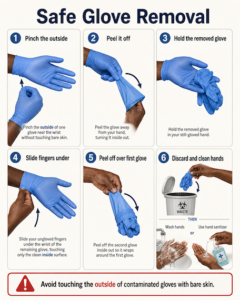
After Giving Care
- Remove gloves carefully without touching the outside surface.
- Dispose of gloves safely.
- Wash or sanitize your hands immediately.
Important Reminder
Gloves do not replace handwashing. Always clean your hands after removing gloves.
Emergency Action Plan: EAP
An Emergency Action Plan is a simple plan that guides people on what to do during an emergency. It helps reduce panic and ensures the right help is called quickly.
Every school, church, office, training centre, home, and community organisation should have an emergency action plan.
A Good EAP Should Include
- Emergency contact numbers.
- Location of the first aid kit.
- Names of trained first aiders.
- Nearest hospital or clinic.
- Evacuation routes.
- Assembly point.
- Fire extinguisher locations.
- Who calls emergency services.
- Who guides responders to the scene.
- How to report and document incidents.
- How to support injured persons until help arrives.
In Nigeria, the national emergency number is 112, a toll-free emergency number routed through Emergency Communication Centres to relevant responders such as ambulance services, police, fire service, and road safety agencies.
Simple Emergency Action Steps
During an emergency, follow these steps:
Step 1: Check the Scene
Look for danger before approaching.
Step 2: Check the Person
Find out if the person is responsive, breathing, bleeding, or in severe pain.
Step 3: Call for Help
Call emergency services or ask a specific person to call.
Example:
“You in the blue shirt, please call 112 now and come back to tell me what they said.”
Step 4: Give First Aid
Provide care based on your training and the person’s condition.
Step 5: Monitor the Person
Watch their breathing, responsiveness, bleeding, pain, and general condition.
Step 6: Handover to Medical Responders
When help arrives, explain clearly:
- What happened.
- What you found.
- What first aid you gave.
- Any changes in the person’s condition.
- Any known medical information.
What NOT to Do
A first aider should not:
- Rush into an unsafe scene.
- Touch blood or body fluids without protection where possible.
- Move a casualty unless there is immediate danger.
- Give care beyond their training.
- Crowd around the injured person.
- Allow bystanders to take photos or videos.
- Remove objects deeply stuck in the body.
- Give food or drink to a seriously injured or unconscious person.
- Delay calling emergency services in serious cases.
When to Call Emergency Services Immediately
Call emergency services immediately if:
- The person is unconscious or not responding.
- The person is not breathing normally.
- There is severe bleeding.
- There is chest pain or difficulty breathing.
- There is suspected stroke.
- There is a serious burn.
- There is suspected spinal, head, or neck injury.
- There is electrocution.
- There is poisoning or chemical exposure.
- There is a serious road accident.
- The scene is dangerous or unstable.
- You are unsure what to do.
Quick Recap
A first aider must protect themselves before helping others. Always check the scene, identify hazards, use PPE when needed, prevent infection, call for help early, and follow an Emergency Action Plan. Safe scene management prevents further harm and improves the chances of survival and recovery.