
Domestic Electrical Installation
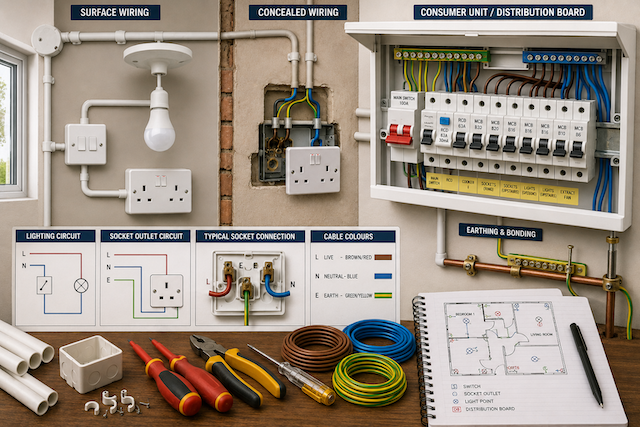
Introduction to Domestic Electrical Installation
Domestic electrical installation refers to the wiring and connection of electrical systems in residential buildings. It includes lighting circuits, socket outlet circuits, consumer units, switches, protective devices, earthing, bonding, and cable containment systems.
A domestic installation must be safe, reliable, easy to maintain, and suitable for the expected electrical load. Poor installation can lead to electric shock, fire, overheating, appliance damage, and frequent circuit failure. Electrical Safety First explains that a consumer unit controls and distributes electricity around the home, while earthing and bonding help reduce the risk of electric shock during faults.
Surface Wiring
Surface wiring is a method where electrical cables are installed on the surface of walls, ceilings, or structures. The cables are usually protected using PVC conduit, metal conduit, trunking, or cable clips.
Surface wiring is common in homes, shops, workshops, renovations, temporary installations, and buildings where chasing walls is not practical.
Advantages of Surface Wiring
Surface wiring is:
- Easier to install than concealed wiring.
- Easier to inspect and maintain.
- Easier to modify or extend.
- Suitable for renovations and existing buildings.
- Usually cheaper and faster to complete.
Limitations of Surface Wiring
Surface wiring may:
- Be more visible and less attractive.
- Be exposed to mechanical damage if not properly protected.
- Require neat workmanship to look professional.
- Need careful routing to avoid heat, water, impact, and sharp edges.
Good Practice for Surface Wiring
Surface wiring should be installed neatly and securely. Cables should follow straight vertical or horizontal routes where possible.
Good practice includes:
- Use suitable conduit or trunking.
- Support cables properly with clips, saddles, or trunking.
- Avoid loose or hanging cables.
- Keep wiring away from heat, water, and sharp edges.
- Avoid overcrowding trunking or conduit.
- Use correct fittings, bends, couplers, and boxes.
- Keep covers properly fitted.
- Label circuits where necessary.
- Inspect for damaged insulation before energising.
Surface wiring should not be treated as temporary or careless work. It must still meet proper safety and installation standards.
Concealed Wiring
Concealed wiring is installed inside walls, floors, ceilings, or building structures. The cables are hidden from view and are usually protected by conduit, capping, or approved wiring routes.
This method is common in modern homes because it gives a cleaner appearance.
Advantages of Concealed Wiring
Concealed wiring:
- Provides a neat and finished appearance.
- Reduces visible cable exposure.
- Protects cables from casual contact.
- Is suitable for permanent residential installations.
- Improves the appearance of interior spaces.
Limitations of Concealed Wiring
Concealed wiring can be harder to inspect, repair, or modify after the walls are finished. If the installation is not properly planned, future maintenance can become difficult.
Possible challenges include:
- Difficult fault tracing.
- Wall damage during repairs.
- Risk of hidden cable damage during drilling.
- Need for accurate drawings and records.
- Higher installation time and cost.
Good Practice for Concealed Wiring
Concealed wiring must be planned carefully before plastering or wall finishing.
Good practice includes:
- Follow approved cable routes.
- Use suitable conduit or cable protection.
- Avoid diagonal cable runs unless approved by design.
- Keep cable routes clear and traceable.
- Use correct cable size and insulation type.
- Avoid sharp bends that damage cables.
- Install boxes firmly and at correct depth.
- Keep records or photos before covering the cables.
- Test circuits before and after wall finishing.
- Avoid placing cables where nails, screws, or drilling may damage them.
Never bury cable carelessly inside walls without protection or a clear route. Hidden cable damage can create serious shock or fire hazards.
Lighting Circuits
Lighting circuits supply electricity to lamps, light fittings, and lighting accessories. A domestic lighting circuit usually includes a supply cable, switch, lamp holder or fitting, neutral conductor, live conductor, earth conductor, and protective device.
Lighting circuits may serve:
- Bedrooms
- Sitting rooms
- Kitchens
- Bathrooms
- Corridors
- Outdoor lights
- Security lights
- Staircase lights
Common Lighting Circuit Components
| Component | Function |
|---|---|
| Light point | Where the lamp or fitting is installed |
| Switch | Controls the light |
| Lamp holder / fitting | Holds and connects the lamp |
| Live conductor | Supplies voltage |
| Neutral conductor | Completes the circuit |
| Earth conductor | Provides fault protection |
| Junction box | Allows cable connections where required |
| Protective device | Protects the circuit from faults |
Lighting Circuit Safety
Lighting circuits should be correctly wired, protected, and tested.
Important safety points include:
- Switch the live conductor, not the neutral.
- Use the correct cable size for the lighting load.
- Use suitable light fittings for the environment.
- Ensure metal fittings are properly earthed.
- Use bathroom and outdoor fittings with suitable protection ratings.
- Avoid loose connections in ceiling roses and junction boxes.
- Do not overload lighting circuits.
- Use correct protective devices.
- Test polarity, continuity, insulation resistance, and earth connection where required.
A light may still work even when wired incorrectly, but incorrect wiring can leave parts live when they appear switched off.
Socket Outlet Circuits
Socket outlet circuits supply power to plug-in appliances such as televisions, refrigerators, fans, chargers, computers, washing machines, irons, and kitchen equipment.
Socket circuits usually carry more current than lighting circuits, so they require correct cable size, proper protection, sound connections, and good load management.
Common Socket Outlet Components
| Component | Function |
|---|---|
| Socket outlet | Provides connection point for appliances |
| Back box | Holds the socket securely |
| Live terminal | Receives the live conductor |
| Neutral terminal | Receives the neutral conductor |
| Earth terminal | Connects the protective conductor |
| Circuit cable | Carries current to and from the socket |
| Protective device | Protects the circuit |
| RCD / RCBO | Provides earth leakage protection where required |
Socket Outlet Safety
Good socket installation should ensure correct polarity, strong terminal connections, suitable cable size, and reliable earthing.
Important safety points include:
- Connect live, neutral, and earth correctly.
- Tighten terminals properly.
- Do not leave exposed copper outside terminals.
- Use the correct socket rating.
- Do not install damaged or cracked sockets.
- Avoid overloading sockets with too many appliances.
- Use weatherproof sockets outdoors.
- Install sockets away from water unless properly protected.
- Ensure earth continuity.
- Test before use.
If a socket is warm, sparking, buzzing, cracked, or discoloured, it should be inspected and replaced if necessary.
Consumer Unit Installation
A consumer unit is the main control and protection point for domestic electrical circuits. It receives electrical supply and distributes it to circuits through protective devices.
A modern consumer unit may include a main switch, MCBs, RCDs, RCBOs, neutral bar, earth bar, busbar, enclosure, and circuit labels.
Consumer unit work should only be carried out by competent persons. In many jurisdictions, installing or replacing a consumer unit is regulated work because it affects the safety of the entire installation. Electrical Safety First recommends using a registered electrician for electrical installation work, and UK Part P guidance treats new consumer units as notifiable work in homes.
Main Parts of a Consumer Unit
| Part | Function |
|---|---|
| Main switch | Turns off the supply to the unit |
| MCB | Protects against overload and short circuit |
| RCD / RCCB | Trips when earth leakage is detected |
| RCBO | Combines overload, short-circuit, and earth-leakage protection |
| Neutral bar | Connection point for neutral conductors |
| Earth bar | Connection point for protective conductors |
| Busbar | Distributes supply to protective devices |
| Enclosure | Protects internal components |
| Circuit labels | Identifies each circuit |
Consumer Unit Installation Safety
Consumer unit installation must be planned and tested carefully.
Good practice includes:
- Isolate the supply before work.
- Confirm the unit rating is suitable.
- Use correct protective devices for each circuit.
- Ensure correct polarity.
- Separate neutral and earth correctly.
- Keep wiring neat and secure.
- Avoid overcrowding the board.
- Tighten terminals properly.
- Label all circuits clearly.
- Cover unused openings.
- Keep the enclosure closed after work.
- Test the installation before energising.
- Provide records where required.
Never bypass protective devices or replace breakers with higher ratings without proper design checks.
Earthing and Bonding
Earthing and bonding are essential safety measures in domestic electrical installations.
Earthing provides a path for fault current so protective devices can disconnect the supply quickly. Bonding connects metal parts together to reduce dangerous voltage differences during a fault.
Electrical Safety First explains that if an appliance develops a fault, fault current can flow through the protective earthing conductor, causing a fuse, circuit breaker, or RCD in the consumer unit to switch off the supply. Bonding reduces electric shock risk by reducing voltage differences between separate metal parts.
Earthing
Earthing connects exposed metal parts of an electrical installation to the earth system. This helps protect people from electric shock if a fault makes a metal part live.
Common earthing components include:
| Component | Function |
|---|---|
| Earth conductor | Carries fault current safely |
| Earth bar | Connection point for protective conductors |
| Main earthing terminal | Main point where earthing conductors connect |
| Earth electrode / rod | Provides connection to the ground where used |
| Earth clamp | Secures earth connection |
| Protective conductor | Connects exposed metal parts to earth |
OSHA explains that grounding creates a low-resistance path to earth so current from faults or lightning can follow that path, helping prevent dangerous voltage buildup that could cause electric shock, injury, or death.
Bonding
Bonding connects metal services and exposed conductive parts together so they remain at nearly the same voltage during a fault.
Bonding may be required for:
- Metal water pipes
- Metal gas pipes
- Structural steel
- Metal service pipes
- Exposed conductive parts
- Other metallic services, depending on the installation design and local regulations
Bonding does not replace earthing. Earthing and bonding work together to improve safety.
Earthing and Bonding Safety
Good earthing and bonding practice includes:
- Use correctly sized conductors.
- Make tight, secure connections.
- Protect conductors from damage.
- Do not disconnect earth or bonding conductors casually.
- Use proper clamps and terminals.
- Keep connections accessible for inspection where required.
- Test continuity and earth fault path.
- Confirm protective devices operate correctly.
- Follow applicable wiring regulations.
A missing or loose earth connection can make metal equipment dangerous during a fault.
Domestic Installation Testing
After domestic electrical installation work, testing is required to confirm safety before use.
Common tests may include:
| Test | Purpose |
|---|---|
| Continuity test | Confirms conductors are complete |
| Insulation resistance test | Checks insulation condition |
| Polarity test | Confirms live, neutral, and earth are correctly connected |
| Earth continuity test | Confirms protective conductor path |
| RCD test | Confirms RCD trips correctly |
| Functional test | Confirms switches, sockets, and circuits work properly |
Testing should be carried out using suitable instruments and by competent persons. A circuit should not be energised until it has been inspected and confirmed safe.
Real-Life Scenario
A technician installs a new socket in a living room. The socket works when tested with a phone charger, but the earth conductor is loose inside the back box.
This is unsafe.
The socket may appear functional, but the missing earth connection can create a serious shock risk if an appliance develops a fault. The correct action is to isolate the circuit, reconnect the earth properly, tighten all terminals, inspect the socket, and test the circuit before use.
Common Mistakes in Domestic Electrical Installation
Avoid these unsafe practices:
- Running cables without proper protection.
- Mixing up live, neutral, and earth conductors.
- Switching the neutral instead of the live.
- Installing sockets without earth continuity.
- Overcrowding conduits or trunking.
- Using undersized cables.
- Overloading socket circuits.
- Leaving consumer units unlabelled.
- Using damaged sockets, switches, or accessories.
- Bypassing MCBs, fuses, RCDs, or RCBOs.
- Ignoring bonding requirements.
- Energising circuits before testing.
- Making concealed joints that cannot be inspected.
- Failing to record concealed cable routes.
What an Electrical Worker Should Never Do
An electrical worker should never:
- Work on a live domestic circuit without proper authorisation and controls.
- Assume a circuit is dead without testing.
- Leave exposed conductors inside switches, sockets, or consumer units.
- Remove earth or bonding conductors for convenience.
- Use damaged cables or accessories.
- Install a consumer unit without competence.
- Replace protective devices with incorrect ratings.
- Ignore warm sockets, burning smells, buzzing, or sparks.
- Hide unsafe joints inside walls.
- Energise any installation before inspection and testing.
Quick Recap
Domestic electrical installation includes surface wiring, concealed wiring, lighting circuits, socket outlet circuits, consumer units, earthing, and bonding. A safe installation requires correct cable routing, suitable materials, proper protection, secure connections, reliable earthing, and testing before energising. Surface wiring must be neat and protected, concealed wiring must be carefully planned, lighting and socket circuits must be correctly wired, and the consumer unit must protect each circuit properly.