
Electrical Materials
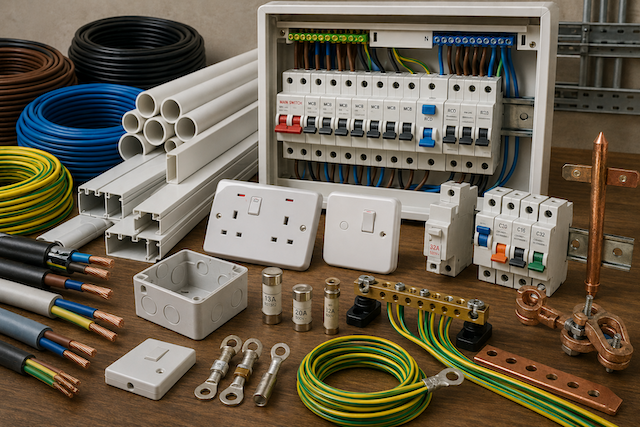
Introduction to Electrical Materials
Electrical materials are the physical items used to build, protect, connect, control, and distribute electrical power in an installation. They include cables, wires, conduits, trunking, switches, sockets, distribution boards, fuses, circuit breakers, and earthing materials.
Good electrical work depends on using the right material for the right purpose. Poor-quality, undersized, damaged, or wrongly installed materials can lead to electric shock, overheating, fire, equipment failure, or frequent faults. Electrical safety guidance from HSE emphasises that electrical systems and equipment must be properly selected, installed, used, and maintained to prevent injury and damage.
Types of Cables and Wires
Cables and wires are used to carry electrical current from the supply source to electrical loads such as lamps, sockets, machines, and appliances.
A wire is usually a single conductor, while a cable contains one or more insulated conductors, often with an outer protective sheath.
Common cable and wire types include:
| Cable / Wire Type | Common Use |
|---|---|
| Single-core wire | Internal wiring inside conduits, panels, and control circuits |
| Twin and earth cable | Lighting and socket circuits in some building installations |
| Flexible cable | Appliances, extension cords, and portable equipment |
| Armoured cable | Underground, outdoor, and industrial installations |
| Coaxial cable | TV, CCTV, and signal systems |
| Data cable | Internet, networking, CCTV, and communication systems |
| Solar PV cable | Solar panel installations |
| Fire-resistant cable | Fire alarm, emergency lighting, and critical safety circuits |
Cable Conductors
Most electrical cables use copper or aluminium conductors.
| Conductor | Key Features |
|---|---|
| Copper | Good conductivity, flexible, reliable, widely used in building wiring |
| Aluminium | Lightweight and cheaper for large sizes, but requires correct termination practices |
Copper is commonly used in domestic and commercial wiring. Aluminium is often used for larger power distribution cables, but it must be installed carefully to avoid loose connections and overheating.
Cable Insulation and Sheathing
Cable insulation prevents conductors from touching each other or exposed metal parts. The outer sheath protects the cable from mechanical damage, moisture, chemicals, and environmental exposure.
Common insulation or sheath materials include:
| Material | Common Feature |
|---|---|
| PVC | Common, affordable, widely used for general wiring |
| XLPE | Good heat and insulation performance |
| Rubber | Flexible, often used for portable equipment |
| LSZH | Low smoke, zero halogen; used where smoke reduction is important |
| Fire-resistant sheath | Designed for emergency and fire-safety circuits |
Damaged insulation is dangerous. It can expose live conductors, cause short circuits, create leakage current, or start a fire.
Cable Size and Current Rating
Cable size must match the expected load current, installation method, cable length, temperature, and protective device rating.
Cable size is commonly measured in square millimetres, written as mm².
Examples include:
| Cable Size | Common Use |
|---|---|
| 1.0 mm² / 1.5 mm² | Lighting circuits, depending on design and local regulations |
| 2.5 mm² | Socket outlet circuits in many installations |
| 4 mm² and above | Higher-load circuits |
| 6 mm² and above | Cookers, water heaters, sub-main circuits, and larger loads |
| 10 mm² and above | Distribution, industrial, and high-current circuits |
Cable sizing must not be guessed. The correct size should be selected according to load current, voltage drop, installation conditions, protective device rating, and applicable wiring standards.
Cable Colour Identification
Cable colours help identify the function of each conductor. The exact colour code depends on the country, system, and applicable standard.
Common conductor functions include:
| Function | Meaning |
|---|---|
| Live / Phase | Carries voltage from the supply |
| Neutral | Returns current in normal operation |
| Earth / Protective conductor | Provides a safe path for fault current |
Always confirm the local wiring colour code before working. Never rely only on colour; test and verify before touching or connecting conductors.
Conduits and Trunking
Conduits and trunking protect cables and provide neat wiring routes.
They help prevent cable damage from impact, heat, moisture, rodents, sharp edges, and poor handling. They also make installations easier to inspect, maintain, and modify.
Conduits
A conduit is a pipe-like wiring enclosure through which cables are run.
Common types include:
| Conduit Type | Common Use |
|---|---|
| PVC conduit | Domestic, commercial, and light-duty installations |
| Metal conduit | Industrial areas, mechanical protection, exposed wiring routes |
| Flexible conduit | Areas requiring movement or vibration control |
| Underground conduit | Cable protection below ground |
| Heavy-duty conduit | Harsh environments and exposed installations |
Conduit Installation Rules
Good conduit installation should:
- Follow a neat and planned route.
- Avoid unnecessary bends.
- Use suitable saddles, clips, or supports.
- Protect cables from sharp edges.
- Avoid overcrowding cables.
- Allow cables to be pulled without damage.
- Use correct fittings, couplers, bends, bushes, and boxes.
- Keep water out where possible.
- Maintain proper separation from heat and mechanical hazards.
Do not force too many cables into a conduit. Overcrowding can make pulling difficult, damage insulation, increase heat, and complicate maintenance.
Trunking
Trunking is a rectangular or square enclosure used to contain and route cables. It is common in offices, commercial buildings, workshops, and surface installations.
Common types include:
| Trunking Type | Common Use |
|---|---|
| PVC trunking | Surface wiring in homes, offices, and shops |
| Metal trunking | Industrial and commercial installations |
| Cable tray | Supporting large groups of cables |
| Cable ladder | Heavy-duty cable support in industrial settings |
| Skirting trunking | Office power and data distribution |
| Floor trunking | Routing cables through floors in offices and workspaces |
Trunking Installation Rules
Good trunking installation should:
- Be straight, firm, and well supported.
- Have covers properly fitted.
- Avoid sharp edges that can damage cables.
- Allow enough space for cables.
- Keep power and data cables separated where required.
- Use proper bends, tees, couplers, and end caps.
- Avoid overloading or overcrowding.
- Be accessible for inspection and maintenance.
Switches and Socket Outlets
Switches and socket outlets are user-access points in electrical installations. They must be correctly selected, installed, wired, and protected.
A switch controls the flow of electricity to a load. A socket outlet provides a connection point for appliances and equipment.
Switches
Common switch types include:
| Switch Type | Common Use |
|---|---|
| One-way switch | Controls one light or load from one position |
| Two-way switch | Controls one light from two positions |
| Intermediate switch | Used with two-way switching for three or more control points |
| Double-pole switch | Switches both live and neutral conductors |
| Isolator switch | Provides local isolation for equipment |
| Rotary switch | Used for selector or control functions |
| Push-button switch | Used in control circuits, bells, and machines |
Safe Switch Installation
When installing switches:
- Use the correct rating for the circuit.
- Ensure the switch controls the live conductor.
- Tighten terminals properly.
- Avoid exposed copper outside terminals.
- Fit the switch firmly to the box.
- Use the correct back box depth.
- Avoid overloading the switch.
- Replace cracked or damaged switches.
- Confirm operation after installation.
Loose switch connections can cause arcing, overheating, flickering, or fire.
Socket Outlets
Socket outlets allow appliances to connect to the electrical supply.
Common types include:
| Socket Type | Common Use |
|---|---|
| Single socket | One appliance connection point |
| Double socket | Two appliance connection points |
| Switched socket | Socket with local on/off control |
| Unswitched socket | Socket without local switch |
| Weatherproof socket | Outdoor or damp-area use |
| Industrial socket | Heavy-duty industrial equipment |
| USB socket | Low-voltage charging applications |
Safe Socket Installation
When installing socket outlets:
- Use the correct socket rating.
- Ensure correct polarity: live, neutral, and earth.
- Tighten terminals properly.
- Do not leave exposed copper.
- Use suitable back boxes.
- Do not overload the circuit.
- Ensure earthing is present and continuous.
- Use weatherproof sockets in outdoor or wet locations.
- Replace burnt, cracked, loose, or damaged sockets.
- Test after installation.
A socket may appear normal but still be unsafe if polarity, earthing, or terminal tightness is wrong.
Distribution Boards
A distribution board is an electrical panel that receives power and distributes it to different circuits through protective devices.
It is one of the most important parts of an electrical installation. It protects circuits, provides isolation, and helps organise electrical supply safely.
Distribution boards commonly contain:
| Component | Function |
|---|---|
| Main switch | Turns off supply to the board |
| Busbar | Distributes supply to protective devices |
| MCB | Protects circuits from overload and short circuit |
| RCD/RCCB | Protects against earth leakage and electric shock risk |
| RCBO | Combines overcurrent and earth-leakage protection |
| Neutral bar | Connection point for neutral conductors |
| Earth bar | Connection point for protective conductors |
| Enclosure | Protects the internal components |
| Circuit labels | Identifies each outgoing circuit |
Distribution boards must be properly designed, rated, installed, labelled, and maintained. IEC-based installation guidance treats distribution equipment, protective devices, earthing, and circuit protection as key parts of safe low-voltage installations.
Distribution Board Safety
Good distribution board practice includes:
- Use a board with suitable rating and capacity.
- Install the board in a dry, accessible location.
- Keep the enclosure closed after work.
- Label all circuits clearly.
- Use correct protective devices for each circuit.
- Do not leave unused openings uncovered.
- Keep wiring neat and secure.
- Separate neutral and earth conductors correctly.
- Avoid overcrowding the board.
- Tighten terminals to the correct level.
- Do not bypass breakers or RCDs.
- Keep unauthorised persons away.
Only competent persons should work inside distribution boards.
Fuses and Circuit Breakers
Fuses and circuit breakers protect electrical circuits from excessive current.
Excessive current can happen because of overload, short circuit, or fault conditions. If the protective device is correctly selected, it disconnects the circuit before cables and equipment overheat dangerously.
Fuses
A fuse contains a thin metal element that melts when current exceeds a safe level. Once a fuse operates, it must be replaced.
Common fuse types include:
| Fuse Type | Common Use |
|---|---|
| Cartridge fuse | Appliances, panels, and distribution systems |
| Rewirable fuse | Older installations |
| HRC fuse | Industrial and high-fault-level applications |
| Plug fuse | Appliance plugs in some systems |
Fuse Safety Rules
- Use the correct fuse rating.
- Never replace a fuse with wire, foil, nails, or oversized fuse elements.
- Investigate why the fuse blew before replacing it.
- Do not bypass a fuse.
- Use only suitable replacement fuses.
- Ensure the circuit is isolated before fuse replacement.
A blown fuse is a warning sign. Replacing it without checking the cause can be dangerous.
Circuit Breakers
A circuit breaker is a protective device that trips when excessive current flows. Unlike a fuse, it can usually be reset after the fault has been corrected.
Common circuit breakers include:
| Device | Main Function |
|---|---|
| MCB | Protects against overload and short circuit |
| MCCB | Protects larger circuits and equipment |
| RCCB / RCD | Trips when earth leakage is detected |
| RCBO | Combines MCB and RCD functions |
| ELCB | Older earth-leakage protection device in some installations |
MCBs
An MCB, or Miniature Circuit Breaker, protects a circuit from overload and short circuit.
If an MCB trips, the cause may be:
- Too many loads on the circuit
- Faulty appliance
- Short circuit
- Cable damage
- Loose connection
- Wrong breaker rating
Do not keep resetting a breaker without finding the cause.
RCDs and RCCBs
An RCD or RCCB detects current leakage to earth and disconnects the supply quickly. It helps reduce the risk of electric shock and some fire risks caused by leakage current.
RCDs do not replace proper earthing, correct wiring, or overcurrent protection. They are part of a wider safety system.
RCBOs
An RCBO combines overload, short-circuit, and earth-leakage protection in one device.
It protects individual circuits more selectively than using one RCD for many circuits.
Earthing Materials
Earthing provides a safe path for fault current so that protective devices can operate quickly. It also helps reduce the risk of electric shock when exposed metal parts become live due to a fault.
Earthing is a critical part of electrical safety. Nigerian electricity safety documents and international best-practice guidance recognise earthing and protective measures as essential to preventing electrical injury and equipment damage.
Common Earthing Materials
| Material | Function |
|---|---|
| Earth electrode | Makes contact with the ground |
| Earth rod | Common electrode driven into the ground |
| Earth conductor | Connects installation to the earthing system |
| Earth bar | Connection point for protective conductors |
| Bonding conductor | Connects metal parts to reduce voltage difference |
| Earth clamp | Secures earthing conductor to pipe, rod, or metalwork |
| Inspection pit | Allows access to earth electrode connection |
| Earth tape | Flat conductor used in earthing systems |
| Earth cable lug | Terminates earth cables securely |
| Earth resistance tester | Tests earthing effectiveness |
Earthing and Bonding
Earthing and bonding are related, but they are not exactly the same.
| Term | Meaning |
|---|---|
| Earthing | Connecting exposed metal parts to earth for safety |
| Bonding | Connecting metal parts together to reduce dangerous voltage differences |
Earthing helps fault current flow back safely so that breakers or fuses can operate. Bonding reduces the risk of electric shock between two metal parts that may otherwise be at different voltages.
Earthing Safety Rules
A proper earthing system should:
- Have secure and corrosion-resistant connections.
- Use correctly sized conductors.
- Be protected from mechanical damage.
- Be tested where required.
- Be accessible for inspection.
- Not be disconnected casually.
- Be connected to all required exposed conductive parts.
- Work together with protective devices.
Never remove an earth conductor because it is “in the way.” A missing earth connection can make exposed metal parts deadly during a fault.
Material Selection and Quality
Electrical materials should be suitable for the installation environment and the expected load.
Before selecting materials, consider:
- Voltage rating
- Current rating
- Environmental condition
- Indoor or outdoor use
- Heat exposure
- Moisture exposure
- Mechanical protection
- Fire performance
- Chemical exposure
- Load type
- Maintenance access
- Applicable electrical regulations
Cheap or poor-quality materials may fail early, overheat, crack, loosen, or create unsafe conditions.
Storage and Handling of Electrical Materials
Electrical materials should be stored properly before installation.
Good practices include:
- Store cables in dry conditions.
- Keep cable drums upright and protected.
- Avoid dragging cables over sharp surfaces.
- Keep switches and sockets in packaging until use.
- Store circuit breakers away from dust and moisture.
- Protect distribution boards from impact and water.
- Keep earthing materials organised and clean.
- Do not use materials that are cracked, corroded, wet, or damaged.
Real-Life Scenario
An electrician is installing a socket circuit. The correct cable is available, but the socket outlet is cracked and one terminal screw is loose. The electrician considers using it temporarily because the client wants the work finished quickly.
This is unsafe.
A damaged socket should not be installed. The correct action is to replace it with a suitable socket in good condition, confirm correct wiring, tighten terminals properly, test the circuit, and only energise when the installation is safe.
Common Mistakes With Electrical Materials
Avoid these unsafe practices:
- Using undersized cables.
- Using indoor materials outdoors.
- Installing cracked sockets or switches.
- Overcrowding conduits and trunking.
- Using poor-quality circuit breakers.
- Leaving distribution boards unlabelled.
- Mixing incompatible protective devices.
- Ignoring earthing and bonding.
- Using damaged insulation.
- Leaving sharp conduit edges unprotected.
- Using incorrect cable colours without identification.
- Installing cables without mechanical protection where needed.
- Replacing fuses or breakers with higher ratings without proper design checks.
What an Electrical Worker Should Never Do
An electrical worker should never:
- Use damaged or poor-quality electrical materials.
- Bypass fuses, breakers, RCDs, or earthing systems.
- Install cables without checking current rating.
- Leave live conductors exposed.
- Remove earth conductors for convenience.
- Use a socket or switch with cracks, burns, or loose terminals.
- Overfill conduit or trunking.
- Use metal accessories without proper earthing.
- Ignore overheating, sparks, buzzing, or burning smell.
- Energise a circuit before proper inspection and testing.
Quick Recap
Electrical materials include cables, wires, conduits, trunking, switches, sockets, distribution boards, protective devices, and earthing components. Each material must be correctly selected, installed, protected, inspected, and maintained. Safe installations depend on correct cable sizing, proper circuit protection, reliable earthing, good-quality materials, and careful workmanship.