
Health, Safety and Environment HSE
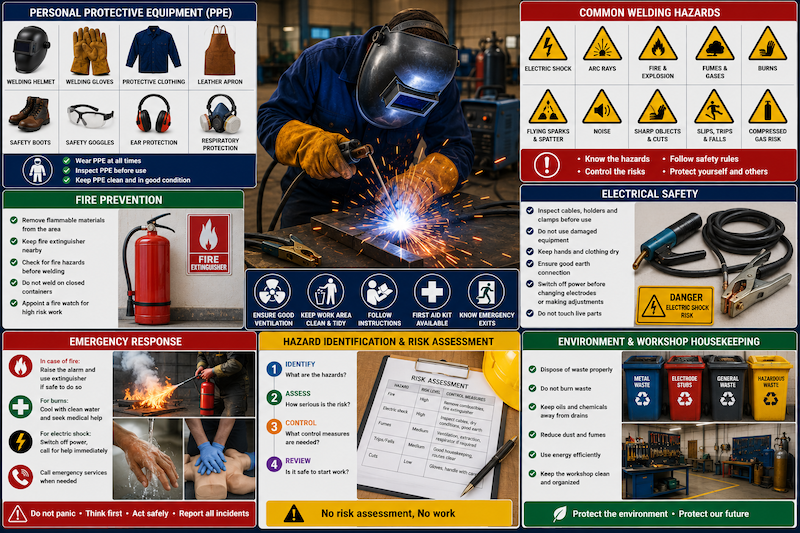
Introduction to HSE in Arc Welding
Health, Safety and Environment, commonly called HSE, is one of the most important parts of welding training. Welding is a useful and valuable skill, but it involves serious hazards if it is not done safely. These hazards include electric shock, burns, fire, explosion, fumes, eye injury, noise, cuts, falling objects, hot metal, poor ventilation, and unsafe handling of tools and equipment.
A good welder must not only know how to produce a strong weld. A good welder must also know how to protect themselves, protect others, protect equipment, and protect the work environment.
In welding, safety is not optional. Safety must come before, during, and after every welding activity.
Why HSE Is Important in Welding
HSE is important because welding can cause injuries, sickness, equipment damage, fire, and even death if hazards are ignored. OSHA identifies welding, cutting, and brazing hazards to include health risks from fumes and ultraviolet radiation, and safety risks such as burns, eye damage, electrical shock, cuts, and crushed toes or fingers.
Good HSE practices help to:
- Prevent injuries and accidents.
- Protect the eyes, skin, lungs, hands, and feet.
- Prevent fire and explosion.
- Reduce exposure to welding fumes.
- Prevent electric shock.
- Keep the workshop organised.
- Protect other workers and trainees.
- Reduce equipment damage.
- Improve work quality.
- Build professional discipline.
A trainee who ignores safety cannot become a professional welder.
Main Hazards in Arc Welding
Arc welding has several hazards that trainees must understand before handling equipment.
| Hazard | Possible Effect |
|---|---|
| Electric shock | Injury, burns, unconsciousness, death |
| Arc rays | Eye injury, skin burns |
| Hot metal | Burns and fire |
| Sparks and spatter | Burns, eye injury, fire |
| Welding fumes | Breathing problems and long-term illness |
| Noise | Hearing damage |
| Grinding particles | Eye and face injury |
| Sharp metal edges | Cuts and puncture wounds |
| Poor housekeeping | Slips, trips, falls |
| Gas cylinders, where used | Fire, explosion, impact injury |
| Flammable materials | Fire and explosion |
| Poor ventilation | Fume accumulation and breathing difficulty |
CCOHS lists welding health risks such as respiratory irritation, metal fume fever, lung cancer, skin cancer, nervous-system damage, and asphyxiation, while safety hazards include burns, eye damage, electrical shock, cuts, toe and finger injuries, fires, and explosions.
Personal Protective Equipment: PPE
PPE means Personal Protective Equipment. PPE is worn to reduce exposure to hazards. It does not remove the hazard completely, but it protects the welder when used correctly.
Welding PPE must be suitable, clean, dry, and in good condition. Damaged PPE should be replaced.
Common welding PPE includes:
| PPE | Purpose |
|---|---|
| Welding helmet | Protects eyes and face from arc rays, sparks, and heat |
| Safety goggles | Protects eyes during grinding, chipping, and cleaning |
| Welding gloves | Protects hands from heat, sparks, and sharp metal |
| Flame-resistant clothing | Protects skin from burns and sparks |
| Leather apron or jacket | Protects body from heat and spatter |
| Safety boots | Protects feet from falling metal, sparks, and sharp objects |
| Ear protection | Protects hearing from grinding and workshop noise |
| Respiratory protection | Helps protect against fumes where required |
| Face shield | Protects face during grinding |
| Helmet or hard hat | Protects head where falling-object risk exists |
PPE must be worn before work begins, not after an accident occurs.
Welding Helmet
The welding helmet protects the eyes and face from arc rays, heat, sparks, and spatter. Looking at a welding arc without proper eye protection can cause painful eye injury commonly called arc eye or welder’s flash.
Helmet safety rules:
- Use the correct welding lens shade.
- Inspect the helmet before use.
- Do not use cracked or damaged lenses.
- Keep the lens clean.
- Do not watch another person weld without eye protection.
- Use welding screens to protect others nearby.
- Keep the helmet lowered before striking the arc.
A welding helmet is compulsory during arc welding.
Safety Goggles and Face Shield
Safety goggles are used during chipping, grinding, brushing, and cleaning. A face shield may also be required when grinding because particles can fly toward the face.
Important rules:
- Wear goggles when chipping slag.
- Wear goggles or face shield when grinding.
- Do not rely on normal eyeglasses as eye protection.
- Replace scratched or cracked goggles.
- Keep eye protection clean.
- Do not chip slag toward another person.
Eye injuries can happen even after welding is finished, especially during slag removal and grinding.
Welding Gloves
Welding gloves protect the hands from heat, sparks, spatter, sharp edges, and minor cuts.
Glove safety rules:
- Use dry welding gloves.
- Do not use wet gloves during welding.
- Do not use torn gloves.
- Do not touch hot metal with bare hands.
- Do not hold small hot pieces without pliers or tongs.
- Keep gloves free from oil and grease.
- Use the correct glove type for welding and grinding tasks.
Wet or damaged gloves increase the risk of burns and electric shock.
Protective Clothing
Welders should wear suitable clothing that protects the skin from sparks, heat, and arc rays.
Good welding clothing includes:
- Flame-resistant cotton or leather clothing.
- Long sleeves.
- Long trousers.
- Leather apron or jacket.
- Clothing without loose hanging parts.
- Trousers worn over boots, not tucked inside.
- No synthetic clothing that can melt onto the skin.
- No oily or greasy clothing.
Avoid nylon, polyester, and other synthetic materials because they may melt when exposed to sparks or heat.
Safety Boots
Safety boots protect the feet from falling objects, hot metal, sharp metal pieces, and sparks.
Boot safety rules:
- Wear safety boots in the welding area.
- Keep laces tied properly.
- Avoid open shoes, slippers, or sandals.
- Use boots with strong soles.
- Keep trousers over the boot tops to prevent sparks entering.
- Do not walk on welding cables or sharp metal pieces.
Foot injuries are common in workshops where heavy metals are handled.
Respiratory Protection and Ventilation
Welding produces fumes and gases that can harm the lungs. The level of risk depends on the welding process, electrode, metal type, surface coating, ventilation, and work area.
HSE states that welding activities generate fumes that may pose significant health risks if not properly managed, and that a risk assessment is essential to identify hazards and implement controls.
Good fume-control practices include:
- Weld in a well-ventilated area.
- Use local exhaust ventilation where available.
- Keep your head away from the welding plume.
- Avoid breathing fumes directly.
- Remove paint, oil, grease, and coatings before welding where possible.
- Do not weld in confined spaces without authorisation, ventilation, and supervision.
- Use respiratory protection where required.
- Report dizziness, coughing, irritation, or breathing difficulty.
PPE should not be the only control for fumes. Ventilation and safe work methods are also important.
Ear Protection
Grinding, hammering, cutting, and some welding environments can produce harmful noise.
Use ear protection when:
- Grinding.
- Chipping for long periods.
- Working near loud machines.
- Working in enclosed noisy areas.
- Instructed by the trainer or safety officer.
Noise damage may happen gradually and may not be noticed immediately.
PPE Inspection Before Work
Before welding, inspect your PPE.
Check:
- Helmet lens is clean and not cracked.
- Gloves are dry and not torn.
- Clothing is not oily or synthetic.
- Boots are suitable and properly worn.
- Goggles are available for chipping and grinding.
- Ear protection is available if needed.
- Respirator is correct and clean if required.
- No loose jewellery or hanging clothing.
Do not begin welding if your PPE is incomplete.
Fire Prevention in Welding
Welding produces heat, sparks, molten metal, and hot slag. These can start fires if they land on flammable materials. Fire prevention is a major part of welding safety.
Common flammable materials include:
- Paper.
- Wood.
- Sawdust.
- Fuel.
- Paint.
- Oil.
- Grease.
- Solvents.
- Gas cylinders.
- Rags.
- Plastic materials.
- Dry grass.
- Packaging materials.
- Cloth.
- Chemicals.
Fire can start during welding or several minutes after the welding work has ended.
Fire Prevention Rules
Before welding:
- Remove flammable materials from the area.
- Clean oil, grease, and fuel from the workpiece.
- Keep a suitable fire extinguisher nearby.
- Know how to raise the alarm.
- Check the other side of walls, plates, floors, or tanks before welding.
- Use welding screens where necessary.
- Do not weld near fuel containers.
- Do not weld sealed containers.
- Keep sparks away from gas cylinders.
- Keep the work area tidy.
- Assign a fire watch for high-risk hot work.
OSHA hot-work rules require combustible materials near welding to be moved or protected, and the standard uses a 35-foot radius as an important fire-prevention zone around welding and cutting operations.
Fire Watch
A fire watch is a trained person assigned to watch for fire during and after welding or cutting operations.
A fire watch may be needed when:
- Welding near flammable materials.
- Welding near walls, floors, or openings.
- Sparks can travel to hidden areas.
- Work is done outside the normal welding bay.
- Work is done in a construction or industrial area.
- Hot work permit requires it.
The fire watch should:
- Monitor sparks and hot materials.
- Keep extinguisher ready.
- Stop work if conditions become unsafe.
- Raise alarm if fire starts.
- Continue watching after welding as required by workplace procedure.
Fire Extinguishers
Welders should know the location of fire extinguishers and how to raise the alarm. Only use a fire extinguisher if:
- You are trained.
- The fire is small.
- You have a safe exit route.
- The correct extinguisher is available.
- You are not putting yourself at risk.
If the fire is large, spreading, producing heavy smoke, or near dangerous materials, evacuate and call emergency help.
Emergency Response in Welding
An emergency response is the action taken when an accident, injury, fire, electric shock, burn, or dangerous situation occurs.
Basic emergency response steps:
- Stop work.
- Raise the alarm.
- Make the area safe if possible.
- Do not put yourself in danger.
- Call the trainer, supervisor, or emergency response team.
- Give first aid within your training.
- Call emergency services when needed.
- Evacuate if required.
- Report the incident.
- Do not restart work until the area is declared safe.
Every trainee should know the workshop emergency procedure.
Response to Fire
If fire occurs:
- Stop welding immediately.
- Alert others.
- Switch off equipment if safe.
- Raise the alarm.
- Use a fire extinguisher only if trained and safe.
- Evacuate if fire cannot be controlled quickly.
- Report to the assembly point.
- Do not re-enter until authorised.
Do not try to be a hero. Life comes before equipment.
Response to Burns
Burns may be caused by hot metal, sparks, flame, or hot workpieces.
First aid for burns:
- Move the casualty away from the heat source.
- Cool the burn under cool running water for at least 20 minutes.
- Remove rings, watches, or tight items near the burn if not stuck.
- Do not remove clothing stuck to the skin.
- Cover the burn with a sterile non-stick dressing or clean covering.
- Do not apply oil, butter, toothpaste, or creams.
- Seek medical help for serious burns.
Report all burns to the trainer or supervisor.
Response to Electric Shock
Electric shock can be fatal. Do not touch a casualty who is still in contact with electricity.
Steps:
- Switch off power if safe.
- Do not touch the casualty until power is isolated.
- Call for help immediately.
- Check response and breathing once safe.
- Start CPR if trained and needed.
- Treat burns if present.
- Call emergency services.
- Report the incident.
All electric shock incidents should be treated seriously, even if the casualty appears well.
Response to Eye Injury
Eye injuries may occur from arc rays, grinding particles, metal chips, dust, or chemical exposure.
If a particle enters the eye:
- Do not rub the eye.
- Rinse gently with clean water if appropriate.
- Seek medical help if pain continues.
- Do not remove embedded objects.
If arc eye is suspected:
- Stop work.
- Report to the trainer.
- Seek medical attention.
- Do not continue welding.
Eye protection must be used during welding, grinding, and chipping.
Electrical Safety in Arc Welding
Arc welding uses electrical current to create heat. Electrical hazards can occur through damaged cables, wet conditions, poor connections, faulty equipment, or contact with live parts.
HSE notes that for MMA welding, using a welding set with an open-circuit voltage limiting device can reduce the risk of electric shock from accidental contact with the electrode.
Electrical safety rules include:
- Inspect cables before use.
- Do not use damaged cables.
- Keep hands, gloves, and clothing dry.
- Do not weld while standing in water.
- Do not place the electrode holder under your arm.
- Do not touch the electrode and workpiece with bare skin at the same time.
- Keep welding cables away from water, oil, sharp edges, and hot metal.
- Switch off the machine before changing connections.
- Report any shock, tingling, sparking, or electrical fault.
- Use properly rated welding equipment.
Electric shock risk increases in wet, confined, or awkward working conditions.
Safe Welding Cable Management
Poor cable management causes trips, electric shock, overheating, and equipment damage.
Good practice:
- Lay cables neatly.
- Keep cables away from walkways.
- Avoid sharp bends.
- Do not drag cables over sharp edges.
- Do not drive equipment over cables.
- Keep cables away from hot metal and sparks.
- Do not wrap live cables around your body.
- Check cable insulation before work.
- Replace or report damaged cables.
A damaged cable should not be repaired casually with ordinary tape unless approved by a competent person.
Earth Clamp Safety
The earth clamp completes the welding circuit. A poor earth connection can cause unstable arc, overheating, sparking, poor weld quality, and electrical hazards.
Good practice:
- Attach the earth clamp directly to clean metal.
- Remove rust, paint, or dirt where the clamp contacts the work.
- Ensure the clamp grips firmly.
- Do not attach to loose or painted surfaces.
- Keep the clamp away from moving parts.
- Do not use damaged clamps.
- Check for heat build-up during work.
A good earth connection improves both safety and weld quality.
Safe Handling of Welding Equipment
Welding equipment should be handled carefully. Equipment damage can cause injury, poor welds, fire, or electric shock.
Safe handling rules:
- Use only equipment you have been trained to use.
- Inspect the machine before use.
- Do not overload the machine.
- Keep the welding machine dry.
- Do not block ventilation openings.
- Do not drag the machine by the cables.
- Do not pull cables from the electrode holder.
- Keep electrode holders insulated and in good condition.
- Switch off equipment after use.
- Allow hot items to cool safely.
- Store electrodes properly.
- Return tools to their correct location.
Treat welding equipment as professional equipment, not rough workshop scrap.
Safe Handling of Electrodes
Electrodes must be stored and handled properly for safety and quality.
Rules:
- Keep electrodes dry.
- Do not use damaged electrodes.
- Do not use electrodes with broken flux coating.
- Do not leave electrodes on wet floors.
- Do not carry loose electrodes in pockets where they may break or injure you.
- Dispose of electrode stubs safely.
- Do not throw hot electrode stubs on the floor.
- Use the correct electrode for the job.
Damp or damaged electrodes can cause poor arc performance and weld defects.
Safe Handling of Hot Metal
A welded workpiece can remain hot even when it no longer looks red.
Rules:
- Assume welded metal is hot.
- Use pliers, tongs, or gloves.
- Mark hot metal where possible.
- Do not leave hot pieces on walkways or benches where others may touch them.
- Warn others before passing metal.
- Allow workpieces to cool in a safe area.
- Do not cool metal in water unless instructed, because rapid cooling may affect the metal or create steam hazards.
Many workshop burns occur because someone touches metal that looks cool.
Safe Grinding and Chipping
Grinding and chipping are common in welding, but they create flying particles, sparks, noise, dust, and cuts.
Rules:
- Wear goggles or face shield.
- Use ear protection where needed.
- Check grinding disc condition.
- Do not use cracked discs.
- Ensure grinder guard is fitted.
- Hold the grinder firmly.
- Keep sparks away from people and flammable materials.
- Do not grind toward yourself or others.
- Let the disc stop before putting the grinder down.
- Wear gloves and protective clothing.
- Keep bystanders away.
Grinding must be done with the same seriousness as welding.
Hazard Identification
Hazard identification means recognising anything that can cause harm before work begins.
In welding, hazards may come from:
- Equipment.
- Electricity.
- Heat.
- Sparks.
- Fumes.
- Gas cylinders.
- Workpiece condition.
- Surrounding materials.
- Poor housekeeping.
- Worker behaviour.
- Poor lighting.
- Noise.
- Confined spaces.
- Weather or wet conditions.
- Lack of training.
A good welder learns to see danger before danger causes injury.
Common Welding Hazards and Controls
| Hazard | Control Measure |
|---|---|
| Arc rays | Welding helmet, screens, correct lens shade |
| Fumes | Ventilation, extraction, respiratory protection where required |
| Fire | Remove combustibles, fire extinguisher, fire watch |
| Electric shock | Dry gloves, good cables, proper earthing, avoid wet areas |
| Burns | Gloves, protective clothing, safe hot-metal handling |
| Eye injury | Goggles during grinding and chipping |
| Noise | Ear protection |
| Trips | Good cable management and housekeeping |
| Cuts | Gloves, deburring, safe handling |
| Poor weld area | Clean, organise, and inspect before work |
Controls should be applied before the job starts.
Risk Assessment
Risk assessment means thinking about what can go wrong, how serious it could be, and what control measures are needed.
A simple risk assessment asks:
- What task am I doing?
- What can harm me or others?
- Who can be harmed?
- How serious could the harm be?
- What controls are already in place?
- What more controls are needed?
- Is it safe to start work?
- What should I do if conditions change?
Risk assessment should be practical, not just paperwork.
Simple Welding Risk Assessment Example
| Task | Hazard | Possible Harm | Control |
|---|---|---|---|
| Arc welding mild steel plate | Arc rays | Eye injury and skin burns | Helmet, gloves, long sleeves, welding screens |
| Welding near wood | Sparks | Fire | Remove wood, keep extinguisher nearby |
| Welding with damaged cable | Exposed electricity | Electric shock | Remove from service and report |
| Grinding weld | Flying particles | Eye injury | Goggles, face shield, grinder guard |
| Welding painted metal | Fumes | Breathing problems | Remove coating, ventilate, use extraction |
| Cables on floor | Trip hazard | Fall injury | Route cables safely |
A trainee should learn to complete this type of thinking before work begins.
Hierarchy of Controls
The hierarchy of controls is a safety method that ranks control measures from most effective to least effective.
| Level | Meaning | Welding Example |
|---|---|---|
| Elimination | Remove the hazard | Remove flammable materials from the area |
| Substitution | Replace with safer option | Use safer material or process where possible |
| Engineering control | Isolate people from hazard | Use welding screens or fume extraction |
| Administrative control | Use rules and procedures | Permit to work, training, supervision |
| PPE | Protect the person | Helmet, gloves, apron, boots |
PPE is important, but it should not be the only safety control.
Workshop Housekeeping
Good housekeeping means keeping the work area clean, organised, and free from unnecessary hazards.
Housekeeping rules:
- Keep walkways clear.
- Coil or route cables safely.
- Remove electrode stubs.
- Store tools properly.
- Remove scrap metal from the floor.
- Clean oil and grease spills.
- Keep flammable materials away.
- Dispose of waste correctly.
- Do not block fire extinguishers.
- Do not block exits.
- Return tools after use.
A dirty workshop is an unsafe workshop.
Environmental Protection in Welding
HSE also includes protecting the environment.
Welding and fabrication activities can produce:
- Metal waste.
- Electrode stubs.
- Grinding dust.
- Used discs.
- Fume.
- Noise.
- Oil-contaminated rags.
- Chemical containers.
- Waste packaging.
Good environmental practices:
- Dispose of waste in correct bins.
- Do not throw electrode stubs on the ground.
- Avoid burning waste.
- Keep oil and chemicals away from drains.
- Control dust and fumes.
- Reduce unnecessary grinding.
- Reuse materials where safe.
- Keep the workshop clean.
- Report spills immediately.
A professional welder respects both people and the environment.
Safe Storage of Welding Equipment and Materials
At the end of work:
- Switch off the welding machine.
- Disconnect equipment if instructed.
- Coil cables neatly.
- Store electrode holder safely.
- Store earth clamp properly.
- Return tools to the correct place.
- Keep electrodes dry.
- Store gas cylinders upright and secured where applicable.
- Keep flammable materials away from hot work areas.
- Allow hot metal to cool in a safe area.
- Clean the workbench and floor.
Proper storage prevents accidents and extends equipment life.
Permit to Work and Hot Work Permit
In many workplaces, welding outside a designated welding area requires a hot work permit.
A hot work permit may be required for:
- Welding near flammable materials.
- Welding in operational plants.
- Welding near tanks, pipes, or vessels.
- Welding in confined spaces.
- Welding at height.
- Welding in areas with gas or chemical risk.
- Welding in customer sites or industrial facilities.
A hot work permit usually confirms:
- The job has been assessed.
- Fire hazards have been controlled.
- The area has been inspected.
- Fire extinguisher is available.
- Fire watch is assigned if needed.
- Gas testing is done where required.
- Workers are authorised.
- Emergency procedures are known.
Trainees should never start hot work in restricted areas without permission.
Confined Space Warning
A confined space is an enclosed or partly enclosed area where there may be limited access, poor ventilation, dangerous gases, or oxygen deficiency.
Examples include:
- Tanks.
- Vessels.
- Pits.
- Boilers.
- Large pipes.
- Manholes.
- Silos.
- Enclosed compartments.
Welding in confined spaces is very dangerous and must not be done by trainees unless a proper confined-space system, permit, ventilation, rescue plan, and supervision are in place. HSE lists confined spaces and inert gases among the hazardous conditions associated with welding work.
Working at Height Warning
Some welding jobs are done on scaffolds, ladders, platforms, roofs, or structural steel.
Safety rules:
- Use fall protection where required.
- Do not carry too many tools while climbing.
- Secure tools from falling.
- Keep cables controlled.
- Do not weld above people without protection below.
- Keep fire risk below the work area under control.
- Use trained personnel and proper access equipment.
Beginners should only work at height under strict supervision.
Safe Behaviour Around Other Welders
In a shared workshop:
- Do not stand close to another welder’s arc.
- Do not distract someone who is welding.
- Do not step over welding cables carelessly.
- Do not touch another person’s workpiece.
- Do not move someone’s earth clamp or cables without permission.
- Do not grind toward others.
- Use screens to protect nearby people.
- Warn others about hot metal.
- Keep your area organised.
Safety includes protecting people around you, not only yourself.
Stop Work Authority
Every trainee should understand that unsafe work must stop.
Stop work if:
- PPE is missing.
- Cables are damaged.
- Fire risk is not controlled.
- Ventilation is poor.
- Someone is injured.
- The machine sparks or smells unusual.
- The workpiece is unsafe.
- You are unsure of the instruction.
- There is a chemical, gas, or electrical danger.
- A trainer or supervisor instructs you to stop.
Stopping unsafe work is a sign of professionalism, not weakness.
Common HSE Mistakes in Welding
Avoid these mistakes:
- Welding without helmet or gloves.
- Wearing slippers, sandals, or synthetic clothing.
- Looking at the arc without protection.
- Welding near flammable materials.
- Using damaged cables.
- Welding in wet areas.
- Leaving hot metal where others can touch it.
- Chipping slag without goggles.
- Grinding without a guard or face protection.
- Breathing welding fumes directly.
- Ignoring poor ventilation.
- Leaving electrode stubs on the floor.
- Not reporting shocks, burns, or near misses.
- Treating safety instructions casually.
What a Welding Trainee Should Never Do
A welding trainee should never:
- Weld without permission.
- Operate equipment without training.
- Use damaged electrical equipment.
- Weld in wet gloves or wet clothing.
- Weld near fuel, gas, paint, or chemicals without control.
- Weld closed containers that once held fuel or chemicals.
- Touch live parts with bare hands.
- Remove machine guards from grinders.
- Grind without eye and face protection.
- Play in the workshop.
- Point sparks toward people.
- Hide injuries or equipment faults.
- Ignore fire alarms or emergency instructions.
Practical HSE Activities for This Module
Trainees should practise:
- Wearing welding PPE correctly.
- Inspecting helmet, gloves, boots, and clothing.
- Identifying hazards in a welding bay.
- Checking welding cables and electrode holder.
- Connecting earth clamp safely.
- Arranging cables to prevent trips.
- Removing flammable materials before welding.
- Locating fire extinguisher and emergency exits.
- Completing a simple welding risk assessment.
- Demonstrating safe shutdown and housekeeping.
HSE Inspection Checklist
| Item | Safe / Unsafe |
|---|---|
| Welding helmet available and usable | |
| Gloves dry and undamaged | |
| Safety boots worn | |
| Protective clothing suitable | |
| Goggles available for grinding/chipping | |
| Welding cables undamaged | |
| Electrode holder insulated | |
| Earth clamp secure | |
| Work area dry | |
| Flammable materials removed | |
| Fire extinguisher accessible | |
| Ventilation adequate | |
| Cables routed safely | |
| Grinder guard fitted | |
| Emergency exits clear | |
| First aid kit accessible | |
| Waste and electrode stubs removed |
Real-Life Scenario
A trainee is asked to weld a small metal frame. Before starting, he wears his welding helmet, gloves, safety boots, and protective clothing. He checks the cables and notices that one cable has exposed insulation. Instead of ignoring it, he reports it to the trainer. The trainer removes the cable from use and replaces it.
The trainee also sees cardboard and oily rags near the welding bench. He removes them from the area, checks that a fire extinguisher is nearby, connects the earth clamp properly, and arranges the cables so nobody will trip.
The key lesson is that welding safety begins before the arc is struck. A good welder identifies hazards, controls risks, and refuses to use unsafe equipment.
Practical Skill Checklist
| Skill | Competent |
|---|---|
| Wears PPE correctly | |
| Identifies major welding hazards | |
| Inspects welding helmet and gloves | |
| Checks cables and electrode holder | |
| Connects earth clamp safely | |
| Removes fire hazards from work area | |
| Explains basic fire response | |
| Explains electric shock response | |
| Uses goggles for chipping or grinding | |
| Demonstrates safe cable management | |
| Explains fume and ventilation control | |
| Completes simple risk assessment | |
| Maintains clean work area | |
| Reports unsafe conditions |
Quick Recap
HSE is essential in arc welding because welding involves electricity, heat, sparks, fumes, radiation, fire risk, sharp metal, noise, and heavy materials. Trainees must wear correct PPE, inspect equipment, control fire hazards, manage cables safely, avoid wet conditions, protect their eyes and lungs, and keep the workshop clean. Fire prevention, emergency response, electrical safety, safe handling of welding equipment, hazard identification, and risk assessment are all part of professional welding practice. A good welder does not wait for accidents to happen. A good welder identifies hazards early, controls risks, follows instructions, and works safely at all times.