
Introduction to Arc Welding
Introduction to Arc Welding
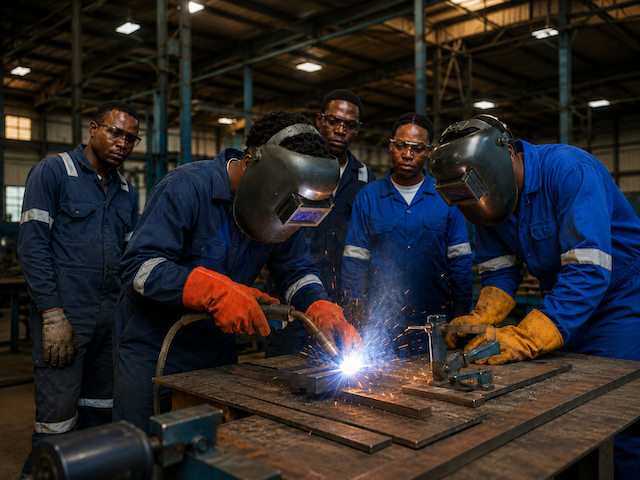
Arc welding is a metal-joining process that uses heat from an electric arc to melt and join metal parts together. The arc is created between an electrode and the workpiece. The heat produced by the arc melts the base metal and, in many cases, melts the electrode or filler metal to form a strong welded joint after cooling.
Arc welding is one of the most widely used welding methods in fabrication, construction, repair, maintenance, shipbuilding, pipeline work, structural steel work, and general metalwork. It is popular because it can produce strong joints, can be used in many work environments, and is suitable for different types of metal jobs when done correctly.
In this course, trainees will focus on basic arc welding skills, especially safe workshop behaviour, machine setup, electrode handling, arc striking, bead control, joint preparation, welding positions, inspection, and equipment maintenance.
What Is Welding?
Welding is the process of joining two or more pieces of metal by using heat, pressure, or both. In many welding processes, filler metal is added to strengthen the joint.
Welding is different from bolting, riveting, or tying materials together because welding forms a permanent joint. When done properly, the welded area becomes part of the metal structure.
Welding is used to make, repair, and maintain metal products such as gates, tanks, frames, trailers, pipes, machines, buildings, bridges, tools, and industrial equipment.
What Is Fabrication?
Fabrication is the process of making metal structures or components by cutting, measuring, shaping, fitting, assembling, and welding metal parts.
A fabricator may carry out tasks such as:
- Reading simple drawings.
- Measuring and marking metal.
- Cutting metal to size.
- Grinding and cleaning edges.
- Aligning parts.
- Tack welding.
- Final welding.
- Checking the finished work.
- Cleaning and finishing the job.
Welding is one part of fabrication. A good welder must also understand basic fabrication because poor measuring, cutting, grinding, or alignment can lead to poor weld quality.
Welding and Fabrication Relationship
Welding and fabrication work together.
| Fabrication Activity | Welding Connection |
|---|---|
| Measuring | Ensures correct size before welding |
| Marking out | Guides cutting and fitting |
| Cutting | Prepares pieces for joining |
| Grinding | Cleans and shapes edges before welding |
| Fit-up | Aligns parts before welding |
| Tack welding | Holds parts in position |
| Final welding | Produces the permanent joint |
| Inspection | Confirms weld and structure quality |
A beautiful weld on badly prepared metal can still produce a poor job. Good welding starts before the arc is struck.
Basic Principle of Arc Welding
Arc welding works by creating an electric arc between the electrode and the metal being welded. This arc produces intense heat that melts the metal surfaces and allows them to fuse together.
The basic arc welding circuit includes:
| Part | Function |
|---|---|
| Welding machine | Supplies welding current |
| Electrode holder | Holds the electrode |
| Electrode | Carries current and may provide filler metal |
| Workpiece | Metal being welded |
| Earth clamp | Completes the electrical circuit |
| Welding cables | Carry current between machine, holder, and workpiece |
| Arc | Heat source that melts the metal |
When the electrode touches or comes close to the workpiece, current flows and an arc is formed. The welder must control the arc length, electrode angle, travel speed, and current setting to produce a good weld.
Common Types of Welding Processes
There are several welding processes. Each has its own equipment, applications, advantages, and limitations.
| Welding Process | Basic Description | Common Use |
|---|---|---|
| Shielded Metal Arc Welding: SMAW | Uses a flux-coated electrode that melts during welding | General fabrication, repair, construction |
| Gas Metal Arc Welding: GMAW / MIG | Uses continuous wire electrode and shielding gas | Fabrication, automotive, production work |
| Gas Tungsten Arc Welding: GTAW / TIG | Uses non-consumable tungsten electrode and shielding gas | Stainless steel, aluminium, precision work |
| Flux-Cored Arc Welding: FCAW | Uses tubular wire with flux inside | Heavy fabrication, structural work |
| Submerged Arc Welding: SAW | Arc burns under flux powder | Large plates, beams, pressure vessels |
| Oxy-fuel Welding | Uses flame from fuel gas and oxygen | Light repair, heating, brazing, cutting support |
| Resistance Welding | Uses electrical resistance and pressure | Sheet metal, automotive manufacturing |
This course focuses mainly on basic arc welding, especially manual electrode welding skills.
Shielded Metal Arc Welding
Shielded Metal Arc Welding, often called SMAW, manual metal arc welding, or stick welding, uses a flux-coated electrode. The electrode melts and supplies filler metal. The flux coating also melts and produces shielding gases and slag that protect the weld from contamination.
Stick welding is widely used because it is simple, portable, and suitable for many workshop and field jobs. It can be used for repair work, fabrication, construction, and maintenance when the right electrode, current, and technique are used.
Why Arc Welding Is Important
Arc welding is important because metal structures and equipment are used in almost every sector of the economy. Welders help build, repair, and maintain the metal parts that support homes, roads, factories, farms, machines, vehicles, ships, pipelines, and industrial plants.
Arc welding is useful because it can:
- Join metal parts permanently.
- Repair broken metal components.
- Build strong structures.
- Support construction and maintenance work.
- Reduce replacement cost by repairing damaged parts.
- Create custom metal products.
- Support small business and entrepreneurship.
- Provide employable technical skills.
A skilled welder is valuable because many industries depend on reliable metal joining.
Applications of Arc Welding
Arc welding is used in many practical areas.
| Area | Examples |
|---|---|
| Construction | Steel frames, beams, columns, staircases, gates |
| Fabrication workshops | Doors, windows, tanks, trailers, racks, machine frames |
| Oil and gas | Pipe supports, skids, platforms, maintenance work |
| Shipbuilding and marine | Hull repair, deck structures, railings, supports |
| Automotive | Body repairs, chassis repairs, exhaust systems |
| Agriculture | Farm tools, trailers, gates, equipment repair |
| Manufacturing | Machinery, frames, guards, brackets |
| Power and utilities | Supports, pipework, platforms, maintenance |
| Home and commercial jobs | Gates, burglar proofing, furniture frames, railings |
| Maintenance | Repair of cracked, worn, or broken metal parts |
The quality of a welded job affects safety, durability, appearance, and customer satisfaction.
Examples of Arc Welding Jobs
Common beginner and workshop welding jobs include:
- Welding straight beads on plate.
- Joining two flat plates.
- Making a simple metal frame.
- Repairing a broken bracket.
- Welding a gate frame.
- Fabricating a small table frame.
- Welding support stands.
- Repairing wheelbarrow or trailer parts.
- Welding hinges and plates.
- Tack welding parts before final welding.
As trainees improve, they can move to more advanced jobs such as structural welding, pipe welding, pressure equipment welding, coded welding, and specialised fabrication.
Welding Career Opportunities
Welding can lead to many career opportunities. A trainee who builds strong skills, safety discipline, and good work habits can work in different industries.
Possible career paths include:
- Welder.
- Fabricator.
- Welding assistant.
- Workshop technician.
- Maintenance welder.
- Structural welder.
- Pipe welder.
- Shipyard welder.
- Construction welder.
- Industrial maintenance technician.
- Welding inspector, after further training and experience.
- Welding supervisor, after further training and experience.
- Self-employed fabrication business owner.
AWS describes itself as a source for welding education, certification, and career development, showing that welding can progress from basic skills into advanced professional pathways.
Qualities of a Good Welder
A good welder is not only someone who can strike an arc. A good welder must be disciplined, safety-conscious, patient, observant, and willing to practise.
Important qualities include:
- Safety awareness.
- Patience.
- Good hand control.
- Attention to detail.
- Ability to follow instructions.
- Ability to read simple measurements.
- Good eyesight and concentration.
- Clean work habits.
- Respect for tools and equipment.
- Willingness to correct mistakes.
- Good attitude toward practice.
Welding skill improves through repetition. The more correctly a trainee practises, the better the hand control becomes.
Basic Welding Terminology
Trainees should understand common welding terms.
| Term | Meaning |
|---|---|
| Base metal | The metal being welded |
| Filler metal | Metal added to the joint |
| Electrode | Rod or wire that carries current and may melt into the weld |
| Arc | Electric discharge that produces welding heat |
| Weld pool | Molten metal formed during welding |
| Bead | The line of weld deposited on the metal |
| Slag | Protective layer formed from melted flux |
| Tack weld | Small temporary weld used to hold parts in position |
| Joint | Area where two or more pieces are joined |
| Penetration | Depth the weld fuses into the base metal |
| Fusion | Melting together of weld metal and base metal |
| Porosity | Small gas holes in the weld |
| Undercut | Groove melted at the edge of the weld and not filled |
| Spatter | Small metal droplets thrown from the arc |
Learning these terms helps trainees understand instructions during practical sessions.
Basic Welding Joints
Welded joints are the ways metal pieces are arranged before welding.
Common joints include:
| Joint Type | Description |
|---|---|
| Butt joint | Two pieces joined edge to edge |
| Lap joint | One piece overlaps another |
| Tee joint | One piece meets another at about 90 degrees |
| Corner joint | Two pieces meet at a corner |
| Edge joint | Edges of two pieces are joined together |
This course will introduce practical welding on common joints such as butt joints, lap joints, tee joints, and corner joints.
Basic Welding Positions
Welding positions describe how the joint is placed while welding.
Common positions include:
| Position | Description |
|---|---|
| Flat position | Welding is done from above the joint |
| Horizontal position | Weld is made across a vertical surface or horizontal line |
| Vertical position | Weld is made upward or downward on a vertical surface |
| Overhead position | Weld is made from below the joint |
Flat welding is usually easiest for beginners. Vertical and overhead welding require more control and practice.
Workshop Rules and Safety Procedures
Welding can be dangerous if safety rules are ignored. Hazards include electric shock, burns, fire, fumes, eye injury, radiation, noise, cuts, flying particles, and gas exposure. OSHA identifies welding, cutting, and brazing as activities covered by specific safety standards in general industry, maritime, and construction.
Every trainee must follow workshop rules at all times.
Basic workshop rules include:
- Wear correct PPE before entering the welding area.
- Do not weld without permission.
- Do not operate equipment you have not been trained to use.
- Keep the welding area clean and dry.
- Do not play or joke around in the workshop.
- Keep flammable materials away from welding areas.
- Check cables and electrode holders before use.
- Do not touch live electrical parts.
- Use welding screens to protect others from arc rays.
- Keep tools in the correct place after use.
- Report damaged tools or unsafe conditions immediately.
- Follow trainer instructions at all times.
Basic Welding PPE
PPE means Personal Protective Equipment. Welders must wear PPE to reduce the risk of injury.
Common welding PPE includes:
| PPE | Purpose |
|---|---|
| Welding helmet | Protects eyes and face from arc rays, heat, and spatter |
| Safety goggles | Protects eyes during grinding and chipping |
| Welding gloves | Protects hands from heat, sparks, and sharp metal |
| Leather apron or jacket | Protects body from sparks and heat |
| Safety boots | Protects feet from falling metal and sparks |
| Ear protection | Protects hearing during grinding and noisy work |
| Respiratory protection | Helps protect against fumes where required |
| Cotton or flame-resistant clothing | Reduces burn risk from sparks |
CCOHS identifies welding hazards such as burns, eye damage, electrical shock, cuts, injuries to toes and fingers, fires, explosions, and health risks from fumes and gases.
Fire Safety in the Welding Workshop
Welding produces sparks and hot metal. These can easily start fires if the area is not controlled.
Fire safety rules include:
- Remove flammable materials from the welding area.
- Keep fire extinguisher nearby.
- Know where the fire extinguisher is located.
- Do not weld near fuel, oil, paint, wood, paper, gas cylinders, or chemicals.
- Check both sides of a wall or plate before welding.
- Allow hot metal to cool in a safe place.
- Warn others before handling hot metal.
- Keep floors clean and free from combustible waste.
- Report smoke, burning smell, or fire immediately.
OSHA welding rules require combustible materials such as paper, wood shavings, or textile fibres on floors to be removed or protected in welding areas, and they specify a 35-foot radius for fire prevention around hot work.
Electrical Safety in Arc Welding
Arc welding uses electricity. Poor handling can cause electric shock, burns, or equipment damage.
Electrical safety rules include:
- Check cables before welding.
- Do not use damaged cables.
- Keep hands and gloves dry.
- Do not weld while standing in water.
- Do not touch the electrode and workpiece at the same time with bare skin.
- Ensure the earth clamp is properly connected.
- Switch off the machine before changing connections.
- Do not pull cables from the holder.
- Keep cables away from sharp edges, oil, heat, and water.
- Report electrical faults immediately.
Welding safety training from AWS includes electrical shock hazards, fire hazards, burns, fumes and gases, radiation, ventilation, and PPE as core safety topics for welding workers.
Fume and Ventilation Awareness
Welding produces fumes and gases that may be harmful if inhaled. The risk depends on the metal, coating, electrode, ventilation, welding process, and work environment.
Good practice includes:
- Weld in a well-ventilated area.
- Use local extraction where available.
- Avoid breathing welding fumes directly.
- Remove paint, oil, grease, and coatings before welding where possible.
- Do not weld in confined spaces without proper permit and ventilation.
- Use respiratory protection where required.
- Report dizziness, breathing difficulty, or irritation.
HSE notes that hazardous substances in welding include fumes and gases from welding and cutting, dust from gouging or blasting, and substances from paints, lubricants, degreasing fluids, and confined-space conditions.
Eye and Face Protection
The welding arc produces intense light and radiation that can injure the eyes. Looking directly at an arc without proper protection can cause painful eye injury commonly called arc eye or welder’s flash.
Protection rules include:
- Always use a proper welding helmet.
- Use the correct lens shade.
- Do not watch another person weld without eye protection.
- Use welding screens to protect nearby people.
- Wear safety goggles during grinding and chipping.
- Keep helmet lens clean and undamaged.
- Replace cracked or damaged lenses.
Eye protection is compulsory in welding.
Workshop Behaviour and Discipline
A welding workshop must be disciplined. Carelessness can injure the welder or other people nearby.
Good workshop behaviour includes:
- Arrive prepared and dressed properly.
- Listen to instructions.
- Ask questions when unsure.
- Handle tools responsibly.
- Keep your work area neat.
- Do not distract someone who is welding.
- Do not touch metal unless you know it is cool.
- Do not leave electrode stubs on the floor.
- Do not leave cables across walkways.
- Clean your work area after practice.
- Respect other trainees and equipment.
A clean, organised workshop helps prevent accidents and improves learning.
Basic Welding Workflow
A beginner should follow a simple welding workflow.
- Understand the task.
- Wear PPE.
- Inspect the welding area.
- Prepare the metal.
- Set up the machine and cables.
- Select the correct electrode.
- Set the correct current.
- Position the workpiece.
- Tack weld if required.
- Strike the arc.
- Run the weld bead.
- Allow the weld to cool.
- Chip slag safely.
- Brush and inspect the weld.
- Correct defects where needed.
- Switch off and clean the area.
This workflow helps trainees build good habits from the beginning.
Common Beginner Challenges
New welders often struggle with:
- Difficulty striking the arc.
- Electrode sticking to the metal.
- Arc too long or too short.
- Uneven travel speed.
- Poor bead shape.
- Excessive spatter.
- Poor penetration.
- Burning through thin metal.
- Slag trapped in the weld.
- Fear of sparks.
- Poor body position.
- Not cleaning metal properly.
These challenges are normal at the beginning. They improve with correct guidance and repeated practice.
Common Beginner Mistakes
Avoid these mistakes:
- Welding without full PPE.
- Looking at the arc without a helmet.
- Holding the electrode too far from the workpiece.
- Moving too fast or too slowly.
- Welding dirty, rusty, oily, or painted metal without preparation.
- Using the wrong current setting.
- Using damp electrodes.
- Poor earth clamp connection.
- Chipping slag without goggles.
- Touching hot metal with bare hands.
- Leaving electrode stubs on the floor.
- Not switching off the machine after work.
- Ignoring trainer instructions.
What a Welding Trainee Should Never Do
A welding trainee should never:
- Weld without permission.
- Weld without a welding helmet.
- Look at an arc with naked eyes.
- Use damaged cables or electrode holders.
- Weld near flammable materials.
- Weld containers that held fuel or chemicals unless properly cleaned and certified safe.
- Touch live electrical parts.
- Weld in wet clothing or wet gloves.
- Play with welding tools.
- Point hot electrode stubs or sparks toward others.
- Chip slag without eye protection.
- Leave hot metal where others may touch it.
- Hide accidents, burns, electric shocks, or damaged equipment.
Real-Life Scenario
A trainee is asked to practise running straight beads on a mild steel plate. Before starting, the trainee wears a welding helmet, gloves, apron, and safety boots. The trainee checks that there are no flammable materials nearby and confirms that the earth clamp is properly attached to the workpiece.
The trainee cleans the plate with a wire brush, selects the correct electrode, sets the current with the trainer’s guidance, and strikes the arc. At first, the electrode sticks several times. The trainer explains that the arc length is too short and the hand movement is not steady. After a few attempts, the trainee maintains a better arc and produces a more consistent bead.
After welding, the trainee allows the metal to cool, wears goggles, chips the slag, brushes the weld, and inspects the bead.
The key lesson is simple: safe setup, clean metal, correct current, proper arc control, and steady practice are the foundation of welding skill.
Practical Training Activities for This Module
Trainees should practise:
- Identifying welding equipment and accessories.
- Wearing welding PPE correctly.
- Identifying workshop hazards.
- Setting up a safe welding work area.
- Connecting electrode holder and earth clamp under supervision.
- Identifying common welding joints.
- Identifying common welding positions.
- Observing a safe arc welding demonstration.
- Cleaning the work area after practice.
- Explaining basic workshop rules.
Practical Skill Checklist
| Skill | Competent |
|---|---|
| Identifies basic welding tools and equipment | |
| Wears PPE correctly | |
| Checks work area for hazards | |
| Identifies fire risks | |
| Understands electrical safety rules | |
| Identifies electrode holder and earth clamp | |
| Explains what an arc does | |
| Identifies common welding joints | |
| Identifies common welding positions | |
| Follows workshop instructions | |
| Keeps work area clean | |
| Reports unsafe conditions |
Quick Recap
Arc welding uses heat from an electric arc to melt and join metals. Welding is a key part of fabrication, which also includes measuring, marking, cutting, grinding, fitting, and assembling metal parts. Common welding processes include SMAW, MIG, TIG, FCAW, SAW, oxy-fuel welding, and resistance welding. Arc welding is used in construction, fabrication, maintenance, shipbuilding, oil and gas, agriculture, automotive repair, and many other industries. A good welder must understand safety, equipment, electrodes, arc control, metal preparation, welding positions, and weld inspection. Workshop discipline is essential because welding involves hazards such as electric shock, burns, fire, fumes, eye injury, and hot metal. The foundation of welding success is safety, preparation, practice, and good attitude.